
How to Choose a Freight Forwarder in China?
Choose a freight forwarder in China by comparing total delivered logistics cost, service scope, route reliability, U.S. customs and delivery capability, communication, cargo insurance, and exception handling. Ask each forwarder to quote the same shipment assumptions, clearly identify included and conditional charges, and test the service with a low-risk shipment before committing more volume.
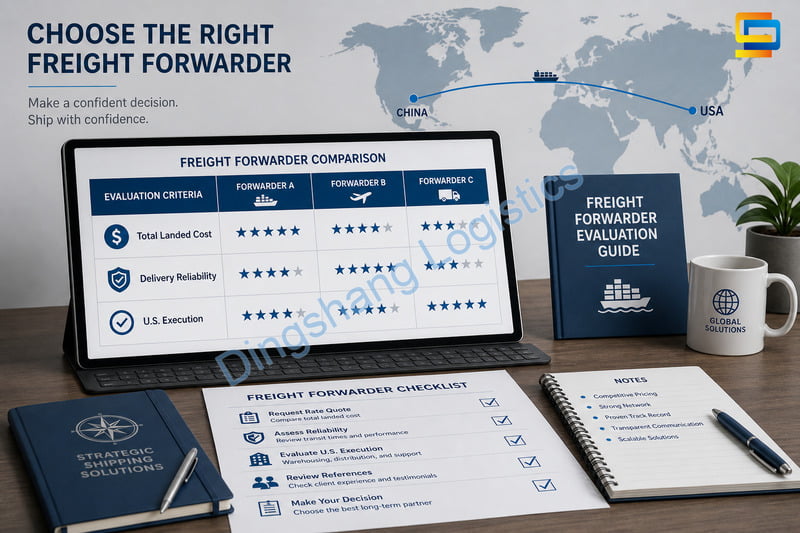
The lowest ocean-freight rate is not necessarily the lowest-cost shipment. For a China-to-USA importer, the forwarder also needs to manage origin execution, booking and routing, U.S. customs coordination, destination release, inland transportation, final delivery, and exceptions when the plan changes.
7 Things to Check Before Choosing a Freight Forwarder in China
Before awarding regular China-to-USA volume, check these seven areas:
- Compare the complete quote and service scope
- Verify China export and origin capability
- Check carrier, routing, and schedule reliability
- Confirm U.S. customs and compliance coordination
- Verify inland rail, drayage, and final-delivery capability
- Review communication, exception handling, and cargo insurance
- Test performance with a trial shipment
These checks are more useful than comparing ocean rates alone because they test whether the forwarder can execute the complete shipment you actually need.
How Do You Compare Freight Forwarder Quotes?
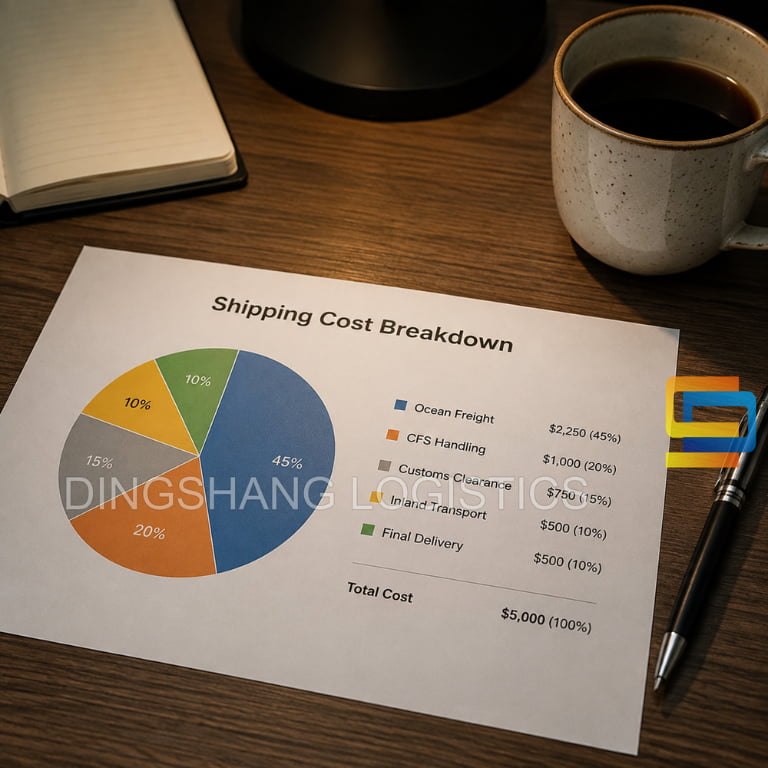
Compare freight-forwarder quotes using the same origin, destination, equipment, commodity, gross weight, cargo-ready date, Incoterm, customs scope, and delivery requirements. Focus on total delivered logistics cost—not ocean freight alone—and make every forwarder identify included, excluded, and conditional charges.
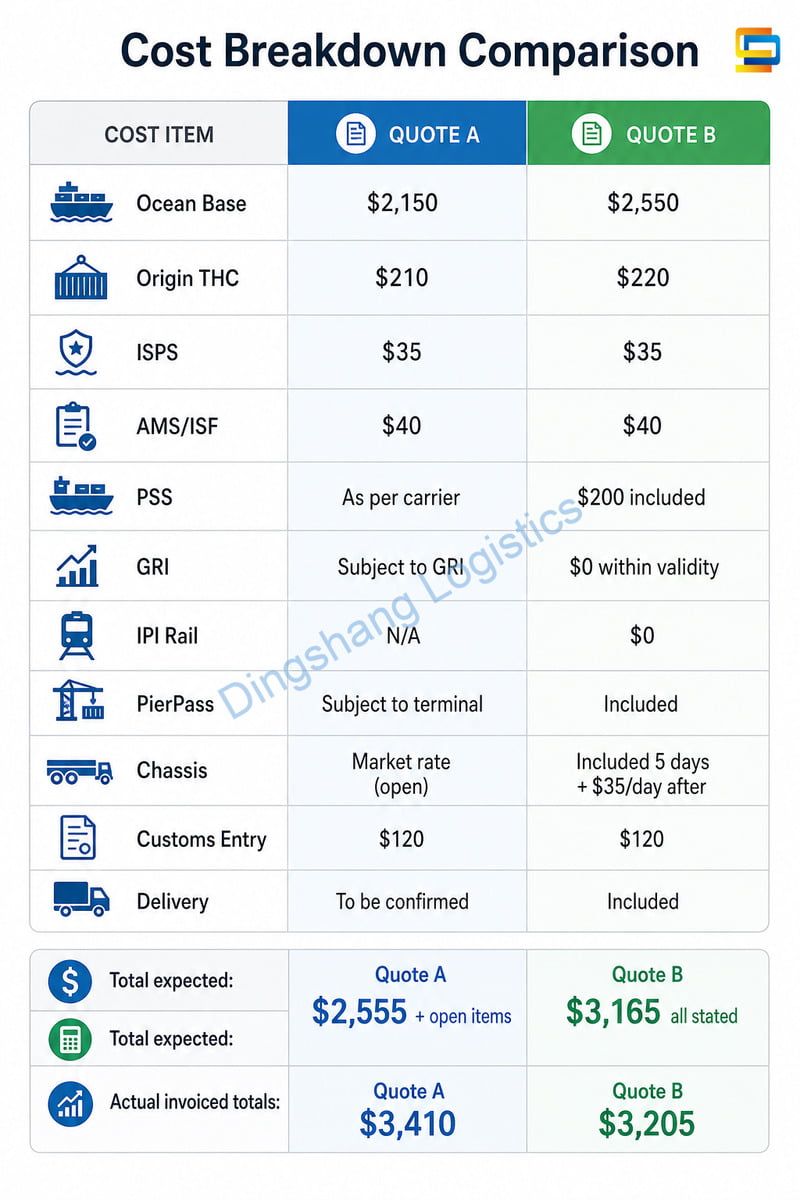
The cost comparison should normally follow this logic:
**Ocean freight
- origin charges
- destination charges
- customs brokerage
- chassis/drayage
- inland rail or truck
- final delivery
- applicable conditional logistics charges
= total delivered logistics cost**
That is different from landed cost, which can also include the product purchase cost, duties, government fees, and other import-related costs.
For a more detailed breakdown, see what you are really paying to ship a container from China.
Example: Why the Lowest Ocean Rate May Cost More
A useful quote comparison does not need an artificial case with exact dollar savings. The operational lesson is simpler: one forwarder may quote a lower ocean line while leaving destination handling, chassis, customs services, or final delivery open-ended.
| Quote Item | Quote A | Quote B | What to Check |
|---|---|---|---|
| Ocean freight | Lower | Higher | Same route, carrier service, and equipment? |
| Origin charges | Partial | Defined | Which origin services are included? |
| Destination charges | Open-ended | Defined | Which terminal or destination charges apply? |
| Chassis | Market rate | Defined terms | What is included and when can extra charges begin? |
| Customs brokerage | Separate | Included | Is the brokerage scope the same? |
| Delivery | To be confirmed | Included | Same ZIP code and receiving conditions? |
| Conditional charges | Unclear | Listed | What events trigger additional costs? |
A lower ocean-freight line can produce a higher delivered logistics cost when important destination or inland services are undefined.
Specificity matters more than an optimistic headline price.
How to Compare Two Freight Quotes
Before choosing a forwarder, line up both quotations and ask:
- Are the POL and POD the same?
- Is the routing direct or via transshipment?
- Is the same container type being quoted?
- Is the China pickup scope identical?
- Are origin charges defined?
- Are U.S. destination charges defined?
- Is customs brokerage included or separate?
- Are chassis and drayage included?
- Is inland rail or truck transportation included?
- Is final delivery to the same ZIP code included?
- Are appointment and unloading requirements defined?
- Is cargo insurance included, optional, or excluded?
- Which charges are conditional?
- What is the rate-validity period?
- What happens if the routing or sailing changes?
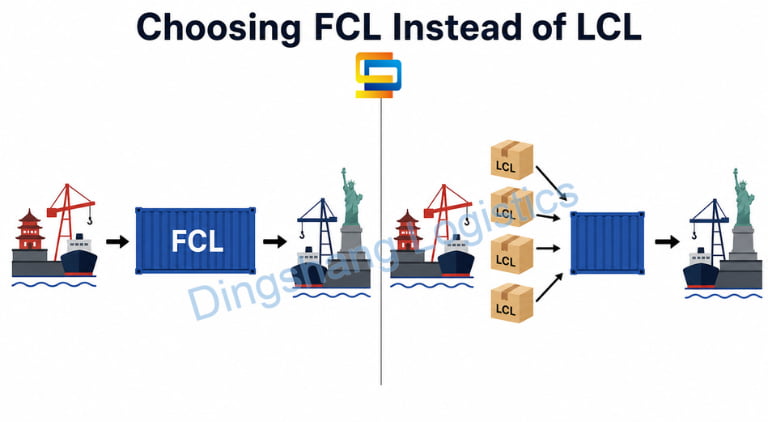
If you are comparing FCL and LCL at the same time, there is no universal CBM threshold where FCL automatically becomes cheaper than LCL. The break-even point changes with the route, gross weight, LCL W/M pricing, destination CFS charges, inland delivery, current FCL rates, stackability, cargo sensitivity, and handling requirements.
For a more detailed mode comparison, see when you should choose FCL instead of LCL.
What Should a Freight Quote Include?
A China-to-USA freight quote should define the complete transportation boundary, routing, rate validity, included charges, conditional charges, customs scope, inland-delivery requirements, and operational assumptions. The quote should make it clear where the forwarder's responsibility starts and where the quoted service ends.
A practical RFQ should cover:
- Origin: factory address or China port
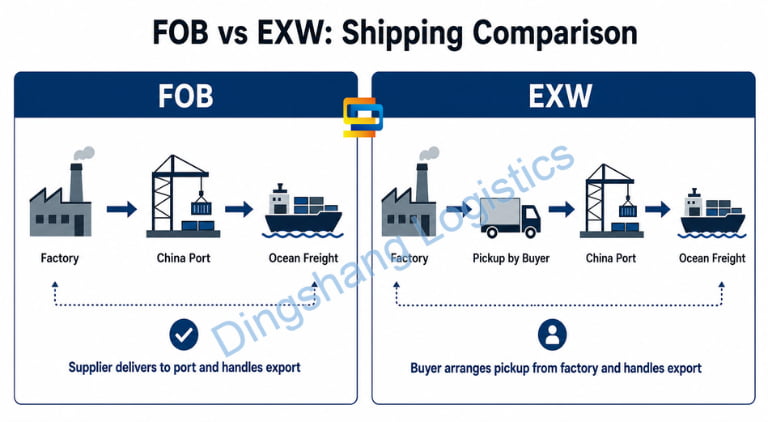
- Incoterm: such as FOB or EXW
- Equipment: 20GP, 40HQ, or LCL details
- Commodity: product description, material, and special requirements
- Gross weight and volume
- Cargo-ready date
- POL/POD
- Carrier and routing, where confirmed
- Direct or transshipment service
- Ocean-freight basis
- Origin charges
- Destination charges
- Customs-brokerage scope
- ISF coordination
- Chassis and drayage
- Rail or inland truck, if required
- Final delivery ZIP code
- Appointment and unloading conditions
- Cargo-insurance terms
- Conditional charges and their triggers
- Rate validity
- Operational and escalation contacts
A forwarder should not imply that every possible extra cost can be fixed in advance. Customs examinations, storage, demurrage, detention, special handling, waiting time, and other exception-related charges may remain conditional.1
The important point is that those exceptions should be identified before booking whenever they can reasonably be anticipated.
If you need to understand how the shipment fits together from factory pickup through U.S. delivery, see how container shipping works from China to the USA.
How Do You Check a Freight Forwarder's Reliability?
Check reliability by reviewing the proposed carrier and routing, direct versus transshipment exposure, recent rollover or schedule issues, cutoff management, communication during disruptions, and the forwarder's contingency plan. Predictable execution is often more valuable than the shortest advertised transit time.
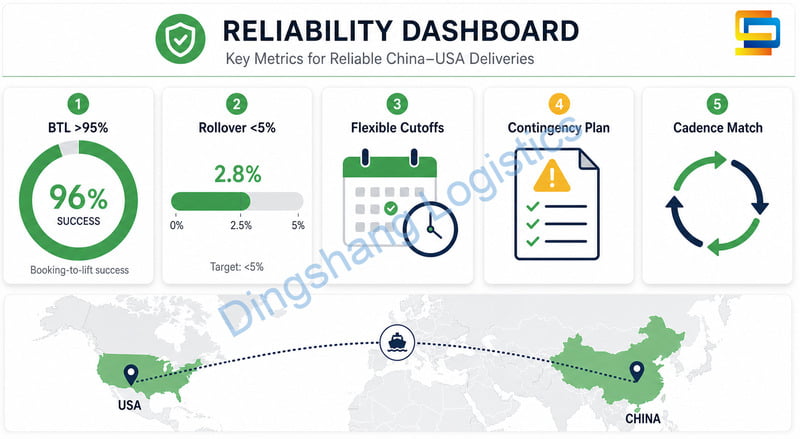
Focus on seven operating signals:
-
Proposed carrier and service
Ask which service is being quoted and whether the routing is confirmed or still subject to booking. -
Direct vs. transshipment
A transshipment service may be commercially reasonable, but you should understand the additional connection point and potential schedule exposure. -
Recent rollover and schedule history
Ask whether the forwarder can provide recent shipment examples, service history, or operational experience on the proposed lane. -
Cutoff management
Confirm SI, VGM, CY gate-in, and other relevant operational cutoffs for the actual booking. -
Blank-sailing contingency
Ask what happens if the intended service changes, blanks, rolls, or becomes unavailable. -
Communication and escalation
Define who communicates exceptions and how quickly your team should expect operational updates. Put the expected notification and escalation process in writing. -
Fit with your receiving schedule
A route that looks faster on paper may not be the best option if its schedule does not align with your warehouse or replenishment plan.
Which Reliability Signals Matter Most?
Do not require every forwarder to produce a formal 90-day KPI dashboard. Many smaller or lane-specific providers may not maintain standardized statistics in the format you request.
Instead, ask whether they can show:
- Recent shipment examples
- Carrier and routing history
- Rollover experience
- Typical sources of schedule variance
- Booking and cutoff-management process
- Contingency routing
- Exception-reporting process
- Escalation contacts
Booking-to-lift performance can be a useful concept: it asks whether booked containers actually load on the intended vessel. But there is no universal percentage that should be treated as an industry-wide pass/fail standard.
For inventory planning, also distinguish ocean transit from total door-to-door lead time. See the China-to-USA sea freight transit time guide for that distinction.
How Do You Verify U.S. Customs and Delivery Capability?
Verify who handles customs brokerage, ISF coordination, port or rail release, chassis, drayage, inland rail, delivery appointments, exception reporting, and proof of delivery. A freight forwarder that can quote China-to-USA door service should be able to explain exactly how the U.S. handoff works.
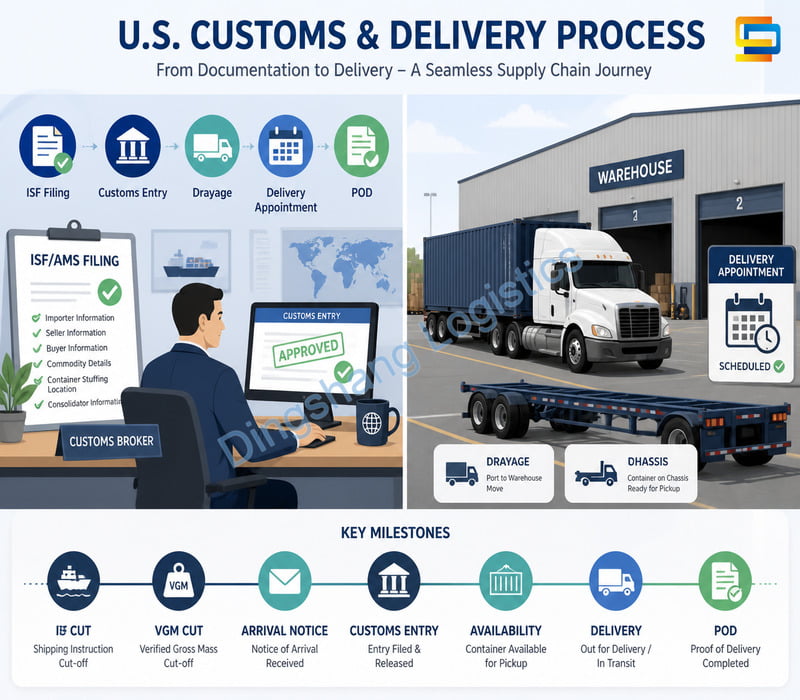
U.S. execution matters as much as the China-side ocean booking.
Customs and Compliance Readiness
Ask:
- Who coordinates the ISF?
- Who is the licensed customs broker?
- Who supplies product and HTS information?
- Who communicates customs holds or exams?
- How are Partner Government Agency requirements handled when applicable?
- Who monitors release status?
For standard U.S.-bound vessel cargo, key ISF data generally must be submitted no later than 24 hours before the cargo is laden aboard the vessel destined for the United States. Two additional ISF elements have later timing provisions.2
That is a cargo-lading requirement, not simply “24 hours before vessel departure.”
CBP also reminds importers that even when a customs broker is used, the importer of record remains ultimately responsible for the correctness of entry information and applicable duties, taxes, and fees.3
Milestones and Service Expectations
Ask the forwarder to define the shipment milestones it will monitor, such as:
- Booking confirmed
- SI submitted
- ISF coordinated
- VGM completed
- Container gated in
- Container loaded
- Actual departure
- Actual arrival
- Customs status
- Cargo availability
- Last free day, where applicable
- Rail departure/arrival, where applicable
- Out-gate
- Delivery appointment
- Delivered
- Empty return for FCL
- Proof of delivery
Do not assume a generic response-time SLA. Instead, define expected response and notification timing in writing for normal updates and exceptions.
Drayage and Delivery Capability
For U.S. delivery, ask:
- Which ports and inland ramps are covered?
- Who provides drayage?
- How is chassis availability handled?
- Who monitors last free day?
- Who books the warehouse appointment?
- Can the receiving facility accept an ocean container?
- How are empty-container returns managed?
- Who provides proof of delivery?
- What is the escalation process if a pickup or appointment fails?
Remember:
A U.S. ocean port ≠ final warehouse delivery.
And:
An inland rail ramp ≠ door delivery.
A container that arrives at an inland rail facility still requires drayage or another final-mile arrangement to reach the consignee.
Customs release is also not necessarily the end of the release process. Customs release alone may not complete all carrier, terminal, CFS, or other operational release requirements.
How Should You Define Customs and Duty Responsibilities?
Before accepting a door-to-door or DDP arrangement, confirm the Importer of Record, customs broker, product-classification responsibility, duty-payment method, government-agency requirements, and which conditional charges remain outside the quote.
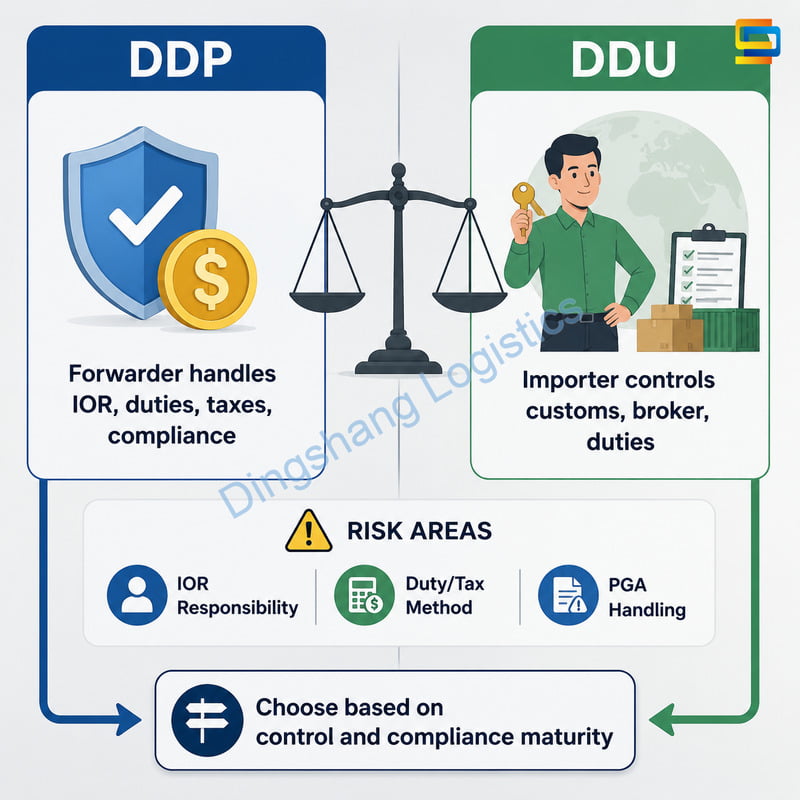
The International Trade Administration explains that Incoterms® allocate transportation-related tasks, costs, and risks between seller and buyer. DDP is one of the current Incoterms® 2020 rules.4
Importer of Record
Confirm who will act as the Importer of Record for the U.S. entry.
Do not accept vague statements such as “our agent will handle everything” without understanding the actual import structure. The importer should know whose identity is used for the entry and who carries the associated customs responsibilities.
Customs Broker and Entry Responsibility
Confirm:
- Who appoints the customs broker?
- Who sends documents to the broker?
- Who provides product descriptions?
- Who supplies or verifies HTS information?
- Who provides valuation and country-of-origin information?
- Who communicates requests for additional customs information?
CBP advises that the importer remains responsible for entry accuracy even when a broker handles the filing.3
Duties and Government Fees
Confirm:
- Who calculates the duty estimate?
- Who actually pays duties and government fees?
- How are additional tariffs or trade measures handled?
- What happens if tariff treatment changes between quoting and entry?
- What happens if CBP determines a different classification or value?
A freight quote should not imply that duties are fixed unless the product, classification, customs value, origin, and applicable trade treatment have been adequately established.
Door-to-Door vs. DDP
Door-to-door is a logistics service scope. DDP is an Incoterms® commercial responsibility framework. They are not the same thing.
A door-to-door quote may coordinate:
- China pickup
- Origin handling
- Ocean freight
- Customs-brokerage coordination
- Drayage or inland transportation
- Final delivery
But the phrase “door-to-door” does not by itself establish who is the Importer of Record or who bears import-duty obligations.
DDP should be used only when the commercial responsibilities are clearly understood and can actually be executed under the agreed import structure.
Product Compliance and Partner Government Agencies
Some products can be subject to requirements administered by agencies in addition to CBP.
Ask who is responsible for identifying and satisfying applicable requirements involving product type, labeling, testing, registrations, permits, prior notices, or other agency-specific obligations.
CBP's importing guidance emphasizes the importance of accurate invoices, tariff classification, origin information, and any additional agency requirements applicable to the merchandise.[^6]
A freight forwarder can coordinate transportation and documentation, but should not replace the importer, customs broker, or qualified compliance adviser where product-specific legal or regulatory interpretation is required.
How Can You Test a Freight Forwarder Before Committing More Volume?
Start with a controlled trial shipment on a representative lane, use the same quote checklist and milestone expectations you would use for long-term business, and review the final invoice, communication, delivery performance, and exception handling before allocating more volume.
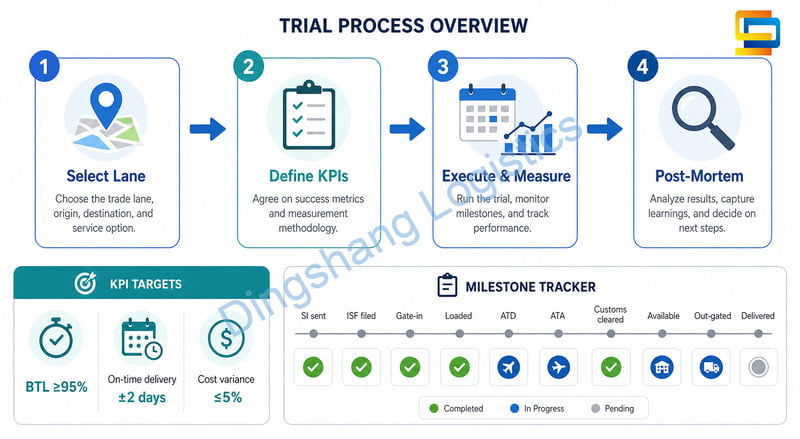
A trial reduces the risk of choosing a provider based only on a sales quotation.
Choose a Representative Shipment
Use a shipment that reflects the type of business you expect the forwarder to handle regularly.
It should ideally use:
- A normal supplier or China origin
- A representative U.S. destination
- Your typical customs workflow
- Your normal warehouse receiving process
- A cargo type that reflects your regular handling requirements
For a smaller trial shipment, compare the all-in LCL cost with the FCL alternative before choosing the trial mode.
If you are evaluating dedicated container options, review the 20GP container cost from China to the USA and 40HQ container cost from China to the USA under the same route and service assumptions.
Define What You Will Measure
Track practical operating results rather than an artificial industry score.
Useful measures include:
- Quote vs. final-invoice variance
- Booking execution
- Schedule variance
- Communication speed and quality
- Customs coordination
- Document accuracy
- Destination release management
- Delivery execution
- Exception handling
- Proof-of-delivery process
- Cargo-insurance support if a claim issue occurs
If the forwarder uses internal KPIs such as booking-to-lift, ask how those metrics are defined and what recent performance looks like on the proposed service. Do not assume one percentage is a universal industry standard.
Review the Final Invoice
After delivery, compare the invoice with the original quotation.
For each additional charge, ask:
- Was the charge identified as conditional?
- Did the stated trigger actually occur?
- Was the rate or calculation method disclosed?
- Was the importer informed when the cost became likely?
- Could the charge have been avoided through earlier action?
This is one of the fastest ways to determine whether “transparent pricing” exists in actual operations rather than only in sales material.
Decide Whether to Scale
After the trial, review:
- Did the routing operate as explained?
- Were exceptions communicated?
- Did customs coordination work?
- Was inland delivery controlled?
- Did the warehouse receive the shipment as planned?
- Were invoice differences understandable?
- Were documents complete?
- Did the operations team respond effectively when something changed?
If the answers are satisfactory, you have stronger evidence for allocating additional lanes or volume.
Frequently Asked Questions
How Many Freight Forwarder Quotes Should I Compare?
Compare at least two detailed quotations using the same shipment assumptions. More quotes can help, but consistency matters more than quantity. Compare origin, routing, destination charges, customs scope, chassis/drayage, final delivery, conditional charges, and rate validity—not only the ocean-freight line.
When Does FCL Become More Competitive Than LCL?
There is no universal CBM threshold. FCL can become more competitive when all-in LCL costs rise because of W/M pricing, destination handling, inland delivery, cargo weight, or additional handling.
Compare both options for the same route and final destination. For a deeper comparison, see when you should choose FCL instead of LCL.
Which China Port Should I Use?
Choose the China port based on the factory location, available carrier services, routing, schedule, origin trucking, and the final U.S. destination. The closest port is not automatically the best routing, and a specific service should be confirmed for the actual booking.
How Do I Check Whether a Freight Forwarder Is Reliable?
Ask for the proposed carrier and routing, recent shipment examples or service history, rollover experience, cutoff-management process, contingency plan, and escalation contacts. A forwarder should be able to explain what happens when a planned sailing, connection, or delivery appointment changes.
What ISF Timing Should a Freight Forwarder Know?
For applicable U.S.-bound vessel cargo, key ISF information generally must be submitted no later than 24 hours before the cargo is laden aboard the vessel destined for the United States. Two additional data elements have later timing provisions.2
Do not use “24 hours before vessel departure” as a substitute for the actual lading-based requirement.
What Documents Should I Prepare for U.S. Customs?
Prepare accurate commercial and product information before shipment. Depending on the entry, this can include the commercial invoice, packing list, bill-of-lading information, HTS classification information, origin information, importer details, and any applicable Partner Government Agency documents.[^6]
For a full import workflow, see how to import products from China to the USA step by step.
Does Door-to-Door Mean Duties Are Included?
No. Door-to-door describes the logistics service scope and does not automatically mean duties or government fees are included. Confirm the Importer of Record, customs broker, duty-payment arrangement, and exclusions separately.
Is DDP the Same as Door-to-Door Shipping?
No. DDP is an Incoterms® rule, while door-to-door describes a transportation service scope. A forwarder may provide door delivery without the sales transaction being DDP.
Should I Test a Freight Forwarder Before Giving Them Regular Volume?
Yes, when practical, a controlled trial can show how the forwarder performs beyond the quotation stage. Review booking execution, communication, customs coordination, final delivery, invoice accuracy, documentation, and exception handling before committing more volume.
What Information Should You Send a Freight Forwarder for an Accurate Quote?
A freight forwarder can provide a more reliable China-to-USA quote when you define the product, origin, destination, cargo size, Incoterm, and customs and delivery requirements at the beginning.
For Dingshang Logistics or another forwarder, send the same information to every provider so the quotations are comparable.
For FCL
- Product name
- HS/HTS code, if available
- Material
- Supplier/pickup location
- U.S. delivery ZIP code
- 20GP or 40HQ
- Gross weight
- Cargo-ready date
- FOB or EXW
- Customs-clearance requirements
- Loading/unloading requirements
For LCL
- Product name
- HS/HTS code, if available
- Material
- Pickup location
- U.S. delivery ZIP code
- Package quantity
- Package dimensions
- Total CBM
- Gross weight
- Cargo-ready date
- Stackable/non-stackable status
- Customs-clearance requirements
Also confirm whether cargo insurance is required and ask for the coverage terms, exclusions, deductible if applicable, and claims process in writing.
Related Shipping Guides
- How Do You Really Find the Best Shipping From China to the US?
- How Container Shipping Works From China To USA?
- How to Import Products from China to USA Step by Step
- What Are You Really Paying to Ship a Container From China?
- Sea Freight Transit Time from China to USA in 2026: How Long Does It Really Take?
- China to USA Container Shipping
References
[Federal Maritime Commission — Detention and Demurrage Billing Practices](https://www.fmc.gov/articles/fmc-publishes-final-rule-on-detention-and-demurrage-billing-practices/) ↩
[International Trade Administration — Know Your Incoterms](https://www.trade.gov/know-your-incoterms) ↩
[U.S. Customs and Border Protection — Tips for New Importers and Exporters](https://www.cbp.gov/trade/basic-import-export/importer-exporter-tips) ↩
[U.S. Customs and Border Protection — Importing into the United States](https://www.cbp.gov/sites/default/files/documents/Importing%20into%20the%20U.S.pdf) ↩
Leave a Comment