
FOB vs EXW: Which Is Better for US Importers?
FOB vs EXW creates confusion because the supplier’s cheaper unit price can hide China-side logistics costs. That confusion often grows when pickup, export documents, port handling, and delivery responsibilities are unclear. I usually recommend comparing the total door-to-door landed cost, not just the product quote, before choosing either term.
For most U.S. importers, FOB is usually better than EXW because it gives clearer responsibility before the cargo reaches the China port. The supplier handles China-side delivery and export arrangements, while the buyer controls international freight. EXW can still work well when the buyer has strong China-side logistics support and needs supplier consolidation.
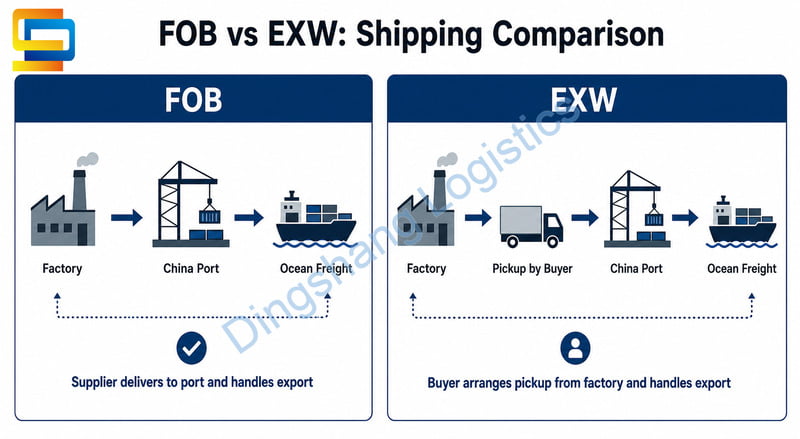
FOB and EXW are not just pricing labels. They change who coordinates the first mile, who prepares export documents, who pays local charges, and how quickly a shipment can move. I see this difference often when U.S. importers send me supplier quotes that look simple at first.
What Does FOB vs EXW Mean for China-to-USA Shipping?
FOB vs EXW can feel like a textbook topic, but the real problem appears during execution. A buyer may think they saved money with EXW. Then the pickup, loading, export declaration, and local China charges start to appear. That is where the risk becomes practical.
FOB means the supplier usually delivers the goods to the named China port and handles export-side arrangements before the cargo is handed over for international shipping.1 EXW means the buyer usually takes responsibility from the supplier’s premises, including pickup, China-side coordination, export handling support, and movement to port.2
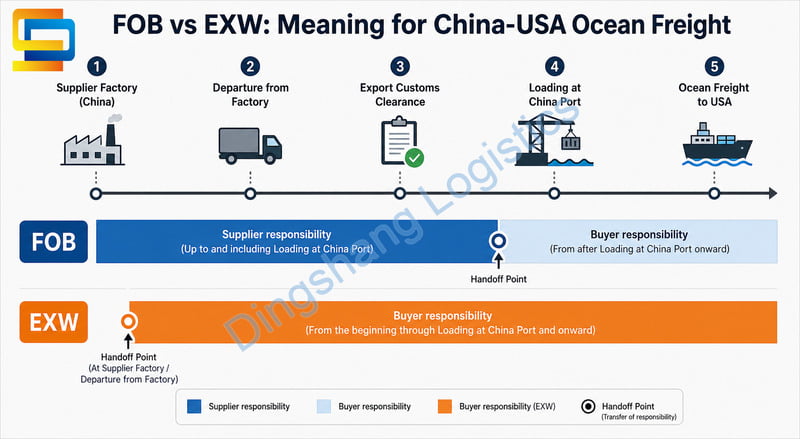
The practical difference is the responsibility handoff
I am not an Incoterms legal authority, so I always suggest that importers confirm the exact Incoterms version and contract wording with qualified professionals when needed. However, in daily China-to-USA freight forwarding work, I see one basic difference again and again:
FOB shifts the China-port preparation burden to the supplier. EXW shifts much more China-side execution to the buyer and their logistics partner.3
That difference affects the whole shipment flow.
Under FOB China port, the supplier typically needs to:
- Deliver the cargo to the named port or warehouse.
- Coordinate export customs declaration.
- Provide commercial documents.
- Handle China-side port-related arrangements included under the agreed FOB scope.
- Make the cargo available for the forwarder’s international ocean freight plan.
Under EXW supplier factory, the buyer or buyer’s forwarder may need to:
- Arrange pickup from the factory or warehouse.
- Confirm loading time with the supplier.
- Check whether the truck can enter and load properly.
- Coordinate export documents with the supplier.
- Manage inland transportation to the export port.
- Handle export declaration arrangements.
- Pay local China-side costs that were not included in the product price.
FOB vs EXW in a simple comparison
| Item | FOB China Port | EXW Supplier Factory |
|---|---|---|
| Product price | Usually higher | Usually lower |
| China pickup | Supplier responsibility in many cases | Buyer/forwarder responsibility |
| Export declaration | Usually supplier-arranged | Needs buyer/forwarder and supplier cooperation |
| China local charges | Often partly included before handoff | Often excluded from product price |
| Buyer control in China | Moderate | High, if logistics partner is strong |
| Risk of missing hidden costs | Lower | Higher without full comparison |
| Best fit | Single-supplier shipments, standard exports | Multi-supplier consolidation, experienced buyers |
Why the named place matters
A quote that says “FOB China” is not specific enough.4 I prefer to see wording like:
- FOB Ningbo
- FOB Shanghai
- FOB Shenzhen
- FOB Qingdao
The named port matters because inland trucking and local handling costs vary by region.5 A factory near Ningbo may offer FOB Ningbo smoothly. A factory far inland may quote FOB Shanghai but include higher inland costs in the product price.
EXW also needs a clear pickup address. “EXW factory” means very little if the buyer does not know:
- The exact factory address.
- Cargo ready date.
- Carton count, weight, and volume.
- Loading method.
- Whether the supplier can support export documents.
- Whether the factory can load a container or only load a truck.
In real FOB vs EXW comparisons, these details often matter more than the Incoterm label itself.
Why Is FOB vs EXW Not Just About the Supplier’s Unit Price?
FOB vs EXW becomes misleading when buyers compare only product unit prices. EXW often looks cheaper because many China-side services are excluded.6 The buyer may feel they found a better deal, but the final landed cost can change after pickup, documents, port handling, and export coordination are added.
The better comparison is not “Which quote has the lower unit price?” The better comparison is “Which quote gives me the lower and more predictable door-to-door cost?” U.S. importers should compare EXW-to-door against FOB-to-door using the same cargo details, supplier location, destination, customs plan, and delivery address.
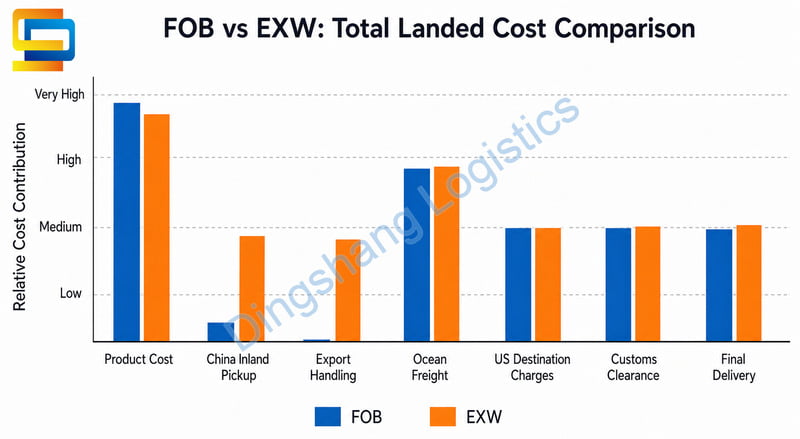
EXW often hides the first-mile cost
When I receive an inquiry from a U.S. importer, I often ask for both the supplier quote and the cargo details. Many early-stage importers send me an EXW unit price and assume the logistics comparison starts from the ocean freight rate. It usually does not.
With EXW, the buyer may still need to pay for China-side steps before the container or LCL cargo even reaches the vessel.
These steps may include:
- Factory pickup.
- Local truck booking.
- Loading supervision or loading coordination.
- Inland delivery to warehouse, CFS, or port.
- Export customs declaration.
- Export document coordination.
- China terminal or warehouse charges.
- Local handling charges.
- Telex release, document, or operational fees when applicable.
Some costs are small. Some are not. The problem is not only the amount. The problem is uncertainty.
A cleaner landed cost framework
I like to compare FOB vs EXW with a simple landed cost structure.
| Cost component | FOB-to-door | EXW-to-door |
|---|---|---|
| Product cost | Supplier FOB price | Supplier EXW price |
| China inland pickup | Usually included before FOB handoff | Usually added separately |
| China export handling | Usually supplier-side before handoff | Usually added separately |
| Ocean freight | Buyer/forwarder quote | Buyer/forwarder quote |
| U.S. destination charges | Buyer/forwarder quote | Buyer/forwarder quote |
| Customs clearance | Buyer/forwarder/broker plan | Buyer/forwarder/broker plan |
| Duties and taxes | Based on HS code and U.S. rules | Based on HS code and U.S. rules |
| Final delivery | Door delivery quote | Door delivery quote |
This table shows why the Incoterm does not solve the entire import process. FOB or EXW does not remove the need for U.S. customs clearance, duty review, ISF filing, destination handling, or final delivery planning.7
The common quote gap I see
In real China-to-USA shipping coordination, I often see this pattern:
- The importer asks the supplier for the lowest product price.
- The supplier gives an EXW price.
- The importer asks a forwarder for ocean freight.
- The forwarder asks for pickup address and export document details.
- The importer realizes the first-mile cost was not included.
- The final cost becomes harder to compare.
This does not mean the supplier acted badly. It often means the buyer asked for the wrong comparison.
A better request is:
“Please quote both FOB [China port] and EXW [factory address], and confirm what China-side costs and export documents are included.”
That one sentence gives the buyer more control.
FOB can look more expensive but still be simpler
FOB product pricing can look higher because the supplier has already included more responsibility before the cargo reaches the port. That does not automatically make FOB cheaper. It does make it easier to compare.
For many U.S. importers, predictability has value. If the shipment is a standard single-supplier order, FOB often reduces coordination pressure. The supplier already knows their local trucker, export agent, and normal port procedures. The buyer’s forwarder can then focus on ocean freight, U.S. customs support, destination handling, and door delivery.
I have learned to ask one question early:
“Are we comparing price, or are we comparing execution?”
For importers who need stable schedules and fewer surprises, execution usually matters more.
When Is FOB vs EXW Usually Better for U.S. Importers?
FOB vs EXW usually points toward FOB when the importer wants a simpler handoff, fewer China-side tasks, and more predictable shipment planning. EXW can be tempting because the product price is lower, but the buyer must be ready to manage the first mile and export-side details.
FOB is usually better for U.S. importers when the shipment comes from one supplier, the supplier is experienced with exports, the cargo moves through a major China port, and the buyer wants a cleaner handoff before international ocean freight begins. It is especially useful for routine FCL and LCL shipments.
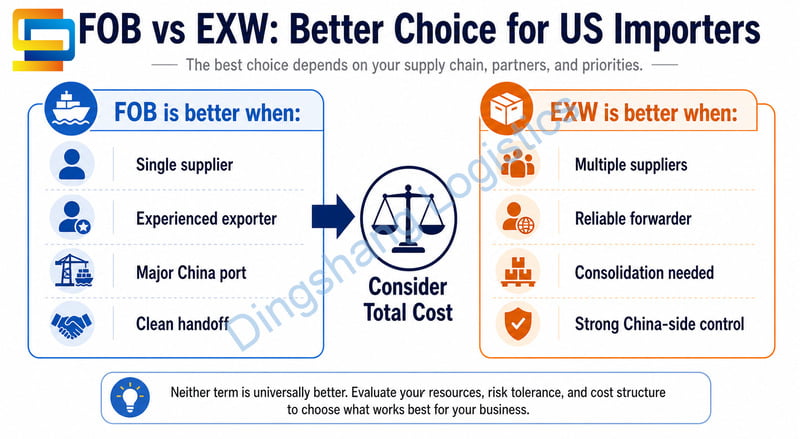
FOB is often stronger for single-supplier shipments
For one-supplier shipments, FOB often creates a cleaner workflow. The supplier produces the goods, books China-side delivery to the port, handles export arrangements, and provides documents. The freight forwarder then takes over the international leg and destination delivery planning.
This works well for many common China-to-USA shipments, including:
- FCL 20GP containers
- FCL 40HQ containers
- LCL ocean freight
- Door-to-door ocean shipments
- Port-to-door shipments
- Amazon or warehouse deliveries, when properly planned
If the supplier is near Ningbo, Shanghai, Shenzhen, or Qingdao, FOB can be especially efficient because these ports have mature export infrastructure and frequent sailings to the United States.
FOB can reduce document friction
Documentation is one of the most underestimated parts of FOB vs EXW. A cargo delay does not always come from vessel space or trucking. Sometimes it comes from missing or unclear paperwork.
For China-to-USA shipments, the documentation flow may involve:
- Commercial invoice.
- Packing list.
- Export declaration documents.
- Bill of lading instructions.
- ISF-related information.
- HS code review support.
- Manufacturer or supplier information.
- Product descriptions and carton details.
Under FOB, the supplier is usually more prepared to support export declaration because they are responsible for getting the cargo to the export point.8 Under EXW, the buyer’s forwarder may need the supplier’s cooperation, but the supplier may not feel responsible for every export-side step unless it was agreed clearly.
That distinction matters.
FOB helps buyers avoid operational blind spots
Many U.S. importers are strong at sourcing and selling. They know their product category, customers, margins, and inventory needs. However, they may not have a China-side operations team. FOB helps reduce that gap.
Here are the FOB advantages I usually explain:
| FOB advantage | Why it matters |
|---|---|
| Clearer supplier responsibility | The supplier must prepare cargo for export handoff. |
| Easier freight quotation | The forwarder can quote from port more cleanly. |
| Lower pickup coordination burden | The buyer does not need to manage factory pickup as often. |
| Better for new importers | The process is easier to understand. |
| Good for standard exports | Many suppliers already quote FOB regularly. |
FOB does not remove all risks
I do not tell buyers that FOB solves everything. It does not.
The importer still needs to review:
- U.S. customs classification.
- Import duties and tariffs.
- Product compliance requirements.
- Cargo insurance.
- Destination charges.
- Final delivery access.
- Palletization needs.
- Warehouse appointment rules.
FOB also depends on supplier reliability. A supplier can still delay cargo readiness, submit wrong packing data, or quote FOB without clearly explaining what is included. So I always recommend written confirmation.
A useful supplier checklist is:
- What is the named FOB port?
- Is export declaration included?
- Are China local charges before FOB handoff included?
- When will cargo be ready?
- What are the final carton count, CBM, and gross weight?
- Can the supplier provide invoice and packing list before booking?
- Can the supplier cooperate with the buyer’s nominated forwarder?
When suppliers answer these questions clearly, FOB becomes much easier to manage.
When Can EXW Be the Smarter Choice in FOB vs EXW?
FOB vs EXW does not always mean FOB wins. EXW can be better when the buyer wants more control in China or needs to consolidate cargo from different suppliers. The risk appears when the buyer chooses EXW only because the unit price looks lower.
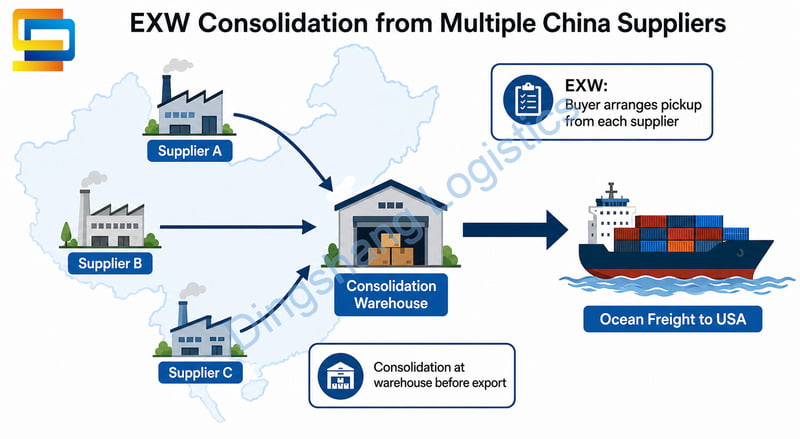
EXW can be the smarter choice when the importer has a reliable China-side freight forwarder, needs multi-supplier consolidation, knows the pickup addresses, and can compare EXW-to-door against FOB-to-door accurately. It is also useful when the buyer wants one logistics partner to coordinate several factories before export.
EXW can work well for multi-supplier buyers
Many U.S. wholesalers and distributors buy from several Chinese suppliers in one purchasing cycle. One supplier may be in Yiwu. Another may be near Ningbo. Another may be in Dongguan. If each supplier ships separately under FOB, the buyer may face multiple small shipments, duplicated charges, and messy timing.9
In that case, EXW can help if the buyer’s forwarder can coordinate:
- Factory pickup from multiple cities.
- Cargo delivery to a consolidation warehouse.
- Carton checking and measurement.
- Repacking or labeling when needed.
- LCL consolidation or FCL container loading.
- Export declaration coordination.
- One ocean shipment to the United States.
This is where a China-based freight forwarder can add real operational value. I have handled inquiries where the importer did not need the cheapest single pickup. They needed someone to make six suppliers move like one shipment.
EXW gives more control, but more responsibility
EXW gives the buyer more control over routing, timing, and consolidation. That control can be useful. It can also create more work.
Before choosing EXW, I suggest that buyers confirm these details:
| EXW question | Why it matters |
|---|---|
| What is the exact pickup address? | Trucking cost depends on location. |
| Can the factory load the cargo? | Some factories lack forklifts or loading docks. |
| Is the cargo packed for export? | Weak packaging may create damage risk. |
| Can the supplier provide export documents? | Export declaration may fail without cooperation.10 |
| What is the cargo volume and weight? | LCL and trucking costs depend on accurate data. |
| Are there multiple suppliers? | Consolidation may justify EXW. |
| Who pays China-side local charges? | The buyer needs total landed cost clarity. |
EXW is risky when the supplier will not cooperate
The biggest EXW issue is not always cost. It is cooperation.
An EXW supplier may say, “The goods are ready at our factory.” But the buyer’s forwarder may still need:
- A contact person at the factory.
- Pickup time confirmation.
- Packing list.
- Commercial invoice.
- Export declaration support.
- Cargo photos or marks.
- Loading assistance.
- Business registration or export-related details, depending on the export setup.
If the supplier does not cooperate, the shipment may slow down. This is why I do not recommend EXW for every early-stage importer. It can work well, but only when the forwarder and supplier communicate clearly.
EXW can reveal the true cost of supplier location
EXW is also useful when a buyer wants to understand how much a supplier’s location affects logistics cost. Two suppliers may quote similar product prices, but one may be much farther from the port.
For example, a buyer comparing suppliers should not only ask:
- “Who has the lower unit price?”
The buyer should also ask:
- “Who has the lower door-to-door landed cost?”
- “Who can prepare export documents faster?”
- “Who is closer to the best sailing route?”
- “Who can meet my delivery deadline with fewer handoffs?”
EXW can make these differences visible because pickup and inland transportation are priced separately. That visibility helps sophisticated buyers make better supplier decisions.
When I would consider EXW
I would consider EXW when at least one of these conditions is true:
- The buyer has multiple suppliers and wants consolidation.
- The buyer already works with a trusted China-side forwarder.
- The supplier’s FOB quote seems unclear or inflated.
- The buyer wants to compare supplier locations fairly.
- The shipment needs special pickup coordination.
- The buyer has enough time before the delivery deadline.
- The forwarder can provide a full EXW-to-door quotation.
EXW should be a controlled decision, not a shortcut.
How Should You Compare FOB vs EXW Door-to-Door Costs?
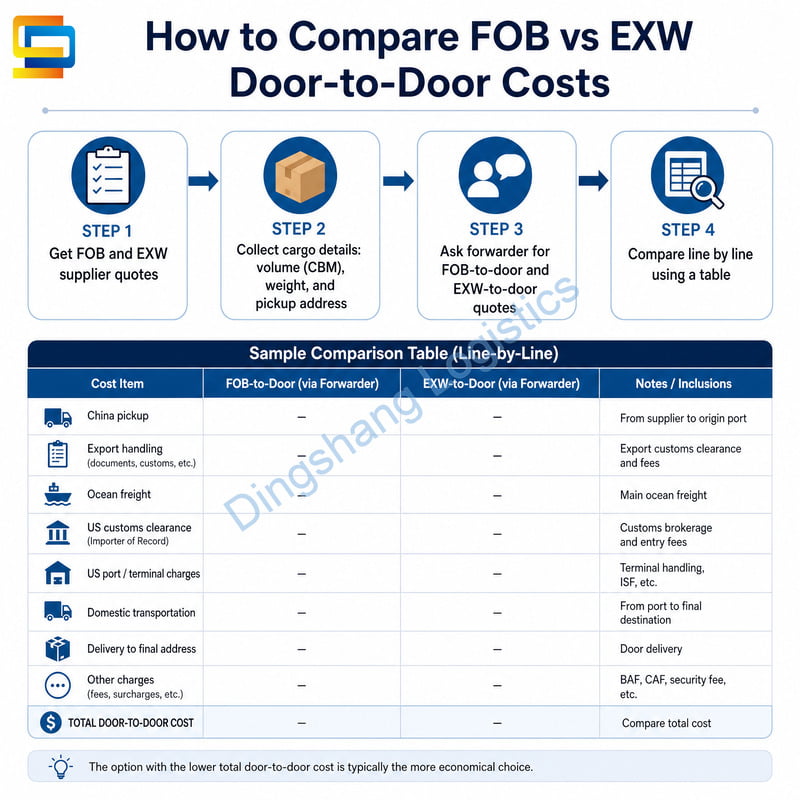
FOB vs EXW becomes easier when the buyer uses the same destination, cargo data, and service scope for both options. Without that structure, the comparison becomes emotional. One quote looks cheaper, another looks safer, and the importer cannot see the true landed cost.
To compare FOB and EXW correctly, ask suppliers for both prices, collect the factory address, cargo dimensions, weight, carton count, ready date, and U.S. delivery address, then ask a forwarder to calculate both FOB-to-door and EXW-to-door costs under the same shipment plan.
Start with the same cargo data
A forwarder cannot compare FOB vs EXW accurately without cargo details. For FCL, I need to know whether the cargo fits a 20GP, 40GP, or 40HQ. For LCL, I need the CBM and gross weight.11 For door delivery, I need the final U.S. address or at least ZIP code.
A good inquiry includes:
- Supplier name and contact.
- Supplier address.
- Incoterm offered: FOB or EXW.
- Named FOB port, if applicable.
- Cargo description.
- HS code, if available.
- Carton count.
- Total CBM.
- Gross weight.
- Cargo ready date.
- U.S. destination address.
- Delivery type: commercial, warehouse, Amazon, residential, or appointment delivery.
- Customs clearance and duty handling needs.
- Insurance preference.
At Dingshang Logistics, we focus on B2B ocean freight from China to the United States. When I receive complete information, I can usually give a cleaner comparison between port-to-door, door-to-door, FCL, LCL, and consolidation options.
Compare service scope line by line
The biggest mistake is comparing a partial EXW quote with a fuller FOB quote. I prefer a line-by-line view.
| Service item | FOB-to-door quote | EXW-to-door quote |
|---|---|---|
| China pickup | Not needed or supplier side | Included |
| China export handling | Supplier side or confirmed | Included or coordinated |
| Origin port charges | Confirmed | Confirmed |
| Ocean freight | Included | Included |
| U.S. port charges | Included | Included |
| Customs clearance | Included if requested | Included if requested |
| Duty handling | Included if requested | Included if requested |
| Final delivery | Included | Included |
| Cargo insurance | Confirmed | Confirmed |
A transparent quote should make the cost boundary clear. I prefer all-in quotations because importers need predictable logistics costs. Hidden charges damage trust and make planning harder.
Do not forget timing
Cost is not the only decision point. Transit time and coordination time matter too.
FOB may be faster when the supplier already has an export routine. EXW may take longer if the forwarder needs to arrange pickup, confirm loading, collect documents, and consolidate with other cargo. However, EXW consolidation may reduce total shipment complexity if several suppliers are involved.
For China-to-USA ocean freight, planning also depends on:
- Vessel schedule stability.
- Port congestion.
- Cut-off time.
- Factory readiness.
- Customs document accuracy.
- U.S. inland rail or truck capacity.
- Warehouse appointment availability.
Dingshang Logistics commonly works with loading ports such as Ningbo, Shanghai, Shenzhen, and Qingdao, and U.S. ports such as Los Angeles, New York, Houston, Miami, Savannah, and Boston. We also arrange inland delivery to destinations like Chicago, Dallas, Atlanta, Memphis, Detroit, Kansas City, Charlotte, Nashville, and Minneapolis. The right Incoterm should support the route, not complicate it.
Use a simple decision framework
Here is the framework I use when discussing FOB vs EXW with U.S. importers:
-
If you are new to importing and have one supplier, start with FOB.
It usually gives a clearer responsibility handoff. -
If you have multiple suppliers, consider EXW consolidation.
It may reduce duplicate shipments and improve control. -
If the EXW product price looks much lower, calculate the full EXW-to-door cost.
Do not assume the difference is savings. -
If the supplier cannot support documents, be careful with EXW.
Export coordination needs cooperation. -
If timing is tight, choose the term with fewer handoffs.
Simpler execution can be more valuable than a lower quote. -
If you are unsure, ask for both supplier quotes.
A forwarder can compare them with the same destination and cargo data.
This approach keeps the decision practical.
Frequently Asked Questions
Is FOB always better than EXW for U.S. importers?
No. FOB is usually safer and more predictable for many single-supplier China-to-USA shipments, but EXW can be better for multi-supplier consolidation or buyers with strong China-side logistics support. The better choice depends on total landed cost, supplier cooperation, cargo details, and destination requirements.
Why does EXW look cheaper than FOB?
EXW often looks cheaper because the product price usually excludes China pickup, export handling, local charges, and port-side coordination. FOB prices often include more supplier-side responsibility before the cargo reaches the China port. Buyers should compare EXW-to-door and FOB-to-door, not just unit prices.
Can my freight forwarder handle EXW pickup in China?
Yes, a China-side freight forwarder can often arrange EXW pickup, consolidation, export coordination, ocean freight, customs clearance support, and door delivery. The forwarder will need the supplier address, cargo details, ready date, documents, and supplier cooperation to quote and execute properly.
Does FOB include U.S. customs clearance and final delivery?
No. FOB only defines responsibility up to the agreed export handoff point under the sales term. U.S. customs clearance, duties, destination charges, and final delivery are separate import-side services. Buyers should request a full door-to-door quotation if they want those costs included.
What information should I send to compare FOB and EXW?
You should send the FOB price, EXW price, supplier address, named FOB port, cargo description, carton count, CBM, gross weight, ready date, U.S. destination address, and delivery requirements. With this information, a forwarder can compare both options on a door-to-door basis.
Conclusion
FOB vs EXW is not just a choice between two supplier prices. It is a choice between two responsibility structures. For most U.S. importers, FOB is usually more predictable because the supplier handles more China-side preparation before ocean freight begins. EXW can still be smart for consolidation and stronger China-side control. If you want a clear comparison, send me both FOB and EXW supplier quotes, the factory address, cargo details, and your U.S. destination. I can help compare the real door-to-door cost from China to the USA.
Related Shipping Guides
"Know Your Incoterms", https://www.trade.gov/know-your-incoterms. Incoterms guidance describes FOB as a rule under which the seller delivers the goods at the named port of shipment and is responsible for export clearance, thereby supporting the article's description of the seller's pre-international-shipping role. Evidence role: definition; source type: institution. Supports: FOB requires the seller to deliver goods at the named port of shipment and clear them for export under the Incoterms framework.. Scope note: This support concerns the Incoterms definition and does not verify whether any particular supplier's FOB quote includes all local charges. ↩
"Know Your Incoterms", https://www.trade.gov/know-your-incoterms. Incoterms guidance defines EXW as a rule in which the seller makes goods available at the seller's premises or another named place, while the buyer bears the main responsibility for collection and onward movement. Evidence role: definition; source type: institution. Supports: EXW places minimal delivery obligations on the seller and requires the buyer to collect the goods from the seller's premises or another named place.. Scope note: The source defines the legal responsibility structure; practical export handling in China may also depend on local rules, licensing, and the supplier's cooperation. ↩
"Know Your Incoterms", https://www.trade.gov/know-your-incoterms. The International Chamber of Commerce's Incoterms rules define FOB and EXW as distinct allocations of delivery, export, and carriage responsibilities, supporting the contrast between seller-managed port handoff under FOB and buyer-managed collection under EXW. Evidence role: definition; source type: institution. Supports: FOB and EXW assign different seller and buyer obligations at origin under Incoterms.. Scope note: Incoterms define default contractual obligations; the final allocation can vary if the sales contract modifies or supplements those terms. ↩
"Know Your Incoterms", https://www.trade.gov/know-your-incoterms. Incoterms materials specify FOB by reference to a named port of shipment, supporting the article's point that a country-level phrase such as “FOB China” lacks the place specificity needed for clear allocation of costs and responsibilities. Evidence role: definition; source type: institution. Supports: FOB is normally expressed with a named port of shipment, making a vague phrase such as country-only FOB incomplete for operational clarity.. Scope note: The source supports the need for a named place but does not address every commercial convention used in informal supplier quotations. ↩
"A Survey of China's Logistics Industry and the Impacts of ...", https://pdxscholar.library.pdx.edu/cgi/viewcontent.cgi?article=1056&context=cengin_fac. Research on freight transport and port choice shows that inland distance, terminal access, and regional logistics conditions are material components of total shipping cost, providing contextual support for why the named FOB port affects pricing. Evidence role: mechanism; source type: paper. Supports: Transport distance, port choice, and regional logistics conditions affect inland freight and handling costs.. Scope note: Such research supports the cost mechanism generally and may not quantify the exact trucking or handling cost for a specific Chinese factory-port pair. ↩
"Know Your Incoterms", https://www.trade.gov/know-your-incoterms. Incoterms guidance explains that EXW imposes minimal obligations on the seller and leaves the buyer responsible for collection and onward costs, supporting the article's explanation that an EXW unit price may exclude China-side logistics services. Evidence role: mechanism; source type: institution. Supports: EXW places fewer transport and export-related obligations on the seller, which can make the quoted product price exclude origin logistics services.. Scope note: This source explains why EXW may exclude such services; it does not prove that every EXW quote is cheaper than every FOB quote. ↩
"Import Security Filing (ISF) - When to submit to CBP", https://www.help.cbp.gov/s/article/Article-1868. U.S. Customs and Border Protection materials describe importer obligations for customs entry, duties, and Importer Security Filing for ocean cargo, supporting the article's statement that FOB or EXW does not replace U.S. import-side compliance and delivery planning. Evidence role: general_support; source type: government. Supports: U.S. importers remain responsible for customs entry, duty compliance, and ISF requirements regardless of the commercial delivery term.. Scope note: CBP sources address regulatory obligations and do not cover all private destination handling or final-mile delivery charges. ↩
"Know Your Incoterms", https://www.trade.gov/know-your-incoterms. Incoterms guidance states that under FOB the seller is responsible for clearing the goods for export, supporting the article's explanation that the supplier is normally positioned to assist with export declaration before handoff. Evidence role: mechanism; source type: institution. Supports: FOB places export clearance responsibility on the seller, which explains why the seller is commonly involved in export declaration.. Scope note: The source supports the contractual allocation of export clearance but does not measure whether a particular supplier is operationally prepared or cooperative. ↩
"Cargo Consolidation, Routing, and Location Optimization ...", https://rosap.ntl.bts.gov/view/dot/76421/dot_76421_DS1.pdf. Logistics research on shipment consolidation describes how combining smaller consignments can reduce duplicated fixed handling and transport costs, giving contextual support to the article's warning about multiple separate supplier shipments. Evidence role: mechanism; source type: paper. Supports: Consolidating shipments can reduce per-shipment fixed costs and coordination burdens compared with moving several small shipments separately.. Scope note: The evidence supports the general consolidation mechanism; actual savings depend on cargo compatibility, timing, locations, and rate structures. ↩
"Common Export Documents", https://www.trade.gov/common-export-documents. Chinese customs guidance on export declaration identifies required shipment and documentary information, supporting the article's point that export processing can be delayed when the supplier does not cooperate in providing necessary details. Evidence role: mechanism; source type: government. Supports: Export customs declaration requires accurate exporter, shipment, and document information, making supplier cooperation important when goods are collected under EXW.. Scope note: Official customs guidance establishes documentation requirements but may not describe every practical failure mode encountered by freight forwarders. ↩
"Shipping Container Size & Dimensions | ONE", https://www.one-line.com/en/dry-containers. Freight-forwarding and container-shipping guidance treats cargo volume, gross weight, and standard container dimensions as basic inputs for FCL and LCL planning, supporting the article's request for container-fit, CBM, and weight data. Evidence role: general_support; source type: institution. Supports: Freight quotations and container planning depend on cargo dimensions, volume, gross weight, and container size.. Scope note: The source supports the general data requirements; individual carriers or forwarders may request additional commodity, packaging, or compliance details. ↩
Leave a Comment