
How to Ship a Container from China to Port of Cincinnati?
Shipping to the Port of Cincinnati confuses many importers because it is an inland rail ramp, not a seaport. The problem is simple: ocean rates do not tell the full story. Delays and fees pile up inland. The fix is smarter corridor planning and disciplined execution from booking to ramp release.
To ship a container from China to the Port of Cincinnati, book an FCL move to a U.S. coastal port, move inland by IPI rail to a Cincinnati-area ramp (CSX/NS), then dray to your door. Choose the corridor (LA/LB IPI or Savannah/Charleston rail) by total landed cost and time, not ocean rate alone, and manage ISF, customs, free days, and appointments tightly.
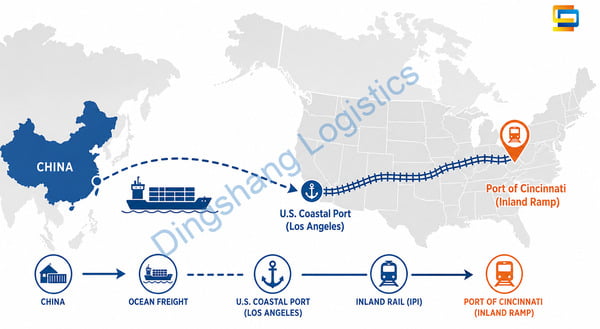
You now know the high-level answer. But corridor choice and operations drive the outcome. Below I share how I evaluate routes to the Port of Cincinnati, the trade-offs I see week to week, and the playbooks my team uses to avoid demurrage, detention, and missed appointments.
What does “Port of Cincinnati” really mean for ocean containers?
Importers often picture a vessel calling Cincinnati. It does not. That mismatch creates bad plans, weak quotes, and avoidable fees. The anxiety spikes when a container sits on a rail car and free days tick down. The solution is to frame Cincinnati correctly from day one.
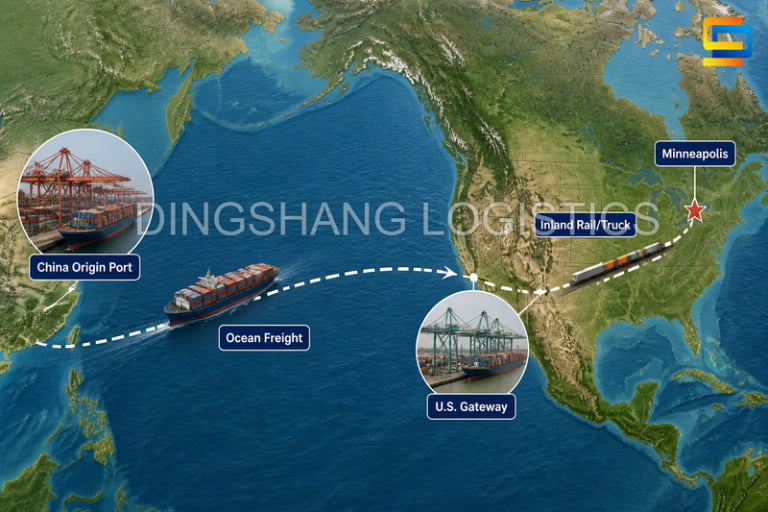
A “Port of Cincinnati” move is an FCL ocean shipment to a coastal U.S. port plus an inland rail move (IPI) to a Cincinnati-area rail ramp, followed by local drayage or door delivery. Treat it as an inland-ramp destination with different free-day clocks and operational steps than a seaport.
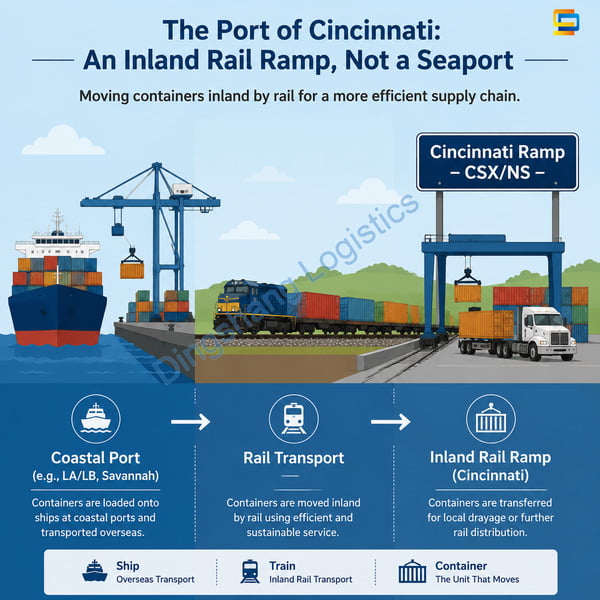
Cincinnati is an inland ramp, not a seaport
- Vessels discharge at a coastal port (e.g., Los Angeles/Long Beach, Savannah, Charleston).
- The carrier issues an IPI move to an inland destination, such as a Cincinnati-area CSX or NS ramp.
- Rail availability, chassis access, and ramp appointment rules determine when you can pick up.
I explain this up front because it changes how you plan:
- Free days reset. Ports often grant more free days than inland ramps. It is common to have, for example, 4–5 free days at discharge but only 1–2 at the ramp. The second clock matters more for your last-mile trucking.
- Different actors own different steps. The steamship line controls the port leg. The rail line controls inland leg and availability. Your dray carrier controls pickup and delivery. Misalignment between them causes fees.
- Appointment constraints and receiving windows matter1. Many Cincinnati consignees require appointments or limit dock hours. Your rail pickup must align with these.
In my recent Q2 run, two Cincinnati-bound containers cleared the coastal terminal on schedule, but one lost a day at the ramp due to chassis shortage. The shipper who pre-allocated chassis paid $0 in storage; the other paid a day of ramp storage and a driver wait charge. Same corridor, different execution.
How do I choose the best corridor to the Port of Cincinnati?
Chasing the lowest ocean rate is tempting. But it hides inland charges, storage risk, and time variability. The frustration builds when “cheap” turns expensive. The fix is a corridor model that compares total cost and time for your specific shipment window.
Build a corridor comparison for the Port of Cincinnati that sums total landed cost and total lead time, not just ocean freight. Include origin cutoffs, ocean transit, U.S. terminal and rail charges, ramp storage, chassis, drayage, and compliance buffer days. Then choose the corridor that fits your speed vs predictability goals.
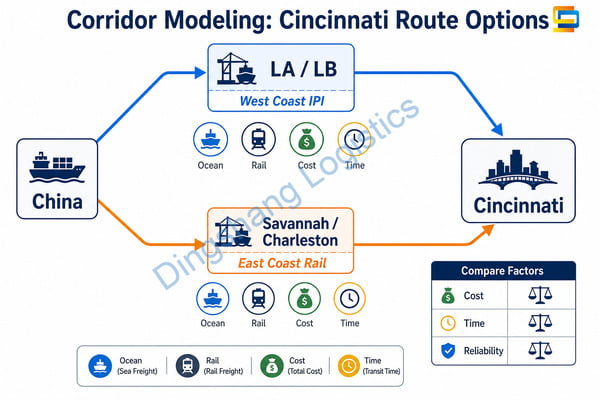
The corridor TCO/TLT model I use
I encourage every importer to evaluate two corridors side-by-side before booking:
- LA/LB IPI to Cincinnati
- Savannah/Charleston rail to Cincinnati
Use a simple calculator with two outputs: Total Cost of Ownership (TCO) and Total Lead Time (TLT). Here is what I include.
Components to include
- Origin side: factory cargo-ready date (CRD), CY cutoff fit, VGM and documentation readiness
- Ocean leg: base freight plus BAF/GRI/PSS where applicable
- U.S. discharge terminal: THC/wharfage, any CTS/port fees, free day assumptions
- Inland rail (IPI): linehaul, rail fuel, rail docs, ramp fees
- Equipment: chassis days, flip fees (if any), fuel surcharges
- Storage/penalties: port demurrage, ramp storage, container detention
- Final mile: drayage, drop/hook, lumper/inside delivery if requested
- Compliance timing: ISF lead time buffer, customs entry and any PGA holds
Variables that swing the result
- Season/peak congestion (e.g., Q4 peaks, pre-Lunar New Year)2
- Chassis availability at the discharge terminal and inland ramp3
- Free-day terms (port vs ramp, carrier-specific)
- Product compliance/inspection probability (e.g., FDA, EPA)
- Receiving appointment constraints at your warehouse
- Your tolerance for variability and willingness to pre-pull
A simple comparison table
| Corridor | Ocean transit (illustrative) | Rail transit (illustrative) | Variability risk (seasonal) | Typical profile |
|---|---|---|---|---|
| LA/LB → Cincinnati (IPI) | 12–16 days ex South China; 15–20 ex East China | 5–8 days linehaul + variable dwell | Higher in peak due to IPI backlogs/chassis | Faster ocean, denser sailings; best when urgency > variability concerns |
| SAV/CHS → Cincinnati | 28–35 days ex South China; 22–28 ex East China | 3–5 days linehaul + steadier dwell | Often steadier during West Coast peaks | Predictability and balanced cost; strong for East China origins |
All figures are ranges drawn from recent FCL moves and vary by carrier and season. I verify current conditions before each booking.
LA/LB IPI vs Savannah/Charleston to the Port of Cincinnati — which fits my shipment window?
When speed is vital, LA/LB IPI often looks right. When predictability matters most, Savannah/Charleston rail often wins. The stress comes from not knowing where costs and delays will land. The solution is to test both corridors with your CRD and receiving limits.
For the Port of Cincinnati, LA/LB IPI is usually faster from South China but riskier in peak seasons. Savannah/Charleston is slower from South China, steadier through rail and chassis, and attractive for East China origins. Run both scenarios with current free-day terms and appointment constraints before booking.
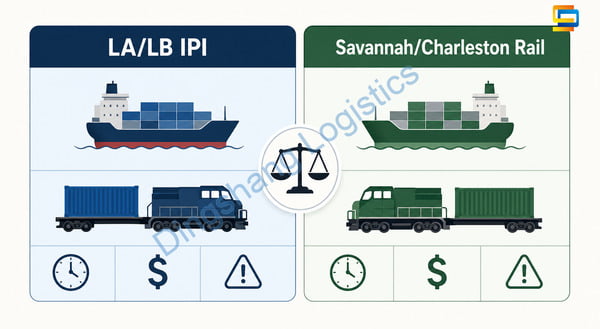
Two anonymized FCL cases (illustrative, season-dependent)
I handled both shipments below in the last 12 months. Figures are representative ranges, not promises. We always confirm live conditions before you decide.
Case A: South China (Shenzhen) → LA/LB → Cincinnati (IPI)
- Ocean transit window: 12–16 days
- Rail transit window: 5–8 days + 0–3 days dwell
- Cost structure (typical ranges)
- Ocean base + BAF/GRI: $2,500–$3,400 per 40HQ (seasonal)
- IPI rail (linehaul + fuel): $800–$1,200
- Port/THC + docs: $250–$450
- Chassis + FSL: $40–$75/day (assume 2–4 days)
- Ramp storage/detention risk: $0–$300 if pre-pull managed; $300–$900 if not
- Dray to door (Cincinnati city zone): $350–$600
- Where risk materialized: In a September push, chassis were tight at the ramp; we pre-pulled on day 0 and stored off-ramp to avoid storage, paying an extra yard fee but $0 ramp storage.
Case B: East China (Ningbo) → Savannah → Cincinnati (rail)
- Ocean transit window: 22–28 days
- Rail transit window: 3–5 days + 0–2 days dwell
- Cost structure (typical ranges)
- Ocean base + BAF/GRI: $3,000–$3,900 per 40HQ (seasonal)
- Rail (linehaul + fuel): $700–$1,000
- Port/THC + docs: $250–$450
- Chassis + FSL: $40–$65/day (assume 2–3 days)
- Ramp storage/detention risk: $0–$200 with appointment secured; $200–$600 if receiving window tight
- Dray to door (Cincinnati city zone): $350–$600
- Where risk materialized: A consignee only accepted Tuesday/Thursday. We built one buffer day into the plan, avoided storage, and delivered inside their 2-hour receiving window.
Key takeaways I see again and again:
- LA/LB IPI corridor shines for urgent South China loads, but only if you actively manage free days and chassis.
- Savannah/Charleston corridor tends to deliver steadier inland operations, especially when you dislike variability or ship from East China.
- The “cheapest ocean” quote is often not the cheapest landed cost once ramp storage and detention are added.
Again, all numbers are illustrative ranges from recent shipments and can change quickly with season, carrier, and rail conditions.
What compliance steps keep containers moving to the Port of Cincinnati?
Compliance confusion causes holds, which cause storage, which cause stress. Many teams blend ISF and customs entry or leave responsibility unclear. The fix is to separate filings, assign roles, and schedule each step into your corridor plan to the Port of Cincinnati.
Treat ISF and customs entry as separate workflows. File ISF before loading, transmit AMS/manifest as required, and submit customs entry before the U.S. arrival/rail move. Assign who files what (importer, broker, forwarder) at booking. Clean, early filings reduce inspections and release delays en route to the Port of Cincinnati.
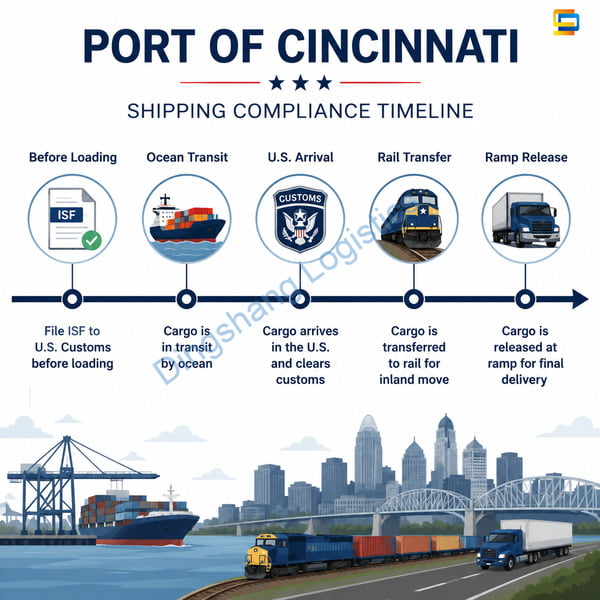
ISF vs customs entry: how I operationalize it
- ISF (Importer Security Filing): Data must be filed before the vessel loads in China.4 Late/incorrect filings can trigger fines and holds.5 We collect supplier, buyer, consolidator, and HTS data early and confirm who files (your broker or our appointed agent).
- AMS/manifest: The carrier transmits; we verify accuracy against commercial docs to avoid mismatches that cause holds.
- Customs entry: Your broker files the formal entry, often before cargo arrives at the U.S. port. For straightforward commodities, entry-ready status before rail transfer helps prevent inland delays.
- PGA agencies (e.g., FDA, EPA)6: If your product is regulated, we flag it during intake and slot extra buffer. A random exam at the discharge port can ripple through to the rail schedule.
Operational tip from my desk: I run a “green light” checklist 5 working days before ETA at the coastal port—ISF on file, entry accepted, duties paid/arranged, any PGA flags cleared—so the container can go directly to rail without paperwork friction.
None of this is legal advice; it is the operational cadence we use to reduce risk and speed up inland transfer.
What inland-ops playbook avoids D&D at the Port of Cincinnati?
The inland ramp is where good plans fail. Missed availability notices, late chassis planning, and tight receiving windows create storage. The frustration peaks when a “delivered” rate balloons with extras. The solution is a dated playbook that starts before the train departs.
For Port of Cincinnati moves, pre-advise your trucker, line up chassis before train arrival, track rail availability daily, secure receiving appointments early, and pre-pull when storage risk outweighs off-ramp parking cost. Manage free days at both the discharge terminal and the Cincinnati ramp—they often differ.
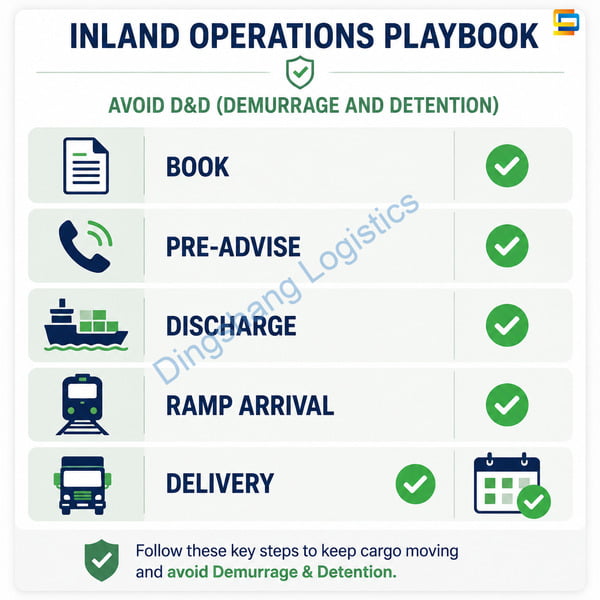
My inland timeline checklist (booking to ramp release)
- Booking day:
- Confirm IPI routing to the Cincinnati ramp (NS/CSX) on the carrier bill.
- Lock free-day terms for both port and ramp in writing.
- Assign who files ISF and customs entry.
- 5–7 days before vessel ETA (U.S. port):
- Pre-advise preferred trucker and chassis source.
- Gather consignee receiving hours and appointment rules.
- Upon discharge:
- Monitor last free day at port; request on-dock rail as early as possible.
- Validate rail billing and correct any hold or mismatch immediately.
- When waybill shows “arrived rail ramp”:
- Confirm availability in the rail system (appointment slots can be limited).
- If receiving window is tight or ramp free days are short, pre-pull on day 0–1 to an off-ramp yard.
- Delivery day:
- Ensure driver has release references and in/out procedures for the ramp.
- Keep consignee ready; avoid driver wait charges with a firm dock time.
- Post-delivery:
- Return the empty container within detention free days; watch for restricted return locations or noon cutoffs.
In my Q3 runs, pre-pull decisions saved more than one consignee from $300–$900 in ramp storage when warehouses could not take same-day. The yard fee plus extra dray leg was still cheaper and more controllable.
What info do you need to quote and route my container to the Port of Cincinnati?
Rushed quotes miss key pieces. Surprises follow later. The pain shows up in storage charges and schedule slips. The solution is a clean intake and a transparent, line-item quote tailored to the Port of Cincinnati.
For Port of Cincinnati FCL quotes, I ask for origin port and cargo-ready window, cargo size/weight/category, transit-time goals and variability tolerance, customs/ISF responsibility and broker, and delivery conditions and constraints. Insist on line-item quotes with free-day terms and surcharge policies in writing.
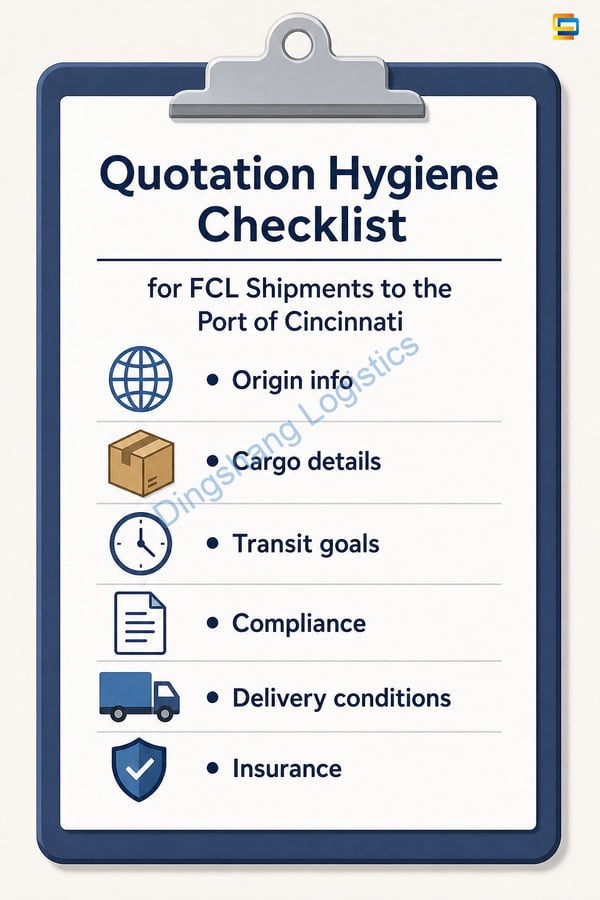
Intake checklist I use
- Supplier details and load port preference (e.g., Ningbo, Shanghai, Shenzhen, Qingdao)
- Cargo-ready window and any hard in-DC dates
- Equipment: 20GP or 40HQ, weight and cube; any special handling
- Commodity and HTS (flag FDA/EPA or other PGA if applicable)
- Transit goals: speed vs predictability; willingness to consider pre-pull/off-ramp storage
- Delivery: door vs ramp pickup, receiving hours, appointment limits, liftgate or inside delivery needs
- Compliance: who files ISF, who files customs entry, broker contact
- Insurance: confirm coverage; for our door-to-door moves we include free cargo insurance
How to read a Cincinnati-bound quote
Ask for specific line items and assumptions:
- Ocean base + BAF/GRI/PSS
- U.S. terminal and documentation charges
- IPI rail charges (linehaul + fuel)
- Ramp fees and free-day terms (port and ramp listed separately)
- Chassis and FSL/fuel surcharges with assumed days
- Drayage/door delivery rate and what it includes (e.g., 2 hours free wait time)
- Storage/detention assumptions and extra charges
- Surcharge and exception policy in writing (e.g., split of exam costs)
Avoid “to port/to door” without a written free-day policy. If a quote omits ramp free days for the Port of Cincinnati, I treat it as incomplete.
Frequently Asked Questions
Is the Port of Cincinnati a seaport with vessel calls?
No. For ocean containers, the Port of Cincinnati refers to inland rail ramp destinations in the Cincinnati area (served by NS/CSX). Your container discharges at a coastal U.S. port and moves inland by IPI rail before local drayage to your door.
What is the fastest corridor from South China to the Port of Cincinnati?
Typically, Shenzhen/Guangzhou to Los Angeles/Long Beach with IPI rail to Cincinnati provides the fastest ocean leg and dense sailing options. However, in peak seasons IPI congestion and chassis shortages can erode speed. Always compare against Savannah/Charleston with live conditions.
How many free days do I get at the Cincinnati rail ramp?
It varies by carrier and rail line. Two common patterns are 1–2 free days at the inland ramp and 4–5 free days at the coastal port. Always confirm both in writing on your booking/quote. We plan pickups with these clocks in mind to avoid storage.
Do ISF and customs entry need to be filed separately?
Yes. ISF is a pre-loading data filing due before the vessel loads in China. Customs entry is the formal import declaration, typically filed before U.S. arrival. Assign responsibilities at booking to avoid holds that can delay rail transfer to the Port of Cincinnati.
Should I choose 20GP or 40HQ for shipments to the Port of Cincinnati?
Pick equipment based on cube and weight. A 40HQ offers better cost per cubic meter for light, bulky cargo. A 20GP suits heavier cargo close to road weight limits. We check weight restrictions for both rail and final dray to your delivery point.
Conclusion
Shipping to the Port of Cincinnati is a corridor-and-ramp decision, not a simple port move. Model total landed cost and total lead time, compare LA/LB IPI against Savannah/Charleston for your origin and season, and run a disciplined compliance and inland playbook. If you want a transparent, all-in FCL plan with stable schedules and door-to-door options, contact Dingshang Logistics. We specialize in China-to-USA corridors and include free cargo insurance for door-to-door shipments to protect your move.
Related Shipping Guides
- How to Ship a Container from China to Port of Chicago
- How to Ship a Container from China to Port of Cleveland
- How to Ship a Container from China to Port of Dallas
- How Container Shipping Works From China To USA?
- How to Import Products from China to USA Step by Step
- China to USA Container Shipping
"Integrating Terminal Gate Appointment Systems at the Port of ...", https://www.ams.usda.gov/sites/default/files/media/TerminalGateSummary.pdf. Transportation research on terminal appointment systems and drayage operations supports the article’s mechanism that limited appointment slots and receiving windows can affect pickup timing and waiting costs; the evidence is general to intermodal drayage and may not be specific to Cincinnati ramps. Evidence role: mechanism; source type: research. Supports: Appointment systems and constrained receiving windows influence drayage timing, truck waiting time, and container pickup performance.. Scope note: Contextual support; findings may come from seaport or terminal studies rather than the Cincinnati rail-ramp environment. ↩
"Review of maritime transport 2025", https://unctad.org/system/files/official-document/rmt2025_en.pdf. International maritime-transport reporting on seasonal container demand supports the article’s inclusion of Q4 and pre-Lunar New Year periods as variables in routing and congestion planning; it does not prove that either Cincinnati corridor will be congested in a particular week. Evidence role: general_support; source type: institution. Supports: Container-shipping demand and port activity can be affected by seasonal trade patterns and production calendars such as the Lunar New Year period.. Scope note: Contextual support; seasonal effects vary by trade lane, carrier, port, and year. ↩
"FMC Receives Fact Finding 29 Final Recommendations ...", https://www.fmc.gov/articles/fmc-receives-fact-finding-29-final-recommendations-and-intermodal-equipment-report/. Government reporting on container-supply-chain congestion identifies chassis availability as a constraint affecting intermodal freight movement, supporting the article’s treatment of chassis planning as a delay and cost-control issue. Evidence role: mechanism; source type: government. Supports: Government or regulatory reports identify chassis availability as a factor in port and intermodal freight congestion.. ↩
"Import Security Filing (ISF) - When to submit to CBP", https://www.help.cbp.gov/s/article/Article-1868. CBP Importer Security Filing guidance states that required ISF data for vessel cargo must generally be transmitted before loading at the foreign port, supporting the article’s pre-loading compliance timeline. Evidence role: mechanism; source type: government. Supports: CBP requires ISF data for vessel shipments to be transmitted before cargo is loaded at the foreign port, generally no later than 24 hours before loading for most ISF data elements.. ↩
"Import Security Filing (ISF) - When to submit to CBP", https://www.help.cbp.gov/s/article/Article-1868. CBP guidance on ISF enforcement describes liquidated damages for inaccurate, late, or missing filings and related enforcement tools, supporting the article’s warning that noncompliance can create monetary and operational risk. Evidence role: mechanism; source type: government. Supports: CBP may assess liquidated damages or take enforcement action for missing, late, or inaccurate ISF filings.. Scope note: Direct for penalty risk; whether a specific shipment is held depends on CBP enforcement decisions and shipment facts. ↩
"Partner Government Agencies Import Guides", https://www.cbp.gov/trade/basic-import-export/e-commerce/partner-government-agencies-import-guides. CBP guidance on Partner Government Agencies supports the article’s statement that regulated imports may require agency-specific review or data beyond ordinary customs entry. Evidence role: definition; source type: government. Supports: CBP coordinates import processing with Partner Government Agencies, including agencies such as FDA and EPA for regulated goods.. ↩
Leave a Comment