
Sea Freight Transit Time from China to USA in 2026: How Long Does It Really Take?
Sea freight from China to the USA typically takes about 14–16 days port-to-port on faster China-to-Los Angeles services, around 29–32 days on many faster services to New York or Houston, and roughly 30–37 days on faster services to Savannah. Slower services can take longer in actual operations, especially when schedule changes or routing delays occur.
Actual transit depends on the China origin, U.S. gateway, carrier service, routing, and sailing. Ocean transit is also not the same as total door-to-door lead time.
Ocean transit is not the same as total door-to-door lead time.
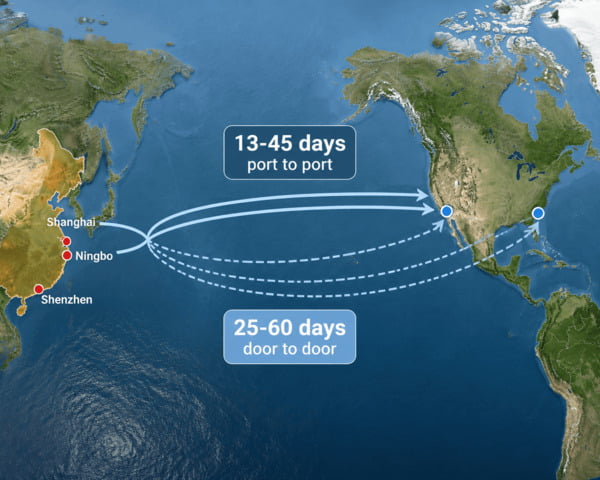
For inventory planning, use the actual booked service rather than a generic China-to-USA average. Then add realistic time for origin handling, customs, carrier and terminal availability, inland rail or truck movement, drayage, and the final warehouse appointment.
What Is the Average Sea Freight Transit Time from China to the USA?
On the faster services reviewed for this guide, China-to-Los Angeles port-to-port transit is typically about 14–16 days, many faster New York and Houston services are about 29–32 days, and faster Savannah services are about 30–37 days, depending on the China origin. Slower services can show longer actual transit than their published schedules.
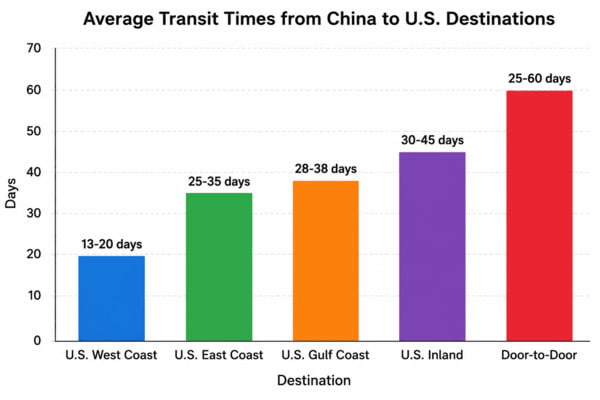
Typical 2026 Port-to-Port Transit Times from China to the USA
The table below is based on carrier-published schedules and actual operational experience on the listed services. OA fast services (Ocean Alliance services commonly used on these lanes) have typically tracked their published transit times more closely in the operations reviewed. Slower services have shown wider schedule-to-actual differences on some routes.
| Route | OA Fast Service – Carrier Schedule | OA Fast Service – Actual | Slower Service – Carrier Schedule | Slower Service – Actual |
|---|---|---|---|---|
| Ningbo → Los Angeles | 14–15 days | 14–15 days | 18–22 days | 18–25 days |
| Shenzhen → Los Angeles | 15–16 days | 15–16 days | 18–20 days | 18–25 days |
| Ningbo → New York | 30–31 days | 30–31 days | 30–35 days | 37–40 days |
| Shanghai → New York | 29–30 days | 29–30 days | 30–35 days | 35–40 days |
| Shanghai → Houston | 29–32 days | 29–32 days | 30–35 days | 35–40 days |
| Shenzhen → Houston | 29–32 days | 29–32 days | 30–35 days | 35–45 days |
| Qingdao → Savannah | 35–37 days | 35–37 days | 35–40 days | 40–45 days |
| Ningbo → Savannah | 30–31 days | 30–31 days | 30–35 days | 37–40 days |
| Shenzhen → Savannah | 30–35 days | 30–35 days | 35–40 days | 40–50 days |
These are practical 2026 planning ranges based on carrier-published schedules and actual operational experience on the listed services. They are not guaranteed transit times. Actual timing can change by carrier, vessel, routing, transshipment, port calls, weather, congestion, and other operational conditions.
Carrier schedule means the published or planned port-to-port transit. Actual transit means the observed operational port-to-port transit. The two should not be confused.
If you are comparing China-to-USA container shipping options, ask which service and routing the quotation actually uses. Two bookings between the same origin and destination can have different transit profiles.
Carrier Schedule vs. Actual Transit Time
Carrier-published transit time is the planned port-to-port schedule. Actual transit time is what the shipment experiences in operation. On the faster OA services shown above, actual transit has often tracked the published schedule closely. Slower services have shown a wider gap on some East Coast, Gulf Coast, and Savannah routings.
For example:
- Ningbo → Los Angeles OA fast service: 14–15 days schedule / 14–15 days actual
- Ningbo → New York slower service: 30–35 days schedule / 37–40 days actual
- Shenzhen → Savannah slower service: 35–40 days schedule / 40–50 days actual
Slower services can show a larger difference between the published schedule and actual transit because additional port calls, routing structure, transshipment exposure, schedule recovery, or operational disruptions may affect the final arrival. This does not mean every slower service will be delayed; the result depends on the actual carrier, vessel, routing, and operating conditions.
Published transit time should be treated as a schedule reference, not a guaranteed warehouse delivery commitment.
Port-to-Port Transit vs. Door-to-Door Lead Time
Port-to-port transit measures the ocean portion between the relevant origin and destination ports.
Door-to-door lead time includes the shipment before and after that ocean movement.
For inventory planning, door-to-door lead time is usually the more useful measurement because it reflects when the cargo can actually reach your warehouse—not simply when the vessel reaches the United States.
How Long Does FCL Shipping Take from China to the USA?
FCL port-to-port transit follows the booked carrier service. On the faster services in this guide, China-to-Los Angeles routes are around 14–16 days, while faster New York, Houston, and Savannah services generally fall in the upper-20s to upper-30s depending on origin and routing.
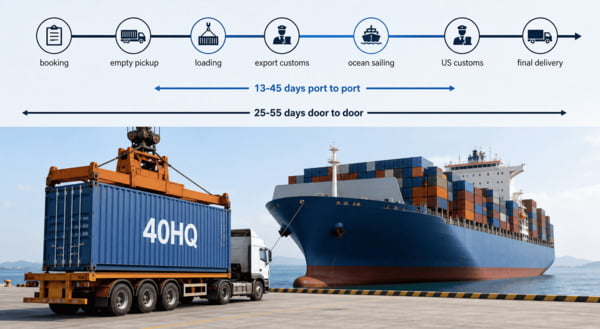
For a 20GP or 40HQ shipment, build the timeline from the supplier's confirmed cargo-ready date rather than assuming the port-to-port transit shown above represents the complete shipment.
A typical FCL workflow includes:
- Confirm the cargo-ready date and Incoterm.
- Book the appropriate carrier service and equipment.
- Confirm the empty-container release and vessel cut-off requirements.
- Load the container and complete China export procedures.
- Deliver the container to the origin terminal before the applicable cut-off.
- Complete the ocean movement to the selected U.S. gateway.
- Complete U.S. customs processing and monitor carrier/terminal availability and operational release status.
- Arrange rail or truck transportation when inland movement is required.
- Complete final delivery and empty-container return.
A missed cut-off, rolled booking, changed sailing, customs exam, or inland connection can materially change the final delivery date. That is why an importer should not treat an estimated vessel arrival as a guaranteed warehouse delivery date.
For a broader explanation of the physical process, see how container shipping works from China to the USA.
Customs Preparation Starts Before the Vessel Arrives
For standard U.S.-bound vessel cargo, key ISF data generally must be submitted no later than 24 hours before the cargo is laden aboard the vessel destined for the United States. Two additional ISF elements have later timing provisions.1
That means customs preparation should not begin when the vessel reaches the U.S. port.
The importer and its customs broker or filing agent should have the required shipment data early enough to complete the applicable filing and prepare the import entry. Product descriptions, classification information, values, consignee information, and other shipment data should be checked before they become a release problem.
How Long Does LCL Shipping Take from China to the USA?
LCL may use the same underlying ocean vessel service as FCL, so the ocean leg itself can be similar. LCL total lead time can be longer even when the ocean leg uses the same vessel service because the shipment also requires origin receiving, consolidation, CFS handling, destination deconsolidation, and final delivery coordination.
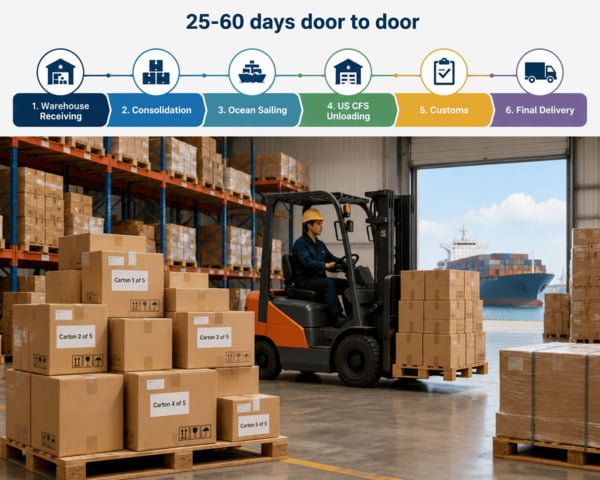
A typical LCL shipment may include:
| LCL Stage | What Happens | Possible Time Risk |
|---|---|---|
| Origin receiving | Cargo enters the consolidation warehouse | Late supplier delivery |
| Consolidation | Multiple shipments are prepared for container loading | Consolidation schedule |
| Export and ocean movement | Container moves under the booked service | Cut-off or schedule changes |
| Destination deconsolidation | Individual shipments are separated | CFS processing |
| Customs/release | Shipment completes applicable import processing | Documentation or exam |
| Final delivery | Cargo moves to the consignee | Truck and appointment availability |
This is why comparing FCL and LCL only by the advertised ocean schedule is incomplete.
LCL can make sense for smaller shipments that do not justify a full container. FCL can make more operational sense when cargo volume, handling sensitivity, inventory timing, or shipment economics support using a dedicated container.
The decision should be based on total delivered logistics cost, cargo characteristics, handling requirements, and required delivery date—not simply which freight quote has the lowest ocean line item. For a more detailed comparison, see when you should choose FCL instead of LCL.
Which China and U.S. Ports Affect Transit Time Most?
The China origin and U.S. gateway can materially affect transit time, but port selection should be based on the complete route rather than geography alone. Ningbo, Shanghai, Shenzhen, and Qingdao are important China loading gateways in the routes reviewed here, while the U.S. side may involve Los Angeles, New York, Houston, Savannah, or another gateway depending on the booking.
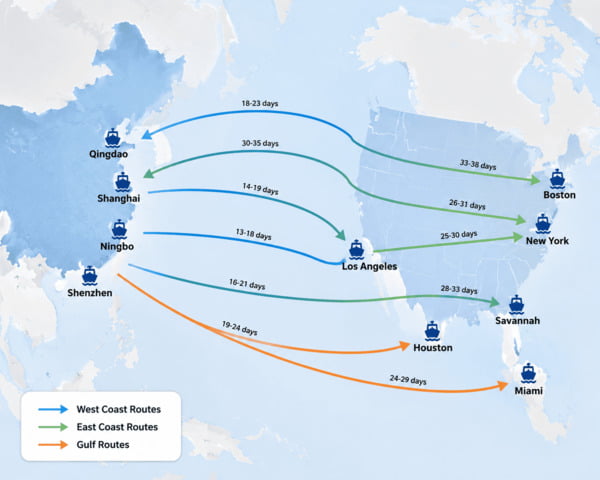
The Port of Los Angeles is a major U.S. container gateway for Asian trade.2 For cargo routed through Southern California, however, vessel arrival is only one part of the decision. You also need to know whether the container terminates near the port or continues inland by rail or truck.
An importer should evaluate the route in this order:
| Decision | Question to Ask |
|---|---|
| China origin | Which port fits the supplier location and booked service? |
| Ocean service | Is the routing direct or does it involve additional port calls or transshipment? |
| U.S. gateway | Which gateway supports the final destination and service plan? |
| Inland mode | Will the cargo move by rail, truck, or a combination? |
| Final delivery | What does the warehouse require for receiving? |
For Southern California cargo, see the detailed guide to shipping a container from China to the Port of Los Angeles.
For East Coast cargo, shipping a container from China to New York involves a different ocean and inland planning decision.
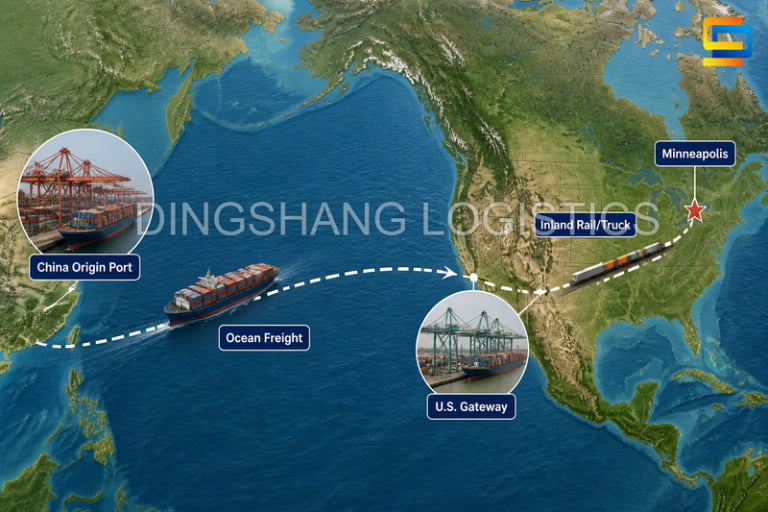
An Inland Destination Changes the Transit-Time Calculation
Chicago, Dallas, Memphis, Detroit, and other inland markets should not be treated as if they were ocean ports.
A container may enter the United States through a coastal gateway and then continue inland. Depending on the booked routing, that inland movement may involve rail, truck, transloading, or another combination of services.
For example, an importer planning container shipping from China to Chicago needs to evaluate the ocean gateway and inland movement separately.
An inland rail ramp is not the same as door delivery. Arrival at an inland ramp still leaves pickup, drayage, equipment availability, appointment scheduling, unloading, and—in many cases—empty-container return to manage.
What Causes Sea Freight Delays from China to the USA?
China-to-USA sea freight can be delayed at origin, during the ocean movement, at the U.S. gateway, during customs processing, or on the inland leg. The most useful way to manage delay risk is to identify which parts of the shipment you can control before cargo moves.
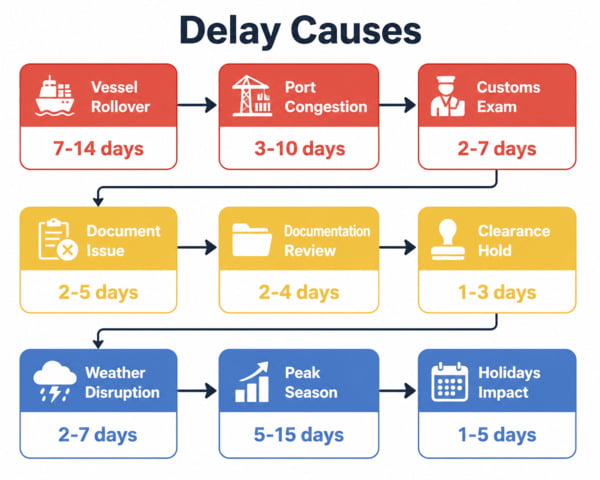
Common delay mechanisms include:
| Delay Risk | Operational Effect | Importer Action |
|---|---|---|
| Cargo not ready | Missed planned booking | Confirm actual cargo-ready date |
| Missed vessel cut-off | Cargo may move on a later sailing | Confirm cut-offs before pickup/loading |
| Schedule change or rollover | Departure moves later | Track the booking and vessel schedule |
| Transshipment disruption | Connection may be delayed | Understand whether routing involves transshipment |
| Documentation problem | Customs processing can slow | Review shipment data before departure |
| Customs exam | Cargo release can be delayed | Keep realistic contingency time |
| Terminal congestion | Cargo availability/pickup may slow | Monitor terminal status |
| Inland rail disruption | Inland ETA may change | Track rail movement separately |
| Truck or chassis constraint | Pickup/final delivery may move | Coordinate delivery promptly |
| Warehouse appointment | Cargo may be ready before the consignee can receive it | Confirm receiving rules early |
Not every shipment will experience these problems, and the size of any delay cannot be predicted accurately from a generic table.
The practical lesson is to protect the parts of the timeline you can control: cargo readiness, documentation, booking timing, cut-offs, customs preparation, and receiving arrangements.
Delay Can Also Create Additional Cost
When containers or equipment remain in the transportation system longer than permitted under the applicable terms, demurrage or detention charges may become relevant. These charges and applicable free-time arrangements vary by carrier, terminal, contract, and shipment circumstances.
The Federal Maritime Commission's detention and demurrage billing rules establish requirements covering invoice content, timing, and dispute procedures. Most provisions took effect in 2024; a 2025 court decision set aside one portion concerning who may be billed, while the FMC states that the other provisions remain in effect.3
For importers, the operational point is simple: a transit-time problem can become a cost problem if cargo availability, pickup, delivery, or equipment return is not managed promptly.
How Should I Plan Door-to-Door Sea Freight Time from China to the USA?
Plan door-to-door sea freight backward from the date your U.S. warehouse actually needs the cargo. Do not use the vessel ETA as the delivery date. Build separate allowances for supplier readiness, origin handling, ocean movement, customs, carrier and terminal availability, inland transportation, and final receiving.
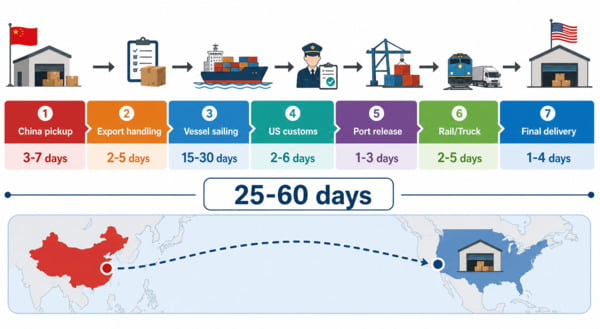
Typical Door-to-Door Planning Times on OA Fast Services
The following ranges are based on actual OA fast-service operations and are measured after vessel departure. They are practical planning ranges rather than guaranteed delivery times.
| Destination | Practical Planning Time After Vessel Departure | Typical Inland Structure |
|---|---|---|
| Southern California warehouse | 18–20 days | Ocean + local drayage |
| Chicago | 30–35 days | West Coast gateway + rail + drayage |
| New York/New Jersey warehouse | 32–37 days | All-water + local delivery |
| Dallas/Houston | 32–35 days | Ocean/inland routing depending on booking |
These are practical planning ranges after vessel departure based on OA fast-service operations. They are not guaranteed delivery times and do not include supplier production time before departure.
The actual gateway and inland routing can vary by booking. These figures therefore should not be interpreted as fixed routing commitments, cargo-ready-to-delivery times, or purchase-order-to-warehouse lead times.
Build the Timeline Backward from the Warehouse Need Date
A practical planning sequence is:
- Set the required warehouse delivery date.
- Confirm the warehouse's receiving and appointment requirements.
- Determine the likely final-mile transportation requirement.
- Allow for inland rail or truck movement where applicable.
- Allow for customs processing, carrier/terminal availability, and possible exceptions.
- Use the actual planned ocean service and routing.
- Add origin terminal, export, loading, and cut-off requirements.
- Work back to the supplier's required cargo-ready date.
- Add contingency appropriate to the importance of the inventory.
This method connects the vessel schedule to the date your business actually needs the cargo rather than treating port arrival as the end of the shipment.
ETA, Customs Release, Cargo Availability, and Delivery Date Are Different Milestones
Importers should not treat vessel arrival, customs release, cargo availability, and warehouse delivery as one event.
- Vessel ETA: when the vessel is expected to arrive.
- Customs release/status: the shipment's applicable customs processing status.
- Carrier/terminal availability: when the carrier or terminal's operational conditions allow the container to proceed.
- Delivery date: when the cargo reaches the consignee's receiving location.
These milestones can occur at different times even when the vessel arrives on schedule. Customs release alone does not necessarily mean the container is immediately available for pickup.
If your business is new to the process, the step-by-step guide to importing products from China to the USA explains the broader import workflow around the ocean shipment.
Is Faster Sea Freight from China to the USA Always Better?
No. The shortest published ocean transit is not automatically the best shipping plan. You should compare actual operational transit, routing complexity, cut-off requirements, inland transportation, cargo availability, warehouse timing, and total delivered logistics cost before choosing a service.
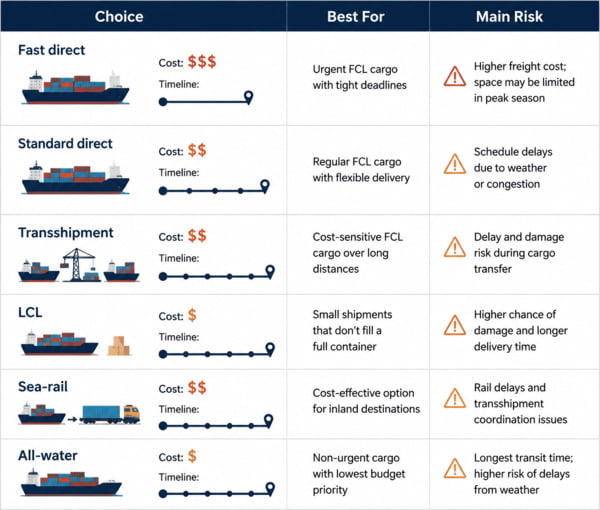
The 2026 operational ranges in this guide show why the distinction matters. On the OA fast services reviewed, actual port-to-port transit has generally tracked the published schedule closely. On some slower services, the observed operational range has been longer than the carrier-published transit.
That does not make the fastest service automatically right for every shipment.
| Service Characteristic | Potential Advantage | What to Check |
|---|---|---|
| OA fast service | Actual transit has tracked published schedules closely on the services reviewed | Actual booking, schedule, space, cut-offs |
| Standard/slower service | May fit a different cost or routing requirement | Published vs. observed transit and routing |
| Transshipment routing | May provide another service option | Connection exposure and total lead time |
| FCL | Avoids LCL consolidation/deconsolidation | Container economics and delivery requirements |
| LCL | Suitable for smaller cargo volumes | CFS handling and consolidation schedule |
| West Coast gateway + inland move | Shorter Pacific ocean leg for many China origins | Rail/truck time, availability, and final delivery |
| All-water service | Can change the inland transportation profile | Ocean transit and final destination fit |
The right question is not simply, "Which vessel is fastest?"
Ask:
Which routing gives my business the best balance of actual delivery timing, total delivered logistics cost, handling requirements, and disruption risk?
How Can Importers Reduce China-to-USA Sea Freight Transit-Time Risk?
Importers can reduce avoidable transit-time risk by controlling shipment readiness before booking and managing customs and final delivery before the container arrives. You cannot eliminate schedule disruption, weather, exams, congestion, or every operational exception, but you can prevent many documentation and coordination delays.
Use this pre-shipment checklist:
- Confirm the supplier's real cargo-ready date.
- Confirm FCL or LCL requirements.
- Verify the origin port and intended U.S. gateway.
- Review the carrier's published transit and the routing structure.
- Confirm whether the planned service involves transshipment or additional port calls.
- Confirm vessel cut-offs before arranging origin pickup.
- Provide customs and ISF data early.
- Confirm the U.S. delivery ZIP code and receiving requirements.
- Identify whether inland rail or trucking is required.
- Check warehouse appointment requirements before arrival.
- Track vessel ETA, customs status, carrier/terminal availability, inland movement, and final delivery as separate milestones.
For standard U.S.-bound vessel cargo, key ISF information generally must be submitted before lading as described above.1 Early data collection is therefore part of transit-time risk management, not simply a customs task.
Your freight forwarder should also be able to explain what the quoted transit represents, which routing is being used, and what happens after the vessel arrives. If you are evaluating providers, see how to choose a freight forwarder in China.
Frequently Asked Questions
How long does sea freight from China to the USA take?
Sea freight from China to the USA typically takes about 14–16 days port-to-port on faster services to Los Angeles, around 29–32 days on many faster New York and Houston services, and about 30–37 days on faster services to Savannah, depending on the China origin and booked routing. Slower services can take longer in actual operation.
Total door-to-door lead time is longer because origin handling, customs, terminal/carrier availability, inland transportation, and final delivery are separate stages.
Is China-to-USA West Coast shipping faster than East Coast shipping?
The ocean leg to a U.S. West Coast gateway is generally shorter on the services reviewed in this guide. On the faster services in this guide, Ningbo/Shenzhen to Los Angeles is approximately 14–16 days port-to-port, while faster New York services are around 29–31 days depending on origin.
That does not guarantee faster warehouse delivery for every importer. If the final destination is inland or on the East Coast, compare the complete ocean, rail or truck, customs, and final-delivery plan.
What is the difference between carrier schedule and actual transit time?
Carrier schedule is the planned or published port-to-port transit. Actual transit is the time observed in operation. On the OA fast services reviewed for this article, actual transit has often tracked the published schedule closely, while some slower services have shown wider differences.
Neither measurement should be treated as a guaranteed warehouse delivery date.
Is FCL faster than LCL from China to the USA?
FCL and LCL may use the same ocean vessel service, so their ocean legs can be similar. LCL total lead time can be longer because the shipment also requires origin receiving, consolidation, CFS handling, destination deconsolidation, and final-delivery coordination.
Does customs clearance count as ocean transit time?
No. Ocean transit and customs processing are separate parts of the shipment. For inventory planning, customs processing, carrier/terminal availability, inland transportation, and final delivery should be included in total door-to-door planning rather than treated as part of the ocean sailing.
Does a vessel ETA mean my container is ready for pickup?
No. Vessel ETA only indicates when the vessel is expected to arrive. Discharge, customs status, carrier and terminal availability, holds, equipment conditions, and other operational steps can affect when the container can actually move.
Can a customs exam delay a China-to-USA shipment?
Yes. A CBP or other government-agency examination can extend the time before cargo can proceed. The duration depends on the circumstances, so a fixed exam-delay allowance should not be treated as guaranteed.
How long should I plan for door-to-door delivery on an OA fast service?
Based on the OA fast-service operations used for this guide, practical planning after vessel departure is 18–20 days to a Southern California warehouse, 30–35 days to Chicago via a West Coast gateway and rail, 32–37 days to a New York/New Jersey warehouse, and 32–35 days to Dallas/Houston.
These are planning ranges after vessel departure, not guarantees. They do not include supplier production time before departure, and the actual gateway or inland routing can vary by booking.
What information is needed to estimate door-to-door transit time?
Provide the China pickup location or FOB port, cargo-ready date, FCL or LCL requirement, container size or shipment dimensions, U.S. delivery ZIP code, cargo description, gross weight, and receiving requirements. The planned carrier service and routing can then be evaluated against the complete origin-to-door movement.
Get a China-to-USA Sea Freight Transit Plan
A useful transit-time estimate should be based on your actual shipment, carrier service, routing, and final delivery requirement rather than a generic online average.
For an FCL quotation and routing review, provide:
- Product name
- HS/HTS code, if available
- Material or product description
- Supplier or pickup location in China
- U.S. delivery ZIP code
- 20GP or 40HQ requirement
- Gross cargo weight
- Cargo-ready date
- FOB or EXW terms
- Customs-clearance requirements
- Special loading, unloading, or warehouse requirements
For LCL, also provide:
- Package quantity
- Package dimensions
- Total CBM
- Gross weight
With that information, Dingshang Logistics can evaluate the appropriate China origin, U.S. gateway, ocean service, customs coordination, inland transportation, and final-delivery requirements. Any transit estimate should then be confirmed against the actual carrier schedule, booking, routing, and current operating conditions.
References
[U.S. Customs and Border Protection — Importer Security Filing (ISF): When to Submit to CBP](https://www.help.cbp.gov/s/article/Article-1868) ↩
[Port of Los Angeles — Facts and Figures](https://portoflosangeles.org/business/statistics/facts-and-figures) ↩
[Federal Maritime Commission — U.S. Court of Appeals Issues Decision in Case on Demurrage and Detention Billing Practices](https://www.fmc.gov/articles/u-s-court-of-appeals-issues-decision-in-case-on-demurrage-and-detention-billing-practices/) ↩
Leave a Comment