
To ship a container from China to Memphis, many importers first search for a “Port of Memphis” rate. The problem is that Memphis is not a seaport. If you quote it like ocean freight only, fees can appear later. The better solution is to plan the gateway port, inland rail, customs timing, and final drayage together.
To ship a container from China to Memphis, you usually move cargo from a China loading port to a U.S. gateway port, then by inland point intermodal rail to the Memphis rail ramp, and finally by truck to the delivery address. The best route depends on total landed cost, rail allocation, free time, customs release, and local drayage conditions.
I have handled multiple FCL shipments to Memphis in the past 12 months. In practice, the lowest ocean rate is not always the best choice. A small saving at the vessel stage can disappear quickly if the rail ramp has storage, chassis delays, or weekend pickup problems.
How Do You Ship a Container from China to Memphis If Memphis Is Inland?
Many first-time Memphis importers start with the wrong map. They ask for a sea freight rate to Memphis, but the container cannot sail directly there. This creates confusion, missing charges, and weak planning around rail arrival. A full route plan solves that issue before booking.
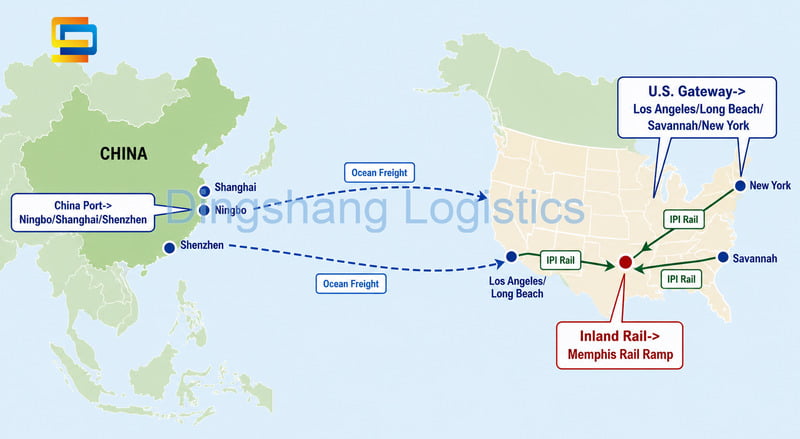
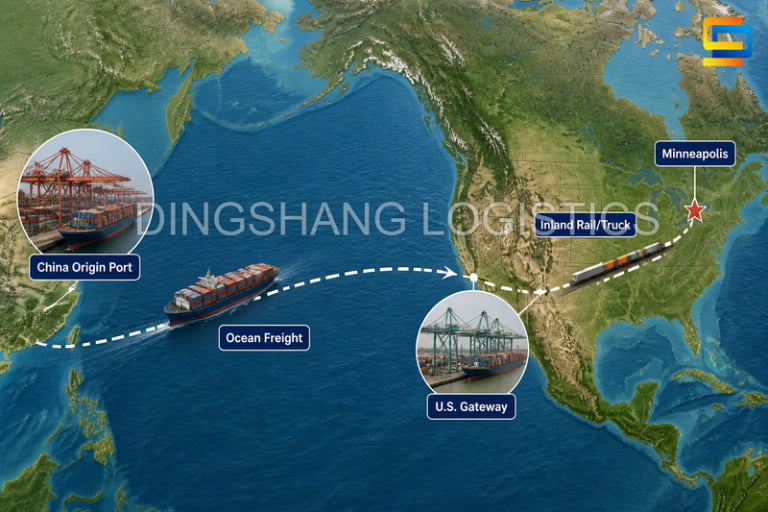
The correct flow is China port of loading → U.S. gateway seaport → inland point intermodal rail to the Memphis rail ramp → local drayage to the door1. The booking, Importer Security Filing, customs release, rail movement, and delivery appointment should be coordinated as one chain.
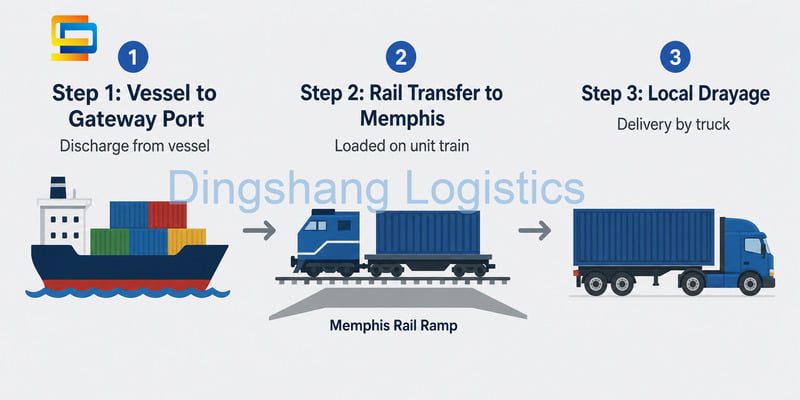
The Real Route Architecture
When I arrange FCL moves to Memphis, I do not treat the shipment as only an ocean booking. I treat it as a combined ocean + IPI rail + drayage product.
IPI means Inland Point Intermodal.2 It is the rail movement from a U.S. gateway port to an inland rail ramp. For Memphis, the inland ramp is the practical destination point before the final truck move.
A common routing looks like this:
- Factory or warehouse in China
- China port of loading, such as Ningbo, Shanghai, Shenzhen, or Qingdao
- Ocean vessel to a U.S. gateway, such as Los Angeles/Long Beach, New York, or Savannah
- Rail transfer from port to Memphis rail ramp
- Local drayage from ramp to importer’s warehouse
- Empty container return, based on the carrier’s instruction
The importer should confirm whether the quoted service is:
- CY to CY: container yard to container yard only
- CY to door: ocean and rail included, with final delivery added
- Door to door: pickup in China and delivery in the U.S.
- DDP-style service: duty handling may be included, but importer obligations still need review
I avoid using the phrase “Port of Memphis” in quotes because it can hide the real cost structure. Memphis is an inland rail ramp destination for containerized import planning.
ISF and Document Timeline Checklist
This timeline is a working checklist. It is not customs or legal advice. A licensed customs broker should confirm all customs, Harmonized Tariff Schedule code, duty, and Importer Security Filing requirements.
| Timing | Action | Responsible Party | Notes |
|---|---|---|---|
| Before booking | Confirm Incoterms, commodity, HS/HTS code, cargo weight, delivery address | Importer + supplier + broker | HTS and duty should be checked by the broker |
| Before vessel loading | Submit Importer Security Filing, known as ISF 10+2 | Importer or customs broker | Usually required at least 24 hours before loading on vessel bound for the U.S. |
| Booking stage | Confirm ocean carrier, gateway port, IPI rail destination, free time | Forwarder | Memphis ramp routing must be stated clearly |
| Before cut-off | Provide shipping instruction, commercial invoice, packing list | Supplier + forwarder | VGM and export documents should match cargo |
| During ocean transit | Prepare customs entry and duty estimate | Broker + importer | Broker confirms release process |
| Before U.S. arrival | Track vessel discharge, rail loading, customs status | Forwarder + broker | Release should align with rail movement |
| Before rail arrival | Schedule drayage, warehouse appointment, chassis plan | Forwarder + importer | Avoid waiting until container is already on storage |
| After delivery | Return empty container before detention expires | Drayage provider + importer | Empty return location must be verified |
Inland Clearance Coordination
Customs clearance for Memphis-bound freight still happens within the U.S. import process. The container may enter through a gateway port, but the cargo may continue inland by rail depending on how the entry and carrier movement are arranged.
I usually tell importers to align three clocks:
- Customs clock: ISF, entry, duty, release, holds if any
- Carrier clock: vessel ETA, discharge, rail departure, rail ETA
- Free time clock: port free time, rail ramp free time, container detention
If one clock is ignored, the shipment can become expensive. For example, I handled one anonymized 40HQ shipment where the ocean leg was smooth, but the importer’s delivery appointment was not ready after rail arrival. We negotiated with the drayage side, arranged a pre-pull, and reduced storage exposure. The lesson was simple: Memphis planning starts before the vessel arrives in the U.S., not after rail arrival.
Which Gateway Is Best to Ship a Container from China to Memphis?
Choosing the gateway is where many importers focus too narrowly on price. A cheap ocean rate through one coast may lose if rail allocation is weak or the terminal is congested. The better question is not “Which ocean rate is cheapest?” It is “Which full route is stable this week?”
The best gateway to ship a container from China to Memphis is usually chosen between West Coast routes, such as Los Angeles/Long Beach to Memphis by rail, and East Coast routes, such as New York or Savannah to Memphis by rail3. The right choice depends on sailing frequency, rail space, dwell risk, weather, seasonality, and local drayage capacity.
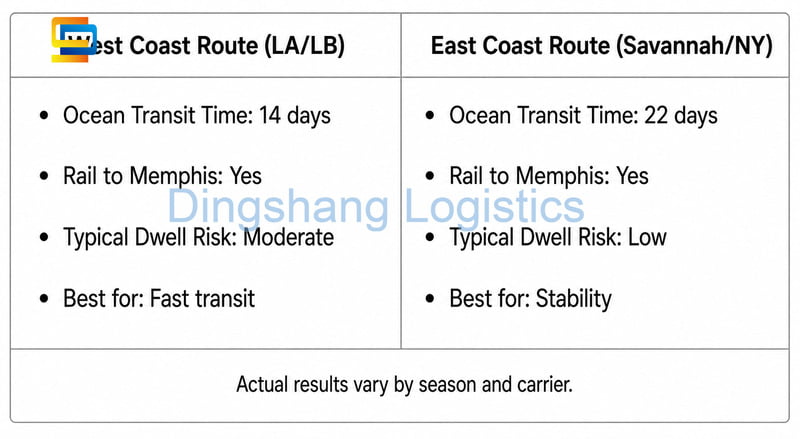
Routing Decision Matrix
This table is a practical planning tool. Carrier names, rail lanes, and allocations change, so every lane must be verified at booking.
| Gateway Route | IPI Rail Option | Drayage Mode | When to Use | When to Avoid |
|---|---|---|---|---|
| LA/LB → Memphis | BNSF or UP, subject to carrier routing | Live unload or drop trailer if available | Good sailing frequency from China, often faster ocean transit, strong option when rail allocation is stable | Avoid during severe West Coast congestion, chassis shortages, labor disruption, or high rail dwell |
| Savannah → Memphis | Carrier-selected rail service | Local drayage from Memphis ramp | Useful when East Coast service is stable and West Coast risk is high | Avoid during hurricane disruption, terminal backlog, or weak inland rail availability |
| New York/New Jersey → Memphis | Carrier-selected rail service | Local drayage from Memphis ramp | Useful for some East Coast contracts and when northeast gateways have better schedule integrity | Avoid during winter weather, terminal congestion, or longer inland complexity |
| Premium all-water + rail plan | Confirmed with carrier before booking | Pre-scheduled delivery | Useful for high-value or time-sensitive B2B cargo where predictability matters more than lowest rate | Avoid if the importer only wants the lowest freight number and cannot commit to delivery appointments |
West Coast Route: LA/LB to Memphis
For many China-origin shipments, Los Angeles/Long Beach is the first option to review. It has high sailing frequency from Ningbo, Shanghai, Shenzhen, and Qingdao. In normal conditions, the ocean leg can be shorter than all-water East Coast services.
I often consider this route when:
- The importer wants faster transit potential.
- The ocean carrier has confirmed IPI routing to Memphis.
- Rail allocation looks stable.
- The consignee can receive cargo shortly after rail arrival.
However, I do not choose it blindly. In a recent Memphis case, the West Coast ocean quote looked attractive, but rail dwell was the concern. The difference in ocean price was small compared with the possible cost of storage and delayed delivery. In that case, I showed the importer two scenarios: one with lower ocean cost and higher dwell risk, and another with higher base cost but better schedule stability. The importer chose the more stable option because the cargo supported a retail distribution schedule.
East Coast Route: Savannah or New York to Memphis
East Coast routes may work better when West Coast terminals are unstable or when the shipper’s supply chain favors all-water service. Savannah can be attractive for U.S. inland distribution in the Southeast. New York/New Jersey can also be useful depending on the carrier contract and sailing schedule.
These routes can win when:
- West Coast congestion is high.
- The all-water service has stable vessel performance.
- Rail connection to Memphis is confirmed.
- The importer has more flexible lead time.
- The cargo is less sensitive to a few extra transit days.
They can be weaker when weather, canal routing constraints, port congestion, or inland rail availability create uncertainty. The Panama Canal situation and seasonal weather can also affect service patterns4, so I always verify current carrier schedules before recommending a route.
Why IPI Rail Allocation Matters More Than a Small Ocean Rate Difference
A $200 lower ocean rate can look good on a spreadsheet. But it can disappear if the container sits at the gateway or Memphis ramp. Rail allocation, terminal dwell, and chassis access often decide the real outcome.
Key stability questions include:
- Does the ocean carrier offer direct IPI service to Memphis?
- Is the IPI destination listed correctly on the booking confirmation?
- What is the current rail dwell trend at the gateway?
- How many free days apply at the Memphis rail ramp?
- Is the delivery address inside the standard local zone?
My rule is simple: I compare total landed cost and service stability, not ocean freight alone.
What Does It Cost to Ship a Container from China to Memphis?
Cost surprises are common when importers receive only an ocean quote. The container still needs origin handling, destination rail, ramp services, chassis, fuel, delivery, and possible storage planning. If these items are missing, the landed cost estimate is not complete.
The cost to ship a container from China to Memphis should be calculated across the full chain: China origin charges, ocean freight, IPI rail, customs charges, local drayage.
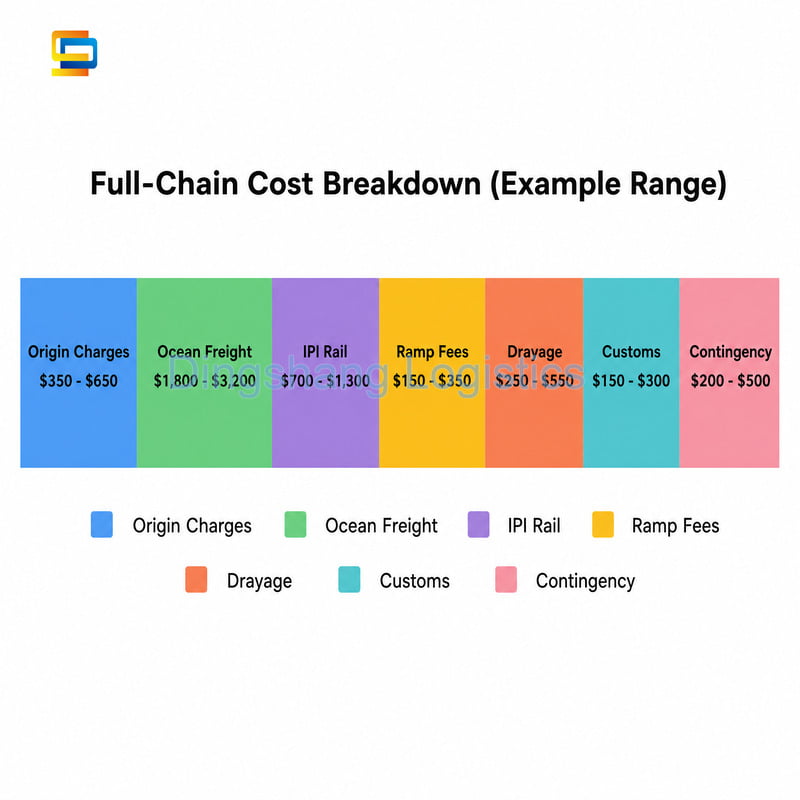
Full-Chain Cost Framework
A proper Memphis quote should show the main cost layers. Some items may be bundled, but they should still be understood.
| Segment | Common Cost Items | Why It Matters |
|---|---|---|
| China origin | Trucking, export customs, document fee, terminal handling charge | Depends on factory location, port, and Incoterms |
| Ocean freight | Base ocean rate, bunker/fuel adjustments, peak season charges | Changes by season and carrier allocation |
| U.S. gateway | Terminal handling, port-related surcharges if applicable | May be bundled in carrier rate |
| IPI rail | Inland rail add-on, rail fuel, carrier intermodal cost | Critical for Memphis inland movement |
| Memphis ramp | Rail storage, ramp handling, lift/flip if needed | Free time must be tracked |
| Local delivery | Drayage, chassis, fuel surcharge, wait time, layover | Depends on distance and appointment conditions |
| Risk charges | Demurrage, detention, storage, pre-pull, yard storage | Usually preventable with planning |
| Customs and duties | Customs entry, duties, taxes, exams if any | Broker must confirm requirements |
Example 20GP Full-Chain Cost Breakdown
The following is an example only and subject to verification. It is not a live quote. Actual rates depend on season, carrier, port pair, commodity, weight, delivery ZIP code, free time, and customs status.
| Cost Item | Example Range, USD | Notes |
|---|---|---|
| China origin charges | $350–$650 | Varies by port and Incoterms |
| Ocean freight to U.S. gateway | $1,200–$2,800 | Highly seasonal |
| IPI rail to Memphis | $900–$1,800 | Carrier and allocation dependent |
| Destination documentation/admin | $100–$250 | Depends on service provider |
| Memphis local drayage | $500–$1,100 | Depends on distance and live unload time |
| Chassis and fuel surcharge | $150–$450 | Market dependent |
| Customs entry service | $120–$250 | Broker charge, excluding duties |
| Duties/taxes | To be confirmed | Based on HTS classification |
| Contingency for storage/D&D | $0–$800+ | Avoidable with planning |
Example planning total before duties: $3,320–$8,100+
Example 40HQ Full-Chain Cost Breakdown
This example is also subject to verification. A 40HQ often offers better cost per cubic meter than a 20GP, but only if cargo volume supports it.
| Cost Item | Example Range, USD | Notes |
|---|---|---|
| China origin charges | $450–$800 | Higher trucking may apply for distance or weight |
| Ocean freight to U.S. gateway | $1,600–$3,800 | Depends on market cycle |
| IPI rail to Memphis | $1,100–$2,200 | Must confirm rail destination |
| Destination documentation/admin | $100–$300 | Provider dependent |
| Memphis local drayage | $550–$1,250 | Delivery ZIP code matters |
| Chassis and fuel surcharge | $180–$500 | Based on days and local market |
| Customs entry service | $120–$250 | Broker charge, excluding duties |
| Duties/taxes | To be confirmed | Importer and broker must verify |
| Contingency for storage/D&D | $0–$1,000+ | Can rise fast if pickup is delayed |
Example planning total before duties: $4,100–$10,100+
Main Cost Drivers for Memphis Shipments
The largest differences usually come from five areas.
-
Gateway choice
LA/LB may have different ocean and rail economics than Savannah or New York. -
Rail carrier availability
Rail allocation can change the service result more than the base ocean rate. -
Free time terms
Free time means the allowed time before storage, demurrage, or detention charges start.5 It must be confirmed in writing. -
Weekend and holiday arrivals
A Friday rail arrival can trigger storage risk if the ramp or warehouse cannot support pickup. -
Delivery appointment constraints
Warehouses with limited receiving hours create wait time, dry run, or storage exposure.
20GP vs. 40HQ for Memphis
For B2B importers, I usually compare container choice by cubic capacity and weight.
| Container Type | Typical Use | Planning Note |
|---|---|---|
| 20GP | Heavy cargo, smaller volume, dense goods | Can hit weight limits before volume is full |
| 40HQ | Lighter bulky goods, larger volume | Often better unit freight cost if volume is enough |
| LCL | Small orders that do not fill a container | May cost more per CBM and has more handling points |
A 40HQ is often economical for wholesalers with regular China purchases. But I still check cargo weight, supplier loading ability, delivery appointment rules, and warehouse unloading time before recommending it.
How Can You Control Rail Storage, Demurrage, and Detention in Memphis?
A Memphis shipment can be perfectly routed and still become expensive at destination. The risk appears when customs release, rail arrival, drayage, and warehouse appointment do not line up. Storage and detention are not random. They are usually the result of weak timing control.
You control destination risk by pre-clearing with the broker, tracking rail arrival alerts, confirming free time, pre-scheduling drayage, preparing warehouse appointments, and using pre-pull when needed. For any ship a container from China to Memphis plan, the destination pickup process should be built before the container reaches the rail ramp.
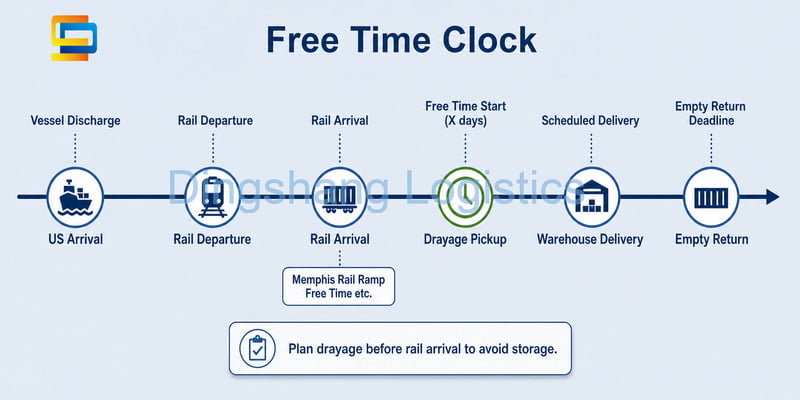
Free Time and Pickup Plan Template
Use this template before U.S. arrival.
| Item | Plan | Owner | Status |
|---|---|---|---|
| Customs broker assigned | Broker name and contact | Importer | Open / Done |
| ISF filed | Filing confirmation | Broker/importer | Open / Done |
| Customs entry prepared | Invoice, packing list, HTS, arrival data | Broker | Open / Done |
| Duties estimated | Amount and payment method | Importer/broker | Open / Done |
| Rail ramp free time confirmed | Number of free days | Forwarder | Open / Done |
| Container tracking enabled | Rail arrival alerts | Forwarder/drayage | Open / Done |
| Delivery appointment booked | Date and receiving hours | Importer | Open / Done |
| Drayage provider assigned | Trucking company and dispatch contact | Forwarder | Open / Done |
| Chassis plan checked | Standard or special chassis | Drayage | Open / Done |
| Pre-pull decision made | Yes/no, yard storage cost | Importer/forwarder | Open / Done |
| Empty return instruction | Return location and deadline | Forwarder/drayage | Open / Done |
Demurrage, Detention, and Rail Storage in Plain English
These terms are often mixed together.
- Demurrage usually relates to container use or storage while the container is still at a terminal or controlled facility.
- Detention usually relates to keeping the container outside the terminal beyond allowed free days.
- Rail storage usually applies when a container sits at the inland rail ramp after free time expires.
- Pre-pull means the trucker pulls the container from the ramp and stores it at a yard before final delivery.
- Flip means the container may need to be moved or lifted for access, depending on terminal conditions.
Exact definitions and billing rules vary by carrier, terminal, rail ramp, and contract. They must be verified for each shipment.
How I Reduce Destination Fee Risk
In one Memphis case, a container arrived near a weekend, and the consignee could not receive until Tuesday. Storage would have started if the container stayed at the ramp. We arranged a pre-pull to a local yard. The pre-pull cost was not free, but it was lower than the expected rail storage plus appointment risk.
In another case, a customs document mismatch delayed release. The importer assumed “door-to-door” meant every customs responsibility was removed. It did not. We worked with the broker to correct documents, but the delay showed why importer data must be accurate before loading.
I use these control steps:
- Ask the broker to review HTS and duty exposure early.
- Track vessel discharge and rail loading.
- Confirm warehouse receiving hours.
- Check if weekend arrival creates storage risk.
- Use pre-pull if the ramp clock is more expensive than yard storage.
- Return the empty container before detention expires.
DDP Misconceptions for Memphis Importers
Some importers ask for “DDP” because they want one simple price. I understand why. But an all-in commercial quote does not remove every importer responsibility.
The importer still needs to ensure:
- The product description is accurate.
- The HTS classification is reviewed by a qualified customs broker.
- Duties and taxes are understood.
- The Importer of Record role is clear.
- ISF responsibility is assigned.
- Product compliance requirements are checked where applicable.
I can help coordinate freight, IPI rail, customs clearance communication, duty handling arrangements, and door delivery for B2B shipments. However, customs classification and legal import compliance should be confirmed by a licensed customs broker or qualified professional.
What Should You Ask Before Booking a Memphis Rail Ramp Shipment?
A vague quote can make every forwarder look similar. The problem appears later, when one quote excludes rail, another excludes drayage, and another hides free time limits. A good checklist turns the quote comparison into a fair decision.
Before you ship a container from China to Memphis, ask your forwarder about gateway routing, IPI rail inclusion, free time, customs coordination, destination charges, drayage coverage, storage risk, and empty return rules. The goal is to normalize all quotes into the same full-chain scope.
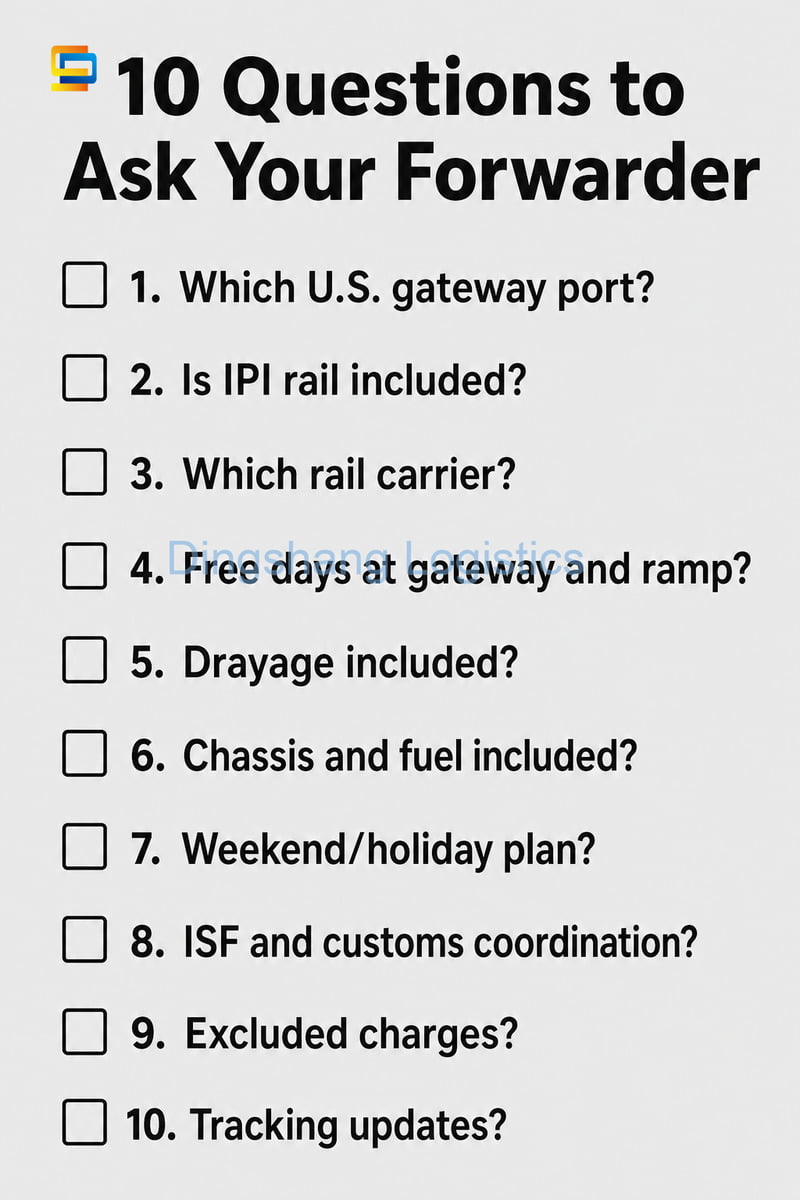
10 Questions to Ask Your Forwarder
Use these questions before you approve a booking.
-
Which U.S. gateway port will the container use?
Ask whether it is LA/LB, Savannah, New York, or another gateway. -
Is IPI rail to the Memphis rail ramp included?
The answer should be clear on the quote. -
Which rail service is expected?
The forwarder may not always control the final rail operator, but they should explain the planned path. -
How many free days apply at the gateway and Memphis ramp?
Normally 1-2 days. -
Does the quote include local drayage to my door?
Provide the full delivery address. -
Are chassis, fuel, waiting time, and appointment fees included?
These are common local cost differences. -
What happens if the container arrives on a weekend or holiday?
Ask about pre-pull options and yard storage. -
Who handles ISF and customs clearance coordination?
Confirm the customs broker and importer responsibility. -
What charges are not included?
Ask directly about exams, storage, demurrage, detention, re-delivery, layover, and empty return issues. -
How will I receive tracking updates?
Ask for vessel, rail, ramp, and drayage milestones.
Quote Normalization Table
I recommend comparing quotes like this:
| Quote Item | Forwarder A | Forwarder B | Forwarder C |
|---|---|---|---|
| China port of loading | |||
| U.S. gateway port | |||
| IPI rail to Memphis included | |||
| Memphis local drayage included | |||
| Customs clearance included | |||
| Duties/taxes included or estimated | |||
| Free time stated | |||
| Chassis/fuel included | |||
| Storage/D&D excluded | |||
| Total scope |
This table often reveals why one quote is cheaper. It may exclude the most important inland pieces.
Frequently Asked Questions
Is Memphis a seaport for container shipping from China?
No. Memphis should be treated as an inland rail ramp destination, not a seaport. A container usually moves from China to a U.S. gateway seaport, then by IPI rail to Memphis, then by local drayage to the final warehouse.
How long does it take to ship a container from China to Memphis?
Transit time depends on origin port, gateway port, vessel schedule, rail allocation, customs status, and drayage appointment. West Coast routing may be faster in some cases, while East Coast routing may be more stable in others. Every schedule should be verified at booking.
Is 40HQ better than 20GP for Memphis imports?
A 40HQ often has a lower freight cost per cubic meter when the cargo volume is high enough. A 20GP may be better for dense or heavy cargo. I compare weight, volume, supplier loading, inland limits, and warehouse unloading before recommending container size.
Can I book DDP shipping from China to Memphis?
You can request a door-to-door or duty-handling arrangement, but DDP does not erase importer responsibilities.6 ISF data, correct product descriptions, HTS classification, duties, and compliance still need proper review.
How can I avoid rail storage at the Memphis ramp?
You can reduce rail storage risk by filing ISF on time, preparing customs entry early, tracking rail arrival, booking drayage before arrival, confirming warehouse appointments.
Conclusion
To ship a container from China to Memphis, I plan the full inland route, not just the ocean leg. Memphis is an inland rail ramp destination, so the right decision combines the China loading port, U.S. gateway, IPI rail service, customs timing, free time, and final drayage. Rates and schedules must be verified for each shipment. If you import B2B cargo from China to the U.S., Dingshang Logistics can help compare full-chain routes, prepare transparent all-in options, and coordinate door delivery to Memphis.
Related Shipping Guides
- How to Ship a Container from China to Port of Chicago
- How to Ship a Container from China to Port of Kansas?
- How to Ship a Container from China to Port of Dallas
- Sea Freight Transit Time from China to USA in 2026: How Long Does It Really Take?
- What Are You Really Paying to Ship a Container From China?
- How Container Shipping Works From China To USA?
"Intermodal Transportation Database", https://www.bts.gov/browse-statistical-products-and-data/statistical-products/intermodal-transportation-database. A transportation agency source should be cited to document the intermodal mechanism by which ocean containers move from seaports to inland rail terminals and then by truck drayage to final destinations. Evidence role: mechanism; source type: government. Supports: International containers can move through a gateway port and continue inland by rail and truck as an intermodal chain.. Scope note: The source would support the general logistics mechanism, not guarantee that every China-to-Memphis shipment follows this exact sequence. ↩
"Intermodal Transportation Database", https://www.bts.gov/browse-statistical-products-and-data/statistical-products/intermodal-transportation-database. An authoritative logistics glossary or transportation institution should be cited for the definition of IPI as Inland Point Intermodal in containerized freight movements. Evidence role: definition; source type: institution. Supports: The term IPI is used in freight transportation to mean Inland Point Intermodal.. ↩
"Port Performance Freight Statistics: 2026 Annual Report", https://www.bts.gov/sites/bts.dot.gov/files/2026-01/BTS_Port-Performance-2026_Annual-Report_Final%2011326.pdf. A U.S. transportation statistics source should be cited to identify Los Angeles/Long Beach, New York/New Jersey, and Savannah as major container gateways relevant to inland intermodal routing. Evidence role: general_support; source type: government. Supports: Los Angeles/Long Beach, New York/New Jersey, and Savannah are major U.S. container gateways with inland freight connections.. Scope note: Such a source supports their gateway status, but current carrier routings and rail allocations still require shipment-specific verification. ↩
"National Hurricane Center - NOAA", https://www.nhc.noaa.gov/. A Panama Canal Authority, NOAA, or similar institutional source should be cited to support the point that canal operating constraints and seasonal weather can affect vessel movements and service planning. Evidence role: general_support; source type: institution. Supports: Panama Canal operating conditions and seasonal weather can influence vessel routing, transit reliability, or port operations.. Scope note: This is contextual support for routing risk; it does not establish the impact on any specific China-to-Memphis booking. ↩
"Detention and Demurrage", https://www.fmc.gov/detention-and-demurrage/. Federal Maritime Commission guidance should be cited to support the definition of free time as the allowed period before demurrage, detention, or related container-use charges begin. Evidence role: definition; source type: government. Supports: Free time refers to the period allowed before demurrage, detention, or similar container-use charges accrue.. Scope note: Exact free-time periods and charge triggers depend on the applicable tariff, terminal rules, carrier terms, and contract. ↩
"Tariff Classification", https://www.cbp.gov/sites/default/files/documents/icp017r2_3.pdf. U.S. Customs and Border Protection guidance should be cited to support that importers retain responsibility for reasonable care in classification, valuation, duty assessment, and compliance information, even when commercial delivery terms allocate costs differently. Evidence role: expert_consensus; source type: government. Supports: U.S. importers are responsible for exercising reasonable care in classification, valuation, duty payment, and compliance information submitted to CBP.. Scope note: The specific responsibilities under a DDP sale depend on the contract, the importer of record arrangement, and applicable customs law. ↩
Leave a Comment