
When Should I Choose FCL Instead of LCL?
Choosing FCL instead of LCL should not be based on cargo volume alone. For China-to-USA ocean freight, FCL becomes worth serious consideration when the all-in LCL cost approaches the cost of a dedicated container, when the shipment is sensitive to additional handling, or when delivery timing and control matter more than the lowest initial freight line.
Choose FCL instead of LCL when a full-container quote provides better total delivered value after you compare origin charges, ocean freight, destination handling, customs-related costs, inland transportation, and delivery requirements. LCL remains practical for smaller shipments when its all-in cost is clearly lower and the cargo can tolerate consolidation and deconsolidation.
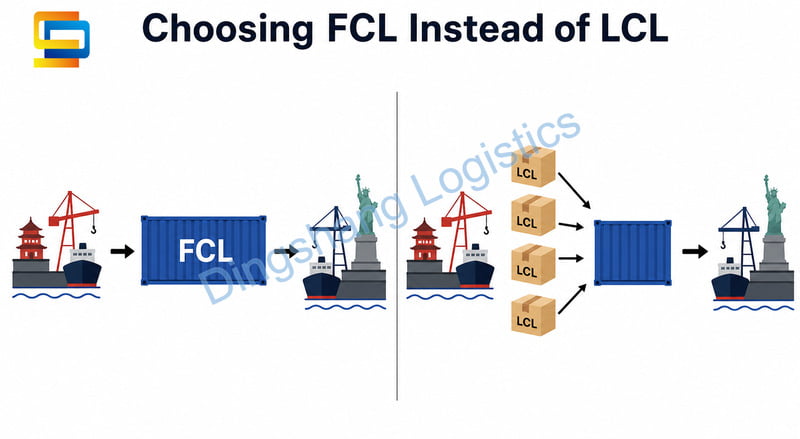
The important question is not simply, “How many CBM do I have?” It is, “Which option gives my shipment the better balance of total cost, handling exposure, timing, and delivery control?”
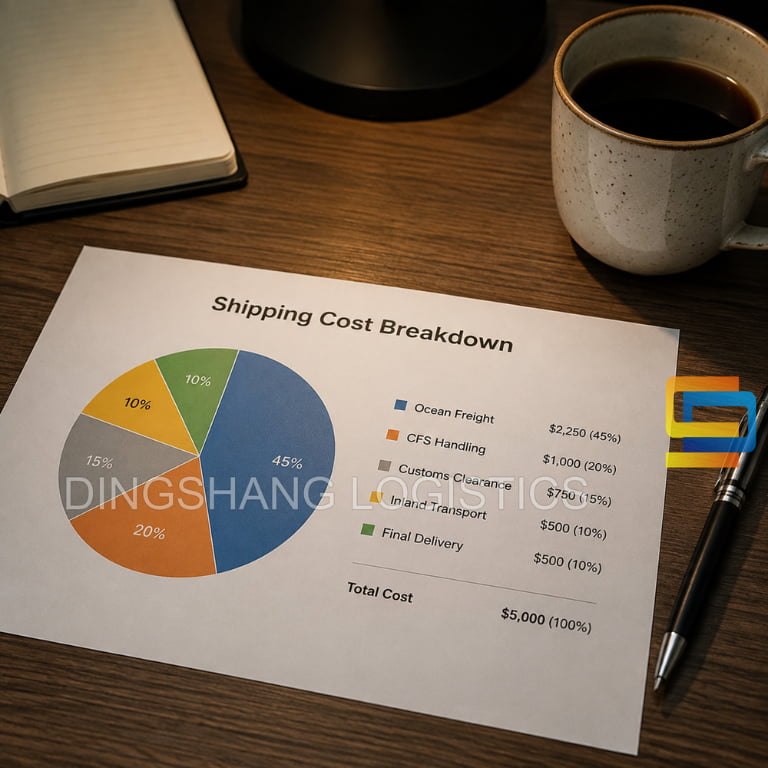
That distinction matters because ocean freight is not the same as total delivered logistics cost. An LCL ocean-freight line can look attractive while destination handling and final delivery materially change the comparison.
Why Is Choosing FCL Instead of LCL a Total Cost Decision?
Choosing FCL instead of LCL is a total cost decision because the two modes have different charging structures and handling processes. LCL normally includes cargo-level receiving, consolidation, deconsolidation, CFS handling, and subsequent delivery arrangements, while FCL is priced around a dedicated container. The correct comparison is therefore LCL door-to-door versus FCL door-to-door under the same shipment scope.
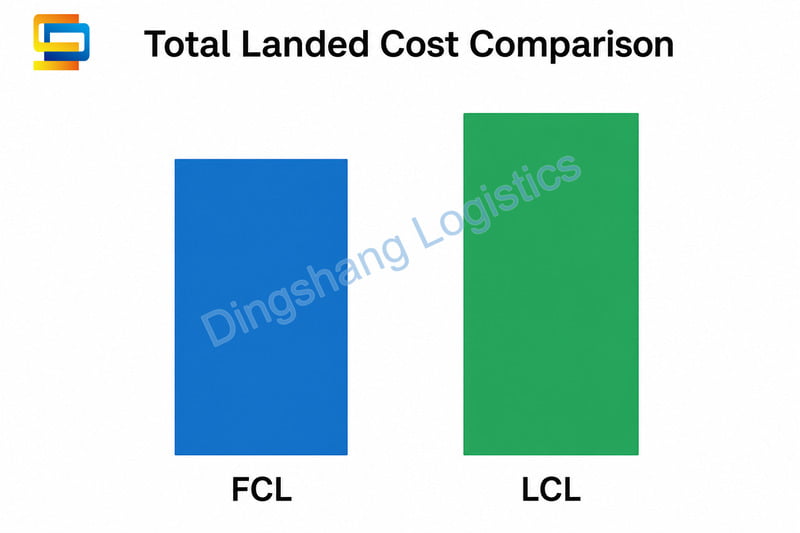
Do not start with a fixed CBM rule
There is no universal CBM point at which every China-to-USA shipment should switch from LCL to FCL.
The economics change with:
- Cargo volume and gross weight
- Carton or pallet configuration
- Origin pickup location in China
- China loading port
- U.S. gateway and final destination
- Destination CFS and handling charges
- Final-mile transportation
- Cargo density and stackability
- Shipment timing
- Actual FCL and LCL market pricing at the time of booking
For example, the same cargo volume delivered near a coastal gateway and delivered to an inland U.S. warehouse can produce very different LCL-versus-FCL economics because inland transportation and handling are part of the total cost.
If you are evaluating the complete cost structure, see what you are really paying to ship a container from China.
The issue is incomplete comparison, not automatically “hidden fees”
LCL is not inherently expensive, and destination charges are not automatically improper or hidden. The problem occurs when an importer compares an LCL ocean-freight line with an FCL quote that covers a broader scope.
Compare equivalent scopes instead:
| Cost Area | LCL | FCL | What to Check |
|---|---|---|---|
| China pickup | Per shipment or cargo lot | Per container/shipment | Same pickup location |
| Origin handling | Consolidation-related handling may apply | Container-related handling applies | What is included |
| Ocean freight | Usually based on cargo measurement/weight under the tariff or quote | Container-based | Current quote basis |
| U.S. destination handling | CFS/deconsolidation charges may apply | Different container-terminal cost structure | Itemized destination charges |
| Customs-related services | Depends on quote scope | Depends on quote scope | Brokerage and exam costs |
| Inland delivery | Cargo/LTL delivery may apply | Container drayage, rail, transload, or trucking may apply | Final ZIP and receiving requirements |
| Storage/accessorials | Possible if cargo is not collected promptly | Possible if container or equipment exceeds applicable free time | Terms and responsibility |
World Bank trade-cost methodology illustrates why international freight should be evaluated beyond a single transportation line: import costs can involve documentation, customs procedures, terminal handling, and inland transportation.1
Compare the same door-to-door scope
A useful comparison is:
- Request an LCL quote to the actual U.S. delivery address.
- Request an FCL quote to the same delivery address.
- Make sure both quotations include the same origin and destination services.
- Separate freight and handling costs from duties, taxes, exams, storage, and other conditional charges.
- Compare timing, handling exposure, and receiving requirements in addition to price.
If the all-in difference becomes small, the operational advantages of a dedicated container may become more important.
For importers who need a broader explanation of the shipment flow, how container shipping works from China to the USA explains the main stages from origin through U.S. delivery.
When Does FCL Instead of LCL Make Sense for U.S. Inland Delivery?
FCL can become more attractive for an inland U.S. destination when LCL deconsolidation, cargo-level delivery, and additional handoffs materially increase the delivered cost or operational complexity. The result depends on the actual gateway, routing, shipment size, destination ZIP code, receiving facility, and current rail or trucking options.
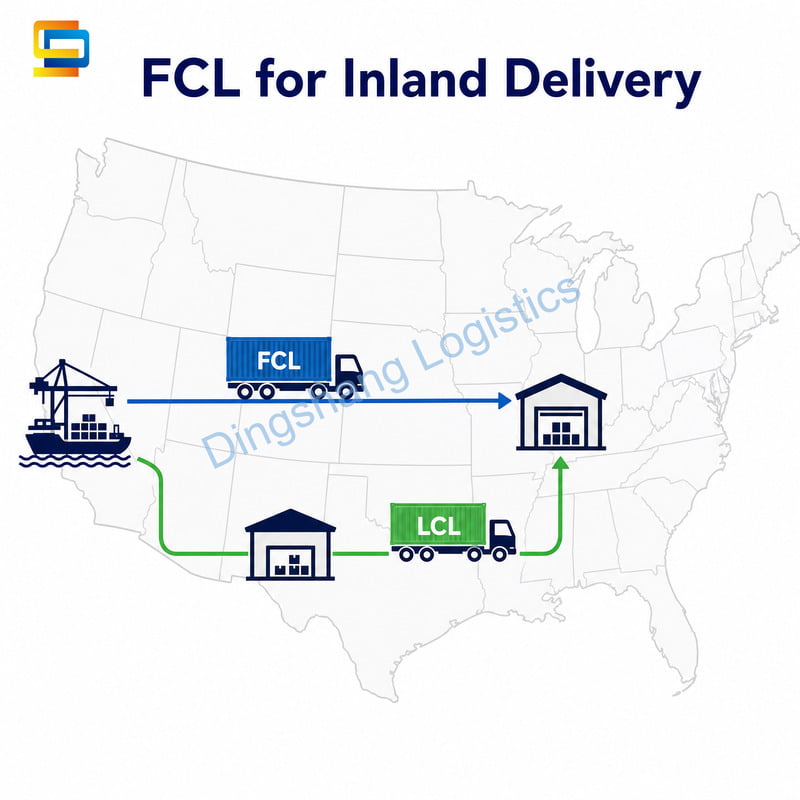
LCL cargo normally has a deconsolidation step
For a typical consolidated LCL movement, the shared container must be unpacked so individual consignments can be released for subsequent transportation.
U.S. regulations specifically provide for containerized cargo to move to a container station for the purpose of “breaking bulk and redelivery.”2 This is an important operational distinction between LCL and a dedicated FCL container.
A simplified LCL flow can look like:
- Supplier pickup or delivery to the origin consolidation facility
- Cargo receiving and measurement
- Consolidation
- Container loading
- Ocean transportation
- Container unloading/deconsolidation
- Individual shipment release
- Final inland transportation
The exact process varies by provider and routing.
Why inland destinations can change the comparison
Suppose the final destination is Dallas, Chicago, Kansas City, Memphis, Cleveland, or another inland market. The importer should not compare only the ocean portion of the shipment.
The relevant question is what happens after the cargo reaches the U.S. gateway.
For LCL, that can involve CFS release followed by cargo-level trucking or another inland arrangement. For FCL, the container may move inland by truck, rail intermodal, or a combination of modes where available under the booked service.
Rail intermodal is a major part of the U.S. freight system: the Bureau of Transportation Statistics describes rail intermodal traffic as shipping containers and trailers moving on rail cars.3 However, the existence of rail infrastructure does not mean that every container, carrier, gateway, or inland destination has a suitable through-rail option. Routing should be confirmed for the actual booking.
For example, an importer evaluating an inland Texas shipment can also review the guide to shipping a container from China to Dallas.
LCL destination costs to check
Ask specifically whether the LCL quotation includes or excludes:
- Destination CFS charges
- Deconsolidation and handling
- Documentation or release charges
- Customs brokerage, if requested
- Customs exam-related charges, if incurred
- Storage if cargo is not collected within applicable free time
- Final-mile delivery
- Delivery appointment charges
- Liftgate or limited-access service, if required
- Other applicable accessorial charges
Do not assume every provider uses the same charge names or billing structure.
FCL can simplify the cargo unit, but not necessarily the entire delivery
FCL keeps the shipment in a dedicated container during the containerized portion of the movement. That can reduce cargo-level consolidation and deconsolidation compared with LCL.
But FCL does not automatically mean direct container delivery to your warehouse.
Your receiving location may require transloading if it cannot accept or unload an ocean container. Inland rail service may also end at a rail ramp, after which drayage or another truck move is still required.
An inland rail ramp is not the same as door delivery. A container arriving at an inland rail terminal still needs a final transportation plan to reach the consignee's warehouse.
Before choosing FCL for an inland shipment, confirm:
| Question | Why It Matters |
|---|---|
| What is the final ZIP code? | Determines the actual inland delivery market |
| Can the facility receive an ocean container? | Determines whether direct container delivery is practical |
| Does the warehouse have unloading equipment? | Affects delivery planning |
| Is an appointment required? | Can affect scheduling and accessorial costs |
| Is transloading required? | Adds another handling and transportation step |
| Is rail part of the proposed route? | Must be confirmed for the actual service |
| How quickly can the container be unloaded? | Relevant to equipment-return planning |
How Do Cargo Value, Fragility, and SKU Mix Affect Choosing FCL Instead of LCL?
High-value, fragile, non-stackable, retail-ready, or complex multi-SKU cargo can strengthen the case for FCL because LCL normally involves cargo-level consolidation and deconsolidation. FCL does not eliminate damage or shortage risk, but a dedicated container can reduce some cargo-handling interfaces and provide greater control over the loading arrangement.
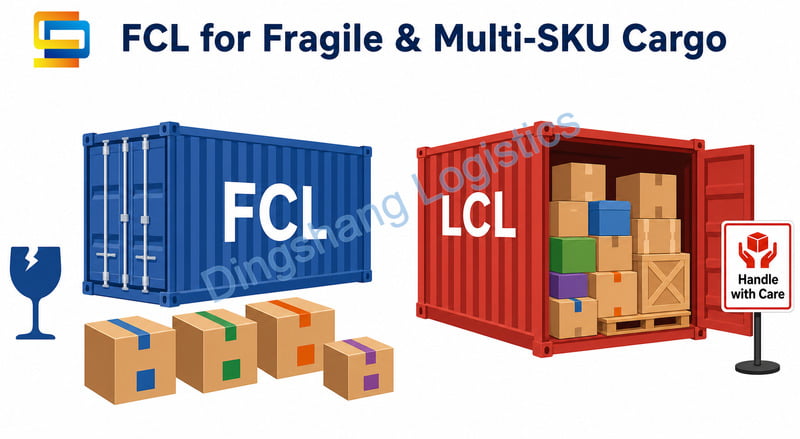
LCL involves additional cargo-level handling
The main operational difference is simple:
FCL: your shipment uses a dedicated container.
LCL: your shipment is handled as part of a consolidated container with other cargo.
Federal Maritime Commission regulations specifically address co-loading of less-than-container-load cargo among NVOCCs, reflecting the consolidated nature of LCL transportation arrangements.4
That does not make LCL unsafe. It means packaging and handling tolerance deserve more attention.
When cargo characteristics may outweigh the lowest freight quote
Review FCL more carefully when your shipment contains:
- Fragile products
- High-value inventory
- Retail-ready cartons that must remain presentable
- Many SKUs requiring controlled loading
- Non-stackable cargo
- Irregular or difficult-to-handle packages
- Weak export cartons
- Seasonal inventory with a firm commercial deadline
- Cargo for a receiving operation that depends on a specific unloading sequence
Packaging remains important regardless of mode. NIST transportation research identifies handling shock, vibration, vehicle impact, and compression from stacking among the hazards that transport packaging may need to withstand.5
FCL reduces some handling interfaces compared with a typical LCL process, but it does not remove transportation risk. Packaging, loading, cargo securing, customs status, terminal handling, inland transportation, and warehouse unloading still matter.
FCL gives you more control over container loading
A dedicated container can make it easier to plan:
- Pallet or carton sequence
- SKU separation
- Carton-mark visibility
- Pallet labels
- Loading photos
- Load distribution
- Receiving sequence at destination
This can be useful for wholesale inventory with many SKUs or for a warehouse that wants cargo arranged around its receiving process.
However, container loading must also account for cargo weight, weight distribution, securing, and the practical requirements of inland transportation. A container's physical payload capability should not be confused with what can legally or operationally move over the planned U.S. inland route.
Cargo-type decision table
| Cargo Profile | LCL | FCL Consideration |
|---|---|---|
| Small volume, strong cartons, flexible timing | Often suitable | Compare only if FCL economics become reasonable |
| Fragile products | Requires strong packaging and careful handling | Fewer cargo-level handling interfaces may help |
| Multi-SKU wholesale order | Practical with accurate labels and packing lists | Dedicated loading can simplify receiving |
| Dense/heavy cargo | Weight-based pricing and handling matter | Check container and inland weight constraints |
| Non-stackable cargo | Space utilization can increase LCL cost | Dedicated space may be useful |
| Seasonal inventory | Consider schedule and handling risk | More control may justify higher cost |
| Retail-ready packaging | Extra handling exposure matters | Dedicated loading may protect presentation |
When Should I Still Use LCL Instead of FCL?
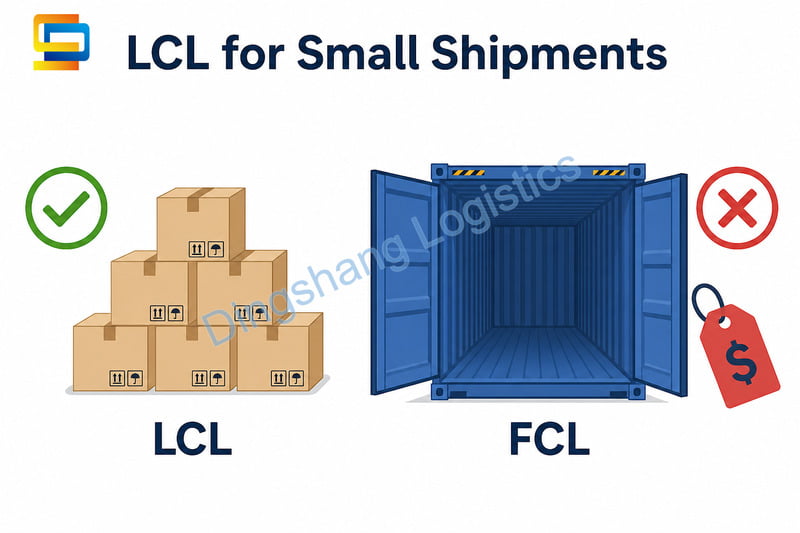
Use LCL when the shipment is relatively small, the all-in LCL cost remains meaningfully below FCL, and the cargo can tolerate consolidation, deconsolidation, and a less direct handling process. LCL is especially useful for trial orders, smaller replenishment shipments, and importers who do not have enough cargo to use a dedicated container efficiently.
LCL avoids paying for unused container space
A small shipment normally does not justify paying for an entire container solely to reduce handling.
For a few cartons or pallets, LCL allows the importer to buy cargo space within a consolidated movement rather than dedicating a complete 20GP or 40HQ to the order.
That can make sense for:
- Trial orders
- New supplier orders
- Small wholesale replenishment
- Low-volume products
- Inventory testing
- Flexible purchasing programs
LCL works better when timing is flexible
LCL requires consolidation and deconsolidation, so its shipment process differs from a dedicated FCL movement.
That does not justify assuming a fixed number of additional transit days. Actual timing depends on cargo-ready dates, consolidation schedules, vessel schedules, transshipment where applicable, U.S. cargo availability, customs status, and final delivery arrangements.
If delivery timing is important, compare the complete planned lead time rather than assuming FCL or LCL will always be faster.
For more detail, see the guide to China-to-USA sea freight transit time.
A good LCL candidate usually has these characteristics
- Smaller shipment volume
- Strong export packaging
- Straightforward SKU identification
- Flexible receiving schedule
- No unusual handling requirement
- Commercial delivery location
- All-in LCL cost clearly below FCL
- Ability to accept the normal LCL consolidation process
Do not choose FCL just for comfort
FCL offers greater control over the containerized shipment unit, but that control has a cost.
If your shipment is small, well packed, non-urgent, and inexpensive to move by LCL after destination charges are included, paying for a mostly empty container may not make commercial sense.
The objective is not to choose FCL whenever possible. It is to choose the mode that provides the best overall result for the shipment.
How Should I Compare FCL and LCL Quotes?
Compare FCL and LCL using the same origin, destination, service scope, cargo details, and customs assumptions. An LCL port quote and an FCL door-to-door quote are not comparable. Ask each provider to identify what is included, what is excluded, and which charges are conditional.
A practical comparison looks like this:
| Comparison Point | LCL Quote | FCL Quote |
|---|---|---|
| China pickup included? | Confirm | Confirm |
| Export handling included? | Confirm | Confirm |
| Ocean freight included? | Confirm | Confirm |
| Destination handling included? | Confirm | Confirm |
| Customs brokerage included? | Confirm | Confirm |
| Duties/taxes included? | Do not assume | Do not assume |
| Customs exam charges? | Usually conditional | Usually conditional |
| Inland transportation included? | Confirm destination | Confirm destination |
| Delivery appointment/accessorials? | Confirm | Confirm |
| Storage/free-time exposure? | Confirm applicable terms | Confirm applicable terms |
| Final delivery point | Exact ZIP/address | Exact ZIP/address |
Ocean freight is not total delivered cost
This distinction is one of the most important parts of an FCL-versus-LCL comparison:
Ocean freight ≠ port-to-port cost ≠ inland transportation cost ≠ door-to-door logistics cost.
Duties and taxes should also be separated from transportation charges unless the quotation specifically states how they are being handled.
If you are new to the import process, how to import products from China to the USA step by step provides a broader view of the shipment and import workflow.
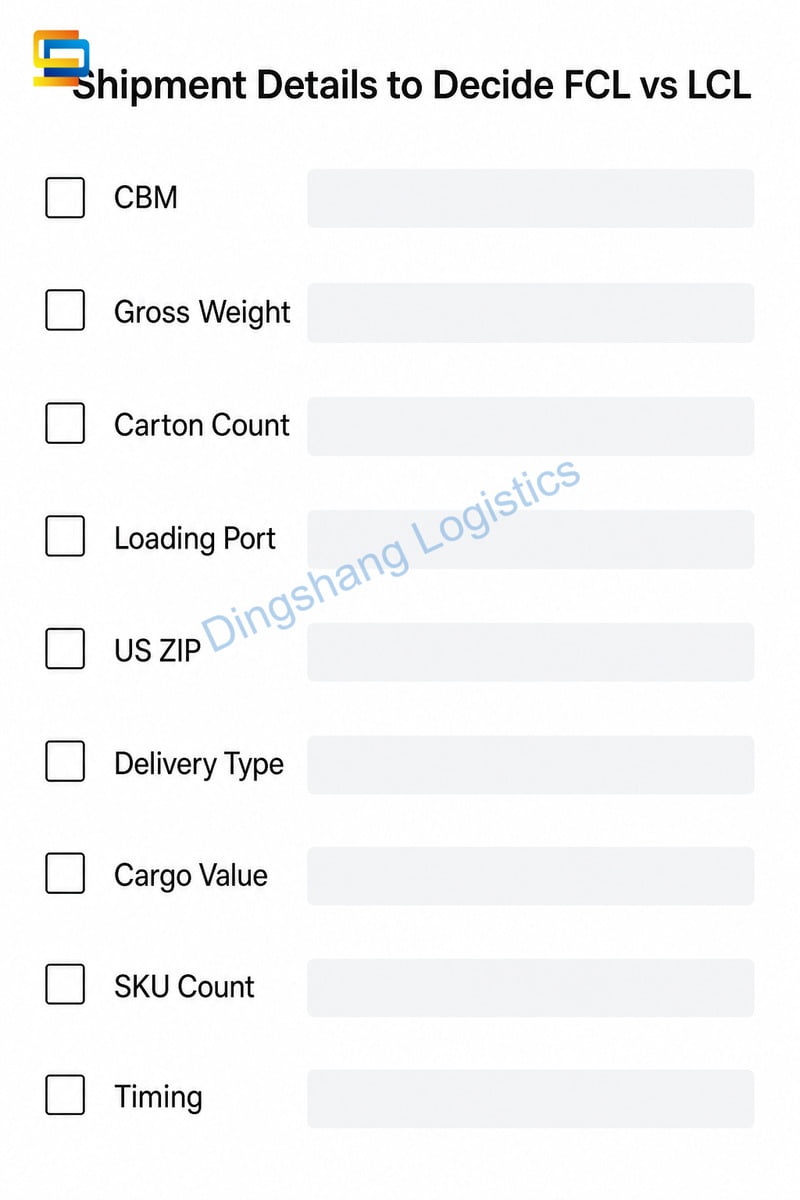
To compare FCL and LCL accurately, provide the forwarder with cargo volume, gross weight, package details, China pickup location, U.S. delivery ZIP code, cargo-ready date, product information, and receiving requirements. CBM alone is not enough because weight, packaging, inland delivery, customs scope, and cargo characteristics can change the recommendation.
Information needed for an FCL comparison
For FCL, provide:
- Product name
- HS/HTS code, if available
- Product material
- Supplier or pickup location
- China port or Incoterm, if already agreed
- U.S. delivery ZIP code
- Preferred 20GP or 40HQ, if known
- Gross cargo weight
- Cargo-ready date
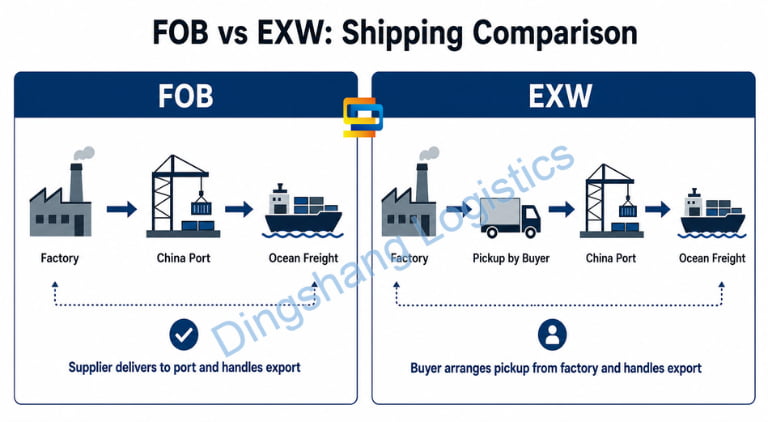
- FOB or EXW terms
- Customs-clearance requirements
- Special loading or unloading requirements
Information needed for an LCL comparison
For LCL, provide:
- Product name
- HS/HTS code, if available
- Product material
- Supplier or pickup location
- U.S. delivery ZIP code
- Number of cartons or pallets
- Package dimensions
- Total CBM
- Gross weight
- Cargo-ready date
- Stackable or non-stackable status
- Customs-clearance requirements
- Special delivery requirements
Accurate product descriptions also matter for import documentation. CBP states that brokers and importers should provide precise cargo descriptions that allow the agency to identify the characteristics of the merchandise.6
Define the delivery scope before requesting prices
“Shipping to the USA” is not a complete quotation scope.
Specify whether you need:
- Port-to-port ocean freight
- China pickup
- Export handling
- U.S. customs-clearance coordination
- Duty handling
- CFS or destination handling
- Inland rail, where suitable and available
- Inland trucking
- Transloading
- Warehouse appointment coordination
- Door-to-door delivery
The mode recommendation can change when the quote scope changes.
A forwarder should also be clear about its role. An NVOCC, for example, provides ocean transportation without operating the vessels used for that transportation, according to the Federal Maritime Commission.7
If you are comparing logistics providers as well as freight modes, review how to choose a freight forwarder in China.
FCL vs. LCL: Quick Decision Guide
| Situation | Usually Review First | Reason |
|---|---|---|
| Small, flexible shipment | LCL | Avoid paying for unused container capacity |
| LCL delivered cost approaching FCL | Compare both | FCL control may justify a small difference |
| Fragile or sensitive cargo | FCL | May reduce cargo-level handling interfaces |
| Complex multi-SKU shipment | Compare both | Receiving and loading control may matter |
| Inland U.S. destination | Compare door-to-door | Inland transportation can change the economics |
| Non-stackable cargo | Compare both | LCL chargeable space may increase |
| Urgent seasonal inventory | Compare complete lead time | Operational predictability may outweigh initial price |
| Warehouse cannot unload a container | LCL or FCL with transload | FCL requires a workable receiving plan |
The table is a screening tool, not a booking rule. The final decision should be based on the actual cargo and current quotations.
Frequently Asked Questions
Is there a fixed CBM point where I should switch from LCL to FCL?
No. There is no universal CBM threshold for switching from LCL to FCL. The break-even point changes with freight rates, cargo weight, origin and destination charges, U.S. inland delivery, packaging, and current service conditions. Compare equivalent all-in quotations rather than relying on a fixed volume rule.
Is LCL always cheaper than FCL?
No. LCL often requires less container capacity and can be economical for small shipments, but its delivered cost also includes cargo-level handling and inland delivery. As shipment size increases, the difference between LCL and a dedicated container can narrow. The actual result must be checked against current quotations.
Is FCL always faster than LCL from China to the USA?
No. FCL avoids the normal LCL consolidation and deconsolidation process, but total lead time still depends on origin handling, vessel schedules, transshipment where applicable, port conditions, customs status, inland transportation, and delivery appointments. Ocean transit is not the same as total door-to-door lead time.
Does FCL mean my container goes directly from the U.S. port to my warehouse?
Not necessarily. An FCL container may move by truck or rail after the ocean leg, depending on the routing and service. Some warehouses cannot receive an ocean container and require transloading. An inland rail ramp is also not the final warehouse, so final drayage or trucking may still be required.
Should I use FCL for fragile cargo?
FCL is worth considering for fragile cargo because a dedicated container can reduce some cargo-level handling compared with LCL. However, FCL does not eliminate damage risk. Export packaging, palletization where appropriate, cargo securing, load distribution, inland transportation, and unloading remain important.
Can I ship multiple SKUs in one FCL container?
Yes, multiple SKUs can be loaded in one FCL container, subject to normal cargo, customs, documentation, loading, and compatibility requirements. Clear carton marks, packing lists, SKU separation, and an organized loading plan can make destination receiving easier.
What information do I need for an accurate FCL vs. LCL quote?
Provide the product description, HS/HTS code if available, pickup location, U.S. delivery ZIP code, package count and dimensions, total CBM, gross weight, cargo-ready date, Incoterm, customs-clearance requirements, and any special handling or delivery requirements.
Get an FCL vs. LCL Comparison for Your Shipment
If you are deciding between LCL and a 20GP or 40HQ container from China to the United States, request both options under the same delivery scope.
For an accurate comparison, send Dingshang Logistics:
- Product name and material
- HS/HTS code, if available
- Supplier or pickup location in China
- FOB or EXW terms
- Carton or pallet quantity
- Package dimensions
- Total CBM
- Gross weight
- Cargo-ready date
- U.S. delivery ZIP code
- Cargo value
- Stackable, fragile, or special-handling status
- Customs-clearance requirements
- Warehouse unloading or appointment requirements
With those details, the shipment can be evaluated based on all-in cost, handling exposure, inland delivery, and operational requirements rather than a generic CBM cutoff.
References
[World Bank — Cost to Import Methodology](https://databank.worldbank.org/metadataglossary/doing-business/series/TRD.ACRS.BRDR.IMP.COST.CD.DB0615) ↩
[U.S. Government Publishing Office — 19 CFR § 19.41, Movement of Containerized Cargo to a Container Station](https://www.govinfo.gov/content/pkg/CFR-2023-title19-vol1/pdf/CFR-2023-title19-vol1-sec19-40.pdf) ↩
[Bureau of Transportation Statistics — Freight Rail Traffic: Intermodal Units](https://data.bts.gov/Research-and-Statistics/Freight-Rail-Traffic-Intermodal-Units/ejmp-u4kv) ↩
[Electronic Code of Federal Regulations — 46 CFR § 520.11, NVOCC Co-loading](https://www.law.cornell.edu/cfr/text/46/520.11) ↩
[National Institute of Standards and Technology — Damage Prevention in the Transportation Environment](https://nvlpubs.nist.gov/nistpubs/Legacy/SP/nbsspecialpublication652.pdf) ↩
[U.S. Customs and Border Protection — Precise Cargo Descriptions](https://www.help.cbp.gov/s/article/Article-1898) ↩
[Federal Maritime Commission — Ocean Transportation Intermediaries](https://www.fmc.gov/about/bureaus-offices/bureau-of-enforcement-investigations-and-compliance-beic/office-of-compliance/ocean-transportation-intermediaries/) ↩
Leave a Comment