
How Much Does a 20GP Container Cost from China to USA?
As of August 2026, the example 20GP routes in this guide range from approximately USD 4,500 to USD 7,500, depending on the route and service scope. A port-to-port rate should not be compared directly with a warehouse-delivery rate because the included transportation services are different.
For a U.S. importer, the number that matters is the total delivered logistics cost, not ocean freight alone. Final pricing depends on the origin, destination, cargo-ready date, commodity, gross weight, Incoterm, customs requirements, carrier and routing, and the exact service scope.
August 2026 20GP Shipping Cost Examples
| Route | Service Scope | Indicative 20GP Cost | Updated |
|---|---|---|---|
| Ningbo → Los Angeles | Port-to-port | USD 4,500–5,500 | August 2026 |
| Shanghai → New York | Port-to-port | USD 5,500–7,500 | August 2026 |
| Shenzhen → Los Angeles warehouse | Warehouse delivery | USD 4,800–6,200 | August 2026 |
| Qingdao → Houston warehouse | Warehouse delivery | USD 4,500–6,500 | August 2026 |
| Ningbo → Chicago warehouse | Ocean + inland warehouse delivery | USD 5,500–7,500 | August 2026 |
Important: These are August 2026 indicative planning ranges based on the pricing supplied for this guide. They are not long-term fixed rates or guaranteed quotations. The service scopes are different, so the prices should not be treated as equivalent offers. A current quote should be confirmed for the actual cargo-ready date, commodity, gross weight, Incoterm, customs requirements, carrier/routing, pickup location, delivery location, and included services.
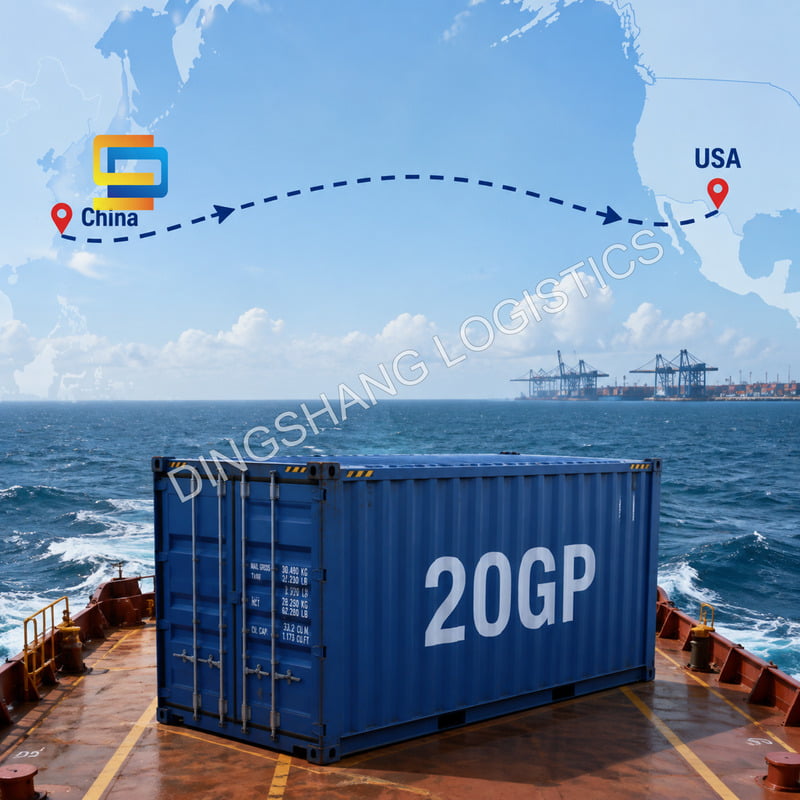
A useful 20GP quote should clearly separate included services from conditional or excluded costs. A low ocean-freight line can become an expensive delivered shipment if destination handling, customs services, chassis, inland transportation, or final delivery are outside the original quotation.
What Is Included in a 20GP Container Cost from China to USA?
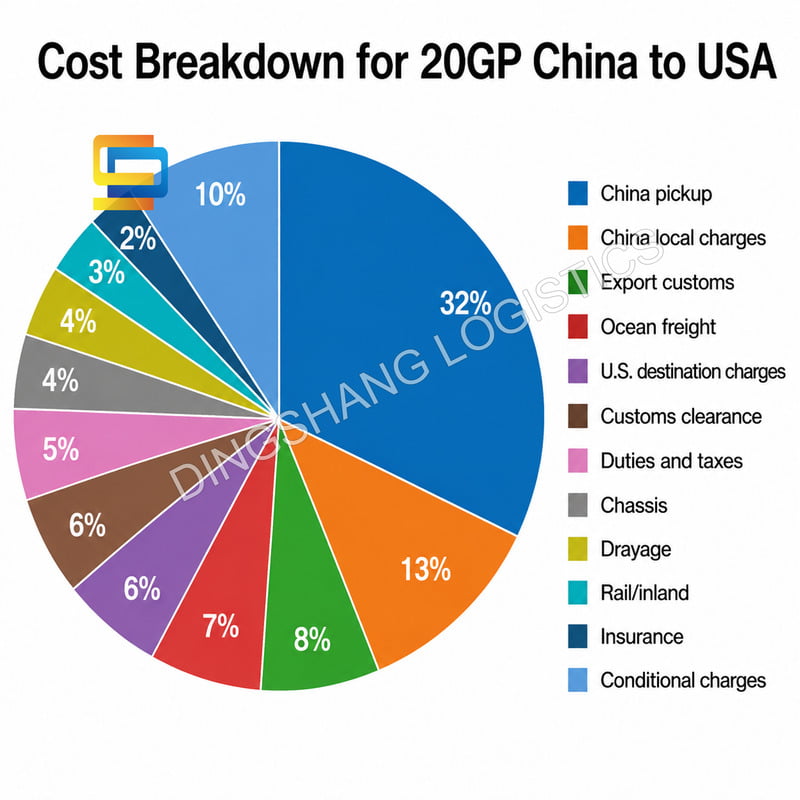
A 20GP shipping quote may include China origin services, ocean freight, U.S. destination handling, customs-clearance coordination, and inland delivery, depending on the service scope. Import duties, customs exams, demurrage, detention, storage, and other conditional costs should not be assumed included unless the quotation specifically says so.
Start by Confirming the Service Scope
A quote from Ningbo to Los Angeles port is not the same as a quote from a China factory to a Dallas warehouse. Both may use one 20GP container, but the cost structure and responsibilities are different.
Before comparing quotes, confirm:
-
Origin
Does the shipment start at the supplier's factory or a China port? -
U.S. destination
Does the quote end at the ocean port, an inland rail ramp, or the final warehouse? -
Service scope
Is the quote port-to-port, port-to-door, or door-to-door? -
Cargo details
Provide the product name, material, HS/HTS code if available, gross weight, and any special cargo requirements. -
Customs scope
Customs-clearance service is different from import duties and taxes. Even when a customs broker is used, the importer of record remains responsible for the accuracy of information submitted on its behalf.1 -
Rate validity
Container rates are time-sensitive. The quotation should cover the expected cargo-ready and booking window.
If you are new to the overall process, see how container shipping works from China to the USA.
Common Cost Categories
| Cost Category | Where It Occurs | What You Should Confirm |
|---|---|---|
| China pickup | Supplier → loading point/port | Included or arranged separately? |
| China local charges | Origin | Which documentation, terminal, loading, VGM, seal, and other applicable charges are included? |
| Export customs services | China | Included in the origin scope? |
| Ocean freight | China → U.S. gateway | Rate validity, carrier/routing, and equipment |
| U.S. destination charges | Port or inland ramp | Which carrier, terminal, or ramp charges are included? |
| Customs clearance | U.S. import | Brokerage scope and bond requirements |
| Duties and taxes | U.S. import | Included, estimated separately, or excluded? |
| Chassis | U.S. inland move | Included in drayage or charged separately? |
| Drayage | Port/ramp → warehouse | Mileage, appointment, waiting, and equipment terms |
| Rail/inland transportation | Inland destination | Included in a through rate or quoted separately? |
| Insurance | Transportation | Included, optional, or separately charged? |
| Conditional charges | If an exception occurs | Exams, storage, demurrage, detention, waiting, redelivery, etc. |
The key distinction is:
Ocean freight ≠ port-to-port cost ≠ inland-ramp cost ≠ door-to-door cost ≠ total delivered logistics cost.
For a deeper cost breakdown, see what you are really paying to ship a container from China.
Which Charges May Be Additional?
Depending on the shipment, additional costs can include:
- Import duties and taxes
- Customs examinations
- Port or terminal storage
- Demurrage
- Detention
- Chassis-related charges
- Driver waiting time
- Redelivery
- Special equipment
- Overweight transportation
- Hazardous-cargo handling
- Oversized-cargo handling
- Special warehouse appointments
- Other shipment-specific accessorials
Demurrage and detention are potential time-related charges associated with terminal use and carrier equipment beyond applicable free time. They are conditional costs, not normal charges that every shipment automatically incurs. The Federal Maritime Commission provides the relevant U.S. regulatory framework for detention and demurrage billing practices.2
How Do Routes Change the 20GP Container Cost from China to USA?
The route can materially change a 20GP container cost from China to the USA because the China loading port, U.S. gateway, inland destination, carrier service, routing, and final delivery ZIP code affect the transportation plan.
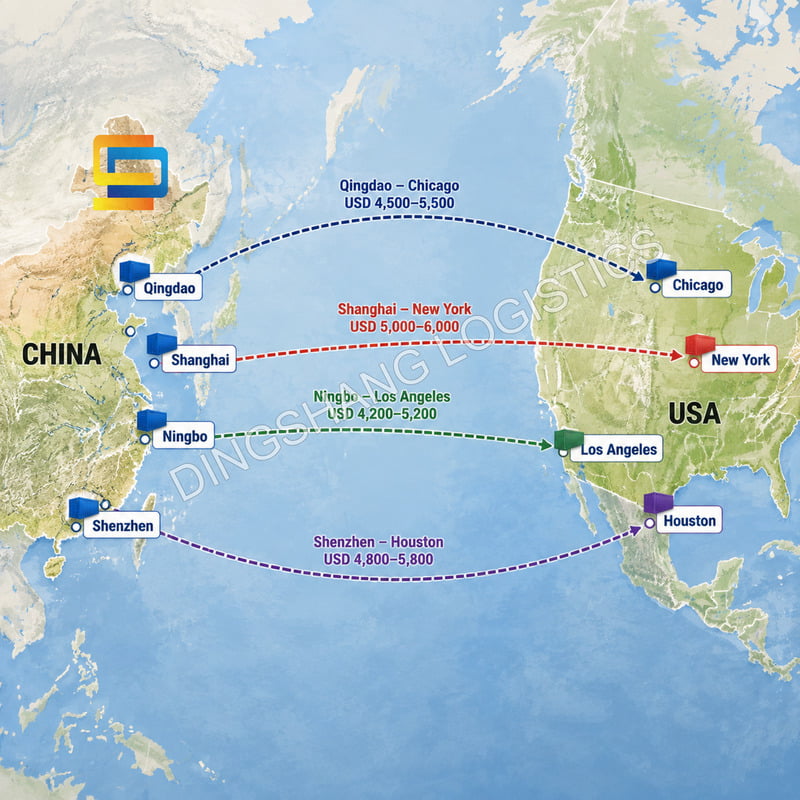
A container ending near Los Angeles or Long Beach has a different cost structure from one continuing to Chicago, Dallas, Memphis, Detroit, Atlanta, or another inland market.
Main Route Factors
The most important variables include:
- China loading port: Ningbo, Shanghai, Shenzhen, Qingdao, or another port
- U.S. ocean gateway: Los Angeles/Long Beach, New York/New Jersey, Houston, or another gateway
- Final destination: Port, inland rail ramp, or warehouse
- Inland mode: Rail, truck, or a combination
- Carrier service: Direct or transshipment routing
- Cargo-ready date: Determines which sailings and rates are relevant
- Delivery conditions: Appointment, unloading time, access, and equipment requirements
A U.S. ocean port is not the same as the final delivery point, and an inland rail ramp is not the same as warehouse delivery.
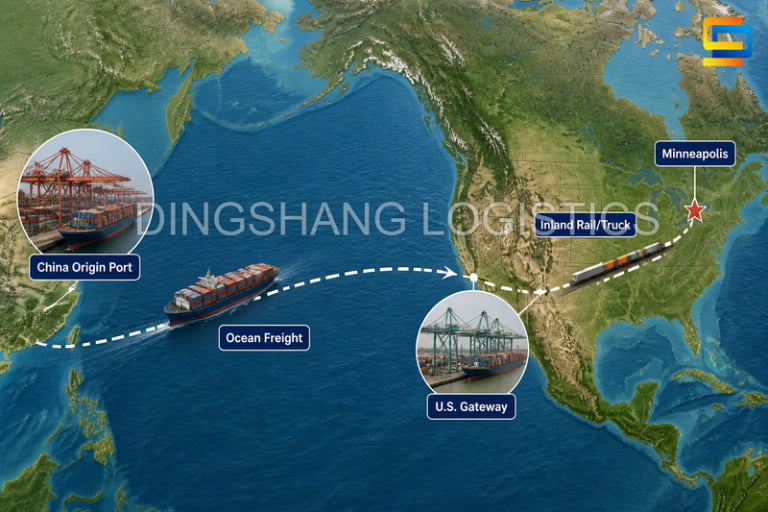
If a container moves by rail to Chicago or another inland market, local drayage may still be required from the inland rail facility to the consignee's warehouse. The actual rail service and routing should be confirmed for the booking rather than assumed from the destination city alone.
For example, see shipping a container from China to Chicago for a closer look at an inland shipment.
Why Inland Delivery Can Change the Total Price
Port arrival is only one stage of an inland shipment.
Before booking, confirm:
- Does the warehouse accept ocean containers?
- Is a delivery appointment required?
- How will the container be unloaded?
- How much unloading time is required?
- Is live unload or another arrangement planned?
- Are receiving hours restricted?
- Is the cargo unusually heavy?
- Is transloading required?
- Where must the empty container be returned?
These details can materially change the inland transportation plan and delivered cost.
Why Isn't a 20GP Container Half the Price of a 40HQ?
A 20GP is usually not half the cost of a 40HQ because many logistics charges do not decrease in proportion to container volume. Container size does not change total logistics cost in direct proportion.
Customs brokerage, documentation, drayage, chassis, terminal-related charges, and some origin and destination charges may be similar for a 20GP and a 40HQ or may change much less than the available cubic capacity.
That means you should compare total delivered cost, usable cargo capacity, gross weight, cargo characteristics, and inventory requirements rather than assuming a 20GP should cost half as much as a 40HQ.
For a direct comparison with larger equipment, see how much a 40HQ container costs from China to the USA.
When Should You Choose 20GP Instead of 40HQ or LCL?
A 20GP can make sense when your shipment justifies a dedicated container but does not require the additional cubic capacity of a 40HQ. It can also be practical for dense cargo, but the decision should be based on total delivered cost, gross weight, cargo characteristics, destination, and handling requirements—not CBM alone.
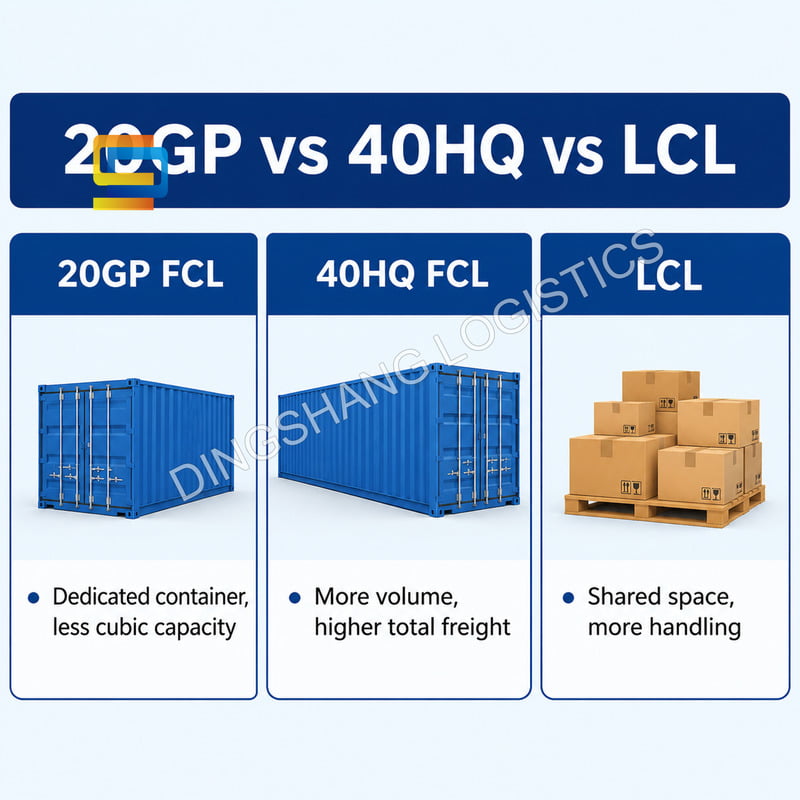
20GP vs. 40HQ vs. LCL
| Option | Often Worth Comparing When | Main Advantage | Main Issue to Check |
|---|---|---|---|
| 20GP FCL | Cargo justifies dedicated capacity but does not need 40HQ volume | Dedicated container without paying for as much unused cubic capacity | Weight and unit economics |
| 40HQ FCL | Cargo is bulky or requires substantially more volume | More loading capacity and potentially lower cost per CBM | Higher total freight and inventory |
| LCL | Shipment is relatively small | Pay for shared container capacity | More cargo-level handling and destination cost variables |
There is no universal CBM point where LCL automatically becomes FCL. The result changes with the route, destination, cargo weight, LCL W/M pricing, destination charges, inland transportation, current FCL rates, and handling requirements.
For a detailed FCL/LCL decision framework, see when you should choose FCL instead of LCL.
How Much Cargo Can a 20GP Container Load?
For practical freight planning, around 28 CBM can be used as a useful working figure for many 20GP general-cargo shipments. This is not the container's official capacity and should not be treated as guaranteed loading capacity.
A standard 20-foot dry container has roughly 33.2 CBM of technical internal volume in Hapag-Lloyd's published example specification.3
The distinction is important:
- 33.2 CBM = technical/internal container volume
- Around 28 CBM = practical planning figure for many general-cargo shipments
Actual usable cargo space can be lower or higher than a planning estimate depending on:
- Carton dimensions
- Pallets
- Packaging
- Cargo shape
- Loading pattern
- Stackability
- Cargo weight
- Cargo-securing requirements
Container specifications can also vary slightly by manufacturer and equipment fleet. Check the packing list and package dimensions before finalizing the container plan.
The 28 CBM planning figure is not an LCL-to-FCL break-even point. Whether LCL or FCL is more economical is a separate cost decision based on the complete shipment.
Is a 20GP Good for Heavy Cargo?
A 20GP can be practical for dense cargo, but it is not automatically the best choice for every heavy shipment. You need to check container payload, gross cargo weight, weight distribution, chassis configuration, axle limits, and the actual U.S. inland transportation route.
Container payload capacity is not the same as the legal or practical weight that can move over a specific U.S. road route.
A container may be within its equipment payload specification while still requiring additional planning for inland transportation.
For dense commodities such as:
- Stone
- Tiles
- Metal products
- Machinery
- Hardware
- Other industrial cargo
provide the gross weight before booking. The forwarder or drayage provider can then evaluate the proposed chassis, weight distribution, route, and any applicable transportation restrictions.
How Should You Compare 20GP Quotes from China to USA?
Compare 20GP quotations using the same origin, destination, commodity, gross weight, cargo-ready date, Incoterm, customs requirements, and final delivery conditions. A lower headline price is not necessarily a lower delivered cost if important services are missing.
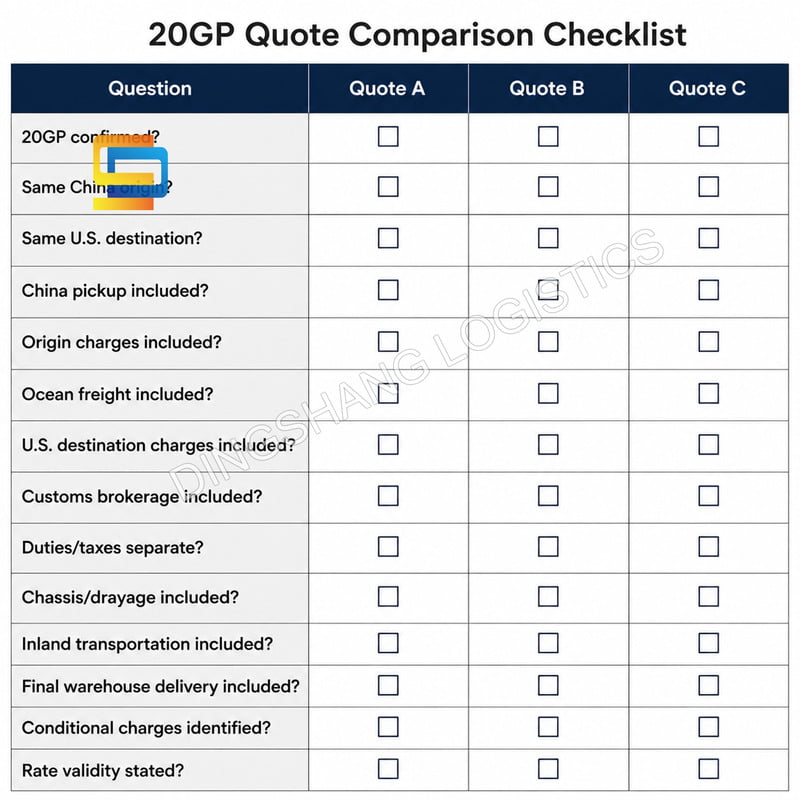
20GP Quote Comparison Checklist
| Question | Quote A | Quote B | Quote C |
|---|---|---|---|
| 20GP confirmed? | |||
| Same China origin? | |||
| Same U.S. destination? | |||
| China pickup included? | |||
| Origin charges included? | |||
| Ocean freight included? | |||
| U.S. destination charges included? | |||
| Customs brokerage included? | |||
| Duties/taxes separate? | |||
| Chassis/drayage included? | |||
| Inland transportation included? | |||
| Final warehouse delivery included? | |||
| Conditional charges identified? | |||
| Rate validity stated? |
Incoterms® define important responsibilities, costs, and risk allocation between buyer and seller in the sales transaction.4 They should not be confused with the freight forwarder's quotation scope.
Compare Total Delivered Cost, Not Just Ocean Freight
A practical comparison should answer:
| Question | Why It Matters |
|---|---|
| Is this port-to-port or door-to-door? | Defines where the quoted service ends |
| Are China local charges included? | EXW and FOB transportation scopes differ |
| Are U.S. destination charges included? | Port or ramp costs may materially affect the total |
| Is customs-clearance coordination included? | Brokerage service is separate from duties |
| Are duties included or estimated separately? | Government charges depend on the actual import |
| Is inland delivery included? | Rail, truck, and drayage can materially change the total |
| What are the applicable free-time terms? | Delays can create conditional charges |
| What is the rate validity? | The quote must cover the actual shipping window |
Be Careful With an Unusually Low Quote
A very low quote is not automatically wrong, but it should be reviewed carefully.
Check whether it is based on:
- Port-to-port service only
- A short validity period
- A different U.S. destination
- Different carrier or routing
- Excluded origin charges
- Excluded destination charges
- No customs-clearance coordination
- No inland delivery
- Unconfirmed equipment or space
- General-cargo assumptions that do not match the actual commodity
For a B2B importer, a transparent and operationally realistic quote is usually more useful than comparing only the lowest headline number.
Does Door-to-Door Shipping Make a 20GP Cost More Predictable?
Door-to-door shipping can make a 20GP shipment easier to budget because one transportation plan can cover the defined China origin through final U.S. delivery. However, door-to-door does not mean every charge is automatically included.
Import duties, customs exams, storage, demurrage, detention, waiting time, special delivery requirements, and other conditional costs may remain outside the base quotation.
Also:
Door-to-door is a logistics service scope. DDP is an Incoterm. They are not the same thing.
Before accepting a door-to-door quote, confirm:
- Pickup point
- Final delivery address
- Customs-clearance scope
- Duty treatment
- Chassis
- Drayage
- Inland transportation
- Delivery appointment
- Unloading requirements
- Applicable free-time terms
- Empty-container return
- Conditional charges
The objective is not simply to receive one large “all-in” number. It is to understand exactly what that number covers.
How Long Does a 20GP Container Take from China to USA?
A 20GP container does not have one fixed China-to-USA transit time. Timing depends on the China origin, U.S. gateway, carrier service, direct or transshipment routing, sailing schedule, customs status, inland transportation, and final warehouse requirements.
Ocean transit ≠ total door-to-door lead time.
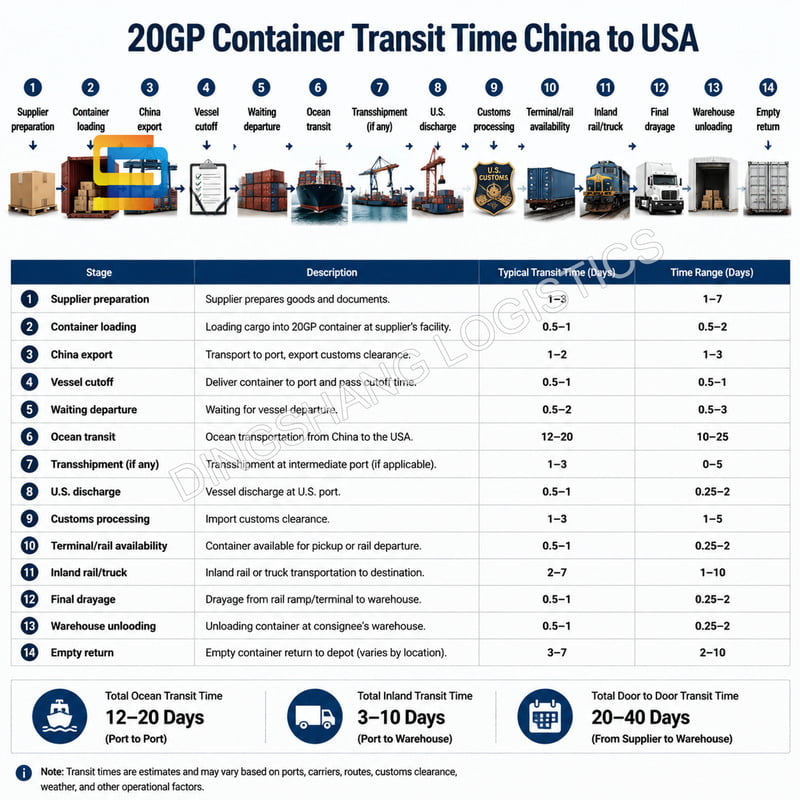
A complete shipment timeline can include:
- Supplier preparation
- Container positioning and loading
- China export procedures
- Vessel cutoff
- Waiting for departure
- Ocean transportation
- Transshipment, if applicable
- U.S. vessel discharge
- Customs processing and cargo release
- Terminal or rail availability
- Inland rail or trucking
- Final drayage
- Warehouse appointment and unloading
- Empty-container return
For route planning, see the China-to-USA sea freight transit time guide.
Use the current booked route and sailing information for inventory planning rather than a generic transit-time promise.
Frequently Asked Questions
How much does a 20GP container cost from China to USA?
As of August 2026, the example 20GP routes in this guide range from approximately USD 4,500 to USD 7,500.
Ningbo to Los Angeles is USD 4,500–5,500 port-to-port, while Shanghai to New York is USD 5,500–7,500 port-to-port. The warehouse-delivery examples are USD 4,800–6,200 from Shenzhen to a Los Angeles warehouse, USD 4,500–6,500 from Qingdao to a Houston warehouse, and USD 5,500–7,500 from Ningbo to a Chicago warehouse.
These are August 2026 indicative planning ranges, not guaranteed quotations. Port-to-port and warehouse-delivery rates should not be compared directly because the service scopes are different.
How many CBM fit in a 20GP container?
For practical freight planning, around 28 CBM is a useful working figure for many 20GP general-cargo shipments. A standard 20GP has roughly 33.2 CBM of technical internal volume in Hapag-Lloyd's published example specification, but actual usable cargo space is normally lower and depends on carton dimensions, pallets, packaging, cargo shape, loading pattern, stackability, and cargo weight.3
The 28 CBM figure is a planning reference, not an official specification or guaranteed loading capacity.
Why isn't a 20GP half the price of a 40HQ?
A 20GP is usually not half the price of a 40HQ because many logistics costs do not decrease in proportion to container volume. Customs brokerage, documentation, drayage, chassis, terminal-related charges, and some origin and destination costs may remain similar between the two container sizes.
Compare total delivered cost and usable capacity rather than container dimensions alone.
Is a 20GP cheaper than a 40HQ?
A 20GP usually has a lower total container freight cost than a 40HQ on the same service, but it is not necessarily cheaper per cubic meter or per product unit. A 40HQ may provide better unit economics for bulky cargo when the additional capacity can be used efficiently.
Is a 20GP cheaper than LCL?
Not always. LCL can be more economical for smaller shipments, while a 20GP may become more competitive as LCL volume, W/M charges, destination handling, and inland transportation increase.
There is no universal CBM point where LCL automatically becomes FCL. Compare the all-in costs for the actual shipment.
Is a 20GP good for heavy cargo?
A 20GP can be practical for dense cargo, but container size alone does not determine whether the shipment can move legally or efficiently. Check container payload, gross cargo weight, weight distribution, chassis, axle limits, and the actual U.S. inland route before booking.
Container payload capacity is not the same as legal or practical U.S. road weight.
What is included in a 20GP shipping quote?
A 20GP quote can include origin services, ocean freight, U.S. destination handling, customs-clearance coordination, and inland delivery, but the scope varies by quotation. Confirm pickup, origin charges, destination charges, customs brokerage, chassis, drayage, final delivery, duties, and conditional charges before comparing prices.
Does a 20GP quote include U.S. import duties?
Not automatically. Duties and other government charges depend on the merchandise classification, customs value, country of origin, and applicable trade measures.
Confirm separately whether the quotation includes customs brokerage and how duties and government charges will be handled.
Does door-to-door mean all charges are included?
No. Door-to-door describes transportation scope. Duties, customs examinations, storage, demurrage, detention, waiting time, and other conditional charges may still be excluded.
Always review the quotation's inclusions and exclusions.
How long does a 20GP container take from China to USA?
There is no single transit time for every 20GP shipment. The timeline depends on the China port, U.S. gateway, carrier service, routing, customs processing, inland transportation, and final delivery requirements.
Ocean transit is only one part of the total door-to-door lead time. Use the actual booked route and current sailing information when planning inventory.
What Information Do You Need for an Accurate 20GP Quote?
For an accurate 20GP container quote from China to the USA, provide enough information to price the actual shipment rather than a generic container rate.
Please provide:
- Product name
- HS/HTS code, if available
- Material or composition
- Supplier/pickup location in China
- U.S. delivery address or ZIP code
- Container type: 20GP
- Total gross cargo weight
- Package quantity
- Cargo-ready date
- Trade term: FOB, EXW, or another agreed Incoterm
- Customs-clearance requirements
- Commercial value if a duty estimate is requested
- Any hazardous, regulated, oversized, or overweight conditions
- Special loading or unloading requirements
- Warehouse appointment requirements
With these details, Dingshang Logistics can evaluate the route, cargo weight, service scope, and final destination so you can compare total delivered logistics cost instead of ocean freight alone.
References
[U.S. Customs and Border Protection — Tips for New Importers and Exporters](https://www.cbp.gov/trade/basic-import-export/importer-exporter-tips) ↩
[Federal Maritime Commission — Detention and Demurrage](https://www.fmc.gov/detention-and-demurrage/) ↩
[Hapag-Lloyd — Container Specification](https://www.hapag-lloyd.com/en/services-information/cargo-fleet/container.html) ↩
[International Trade Administration — Know Your Incoterms](https://www.trade.gov/know-your-incoterms) ↩

Leave a Comment