
How Do You Really Find the Best Shipping From China to the US?
The best shipping option from China to the USA depends on your cargo volume, destination, required delivery date, and total delivered logistics cost. For larger commercial shipments, FCL is often the most practical option, while LCL can work for smaller commercial shipments. The best routing should balance carrier reliability, transit time, customs coordination, inland delivery, and clearly defined costs—not simply the lowest ocean-freight rate.
There is no single “best” route, carrier, or service for every importer. The right choice is the one that fits your cargo and final delivery requirements while giving you enough cost and schedule visibility to plan inventory, production, and customer commitments.
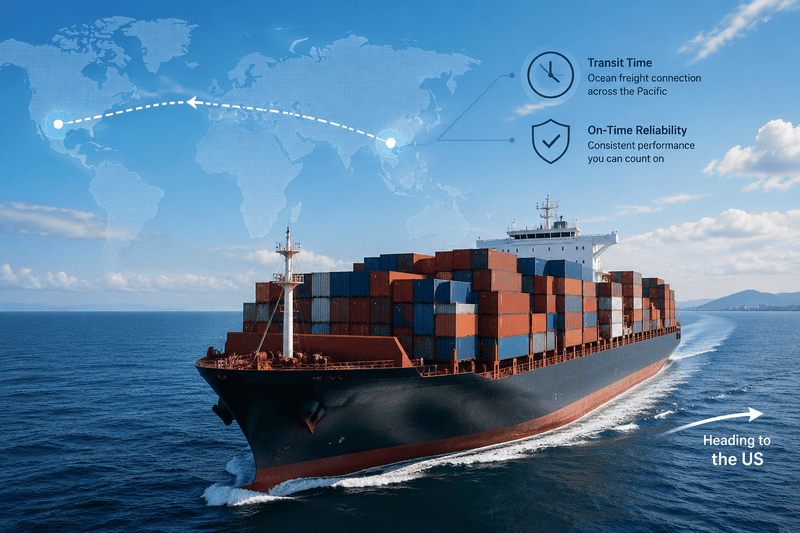
Which Shipping Option Is Best from China to the USA?
For commercial ocean freight, the best option depends mainly on shipment size, final U.S. destination, required arrival date, and how much coordination you want the forwarder to handle. FCL generally fits larger commercial shipments, while LCL can be considered when the cargo does not require a full container.
| Shipment Situation | Practical Option |
|---|---|
| Larger commercial shipment | FCL |
| Smaller commercial shipment | LCL |
| Time-sensitive inventory | Faster and more stable ocean service |
| Southern California delivery | Direct West Coast routing may be practical |
| Chicago/Midwest delivery | West Coast + rail may be considered |
| East Coast warehouse | All-water or intermodal routing depending on cost and timing |
| Need one coordinated logistics service | Door-to-door forwarding |
There is no single best shipping method for every importer. The right option depends on cargo volume, delivery location, required arrival date, handling requirements, and total delivered logistics cost.
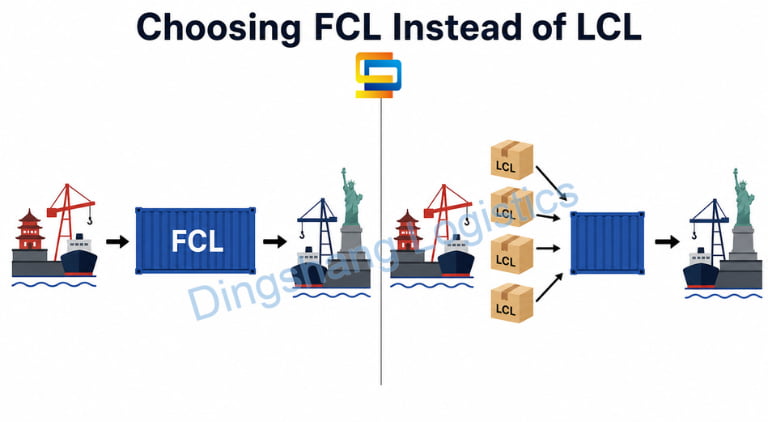
For commercial cargo that does not require a full container, LCL can be considered. As shipment volume increases, FCL may provide better control over handling, routing, and total logistics cost. The decision should be based on the actual shipment rather than a fixed CBM rule; this guide explains when you should choose FCL instead of LCL.
What Should You Evaluate Before Choosing a Shipping Plan?
The best shipping plan should be evaluated as a complete transportation decision rather than an ocean-freight purchase.
| Factor | What to Check |
|---|---|
| Cargo fit | FCL or LCL |
| Cost | Total delivered logistics cost |
| Transit | Realistic route timing |
| Carrier | Service stability |
| Routing | Direct, rail, and truck handoffs |
| Customs | Clear responsibility and required information |
| Delivery | Final ZIP code, appointments, and unloading needs |
| Quote | Included, estimated, excluded, and conditional charges |
| Exceptions | Who coordinates disruptions and additional requirements |
| Communication | One clear contact or defined communication process |
A lower ocean rate can still produce a less suitable shipping plan if the route, inland transportation, service scope, or timing does not fit your business requirements.
How Should You Compare Shipping Quotes?
To compare China-to-USA shipping quotes fairly, make sure each quote uses the same origin, destination, container size or cargo volume, Incoterm, customs scope, inland delivery requirements, and exclusions. A low port-to-port ocean rate cannot be directly compared with a complete door-to-door quote.
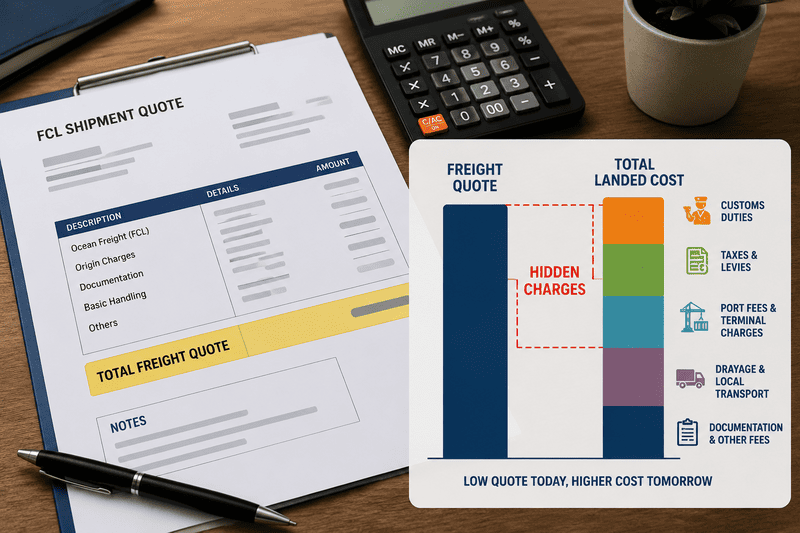
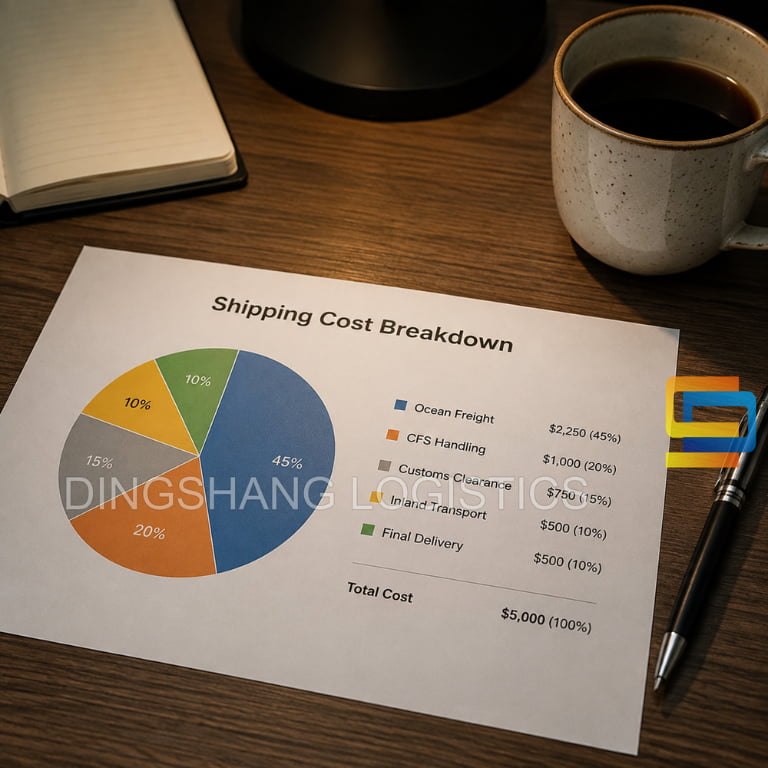
When comparing freight quotes, focus on the total delivered logistics cost rather than the ocean-freight line alone.
Landed cost is a broader concept that may also include the product purchase cost, import duty, government fees, and other import-related expenses. When evaluating freight-forwarding services, total delivered logistics cost gives you a clearer basis for comparing the transportation scope.
At minimum, normalize these points before comparing quotes:
- Same China origin
- Same U.S. destination
- Same FCL/LCL scope
- Same container size or cargo volume
- Same Incoterm
- Same customs scope
- Same inland delivery requirements
- Same conditional-charge assumptions
A low initial freight quote may not represent the final delivered logistics cost if destination charges, customs-clearance services, inland transportation, or other required services are outside the quoted scope.
Once a shipment is in transit, changing providers or routing can become difficult, so the quotation scope and exclusions should be reviewed before booking.
Can Total Shipping Costs Be Known Before Shipment?
Most normal logistics costs can generally be defined or quoted before shipment when the cargo, origin, destination, service scope, and delivery requirements are known. Import duty can also often be calculated or estimated before shipment when sufficient customs information is available.
A transparent, one-time logistics quote can cover the agreed shipping costs and include an estimated import duty when sufficient cargo information is available. In most normal shipments, this gives you a clear picture of the expected total shipping cost before departure.
For a more detailed breakdown of what should be included, excluded, estimated, or treated as conditional, see the guide to all-in container shipping cost from China to the USA.
Can Import Duty Be Calculated Before Shipping?
Yes. Import duty can often be calculated or estimated before shipment when the HTS classification, customs value, country of origin, and applicable U.S. tariff measures are known. The final amount remains subject to U.S. Customs assessment.1
For basic planning:
Estimated Duty = Applicable Duty Rate × Customs Value
This is a planning formula, not a complete calculation rule for every U.S. import. Actual duty can also depend on HTS classification, country of origin, additional tariffs, special trade measures, product-specific duties, and other applicable requirements.
If you are still organizing the customs and import side of the shipment, this step-by-step guide to importing products from China to the USA explains the broader process.
What Costs Can Cause Additional Charges?
Most normal logistics costs can be defined before shipment, and import duty can often be estimated in advance. Exception-related charges are different because they depend on events or operating conditions that may not occur.
Examples include:
- Customs examination, if triggered
- Demurrage, if applicable free time is exceeded
- Detention, if applicable free time is exceeded
- Storage caused by delays
- Waiting or redelivery under applicable delivery conditions
- Other shipment-specific exception charges
The Federal Maritime Commission describes detention as a charge for extended use of intermodal equipment and demurrage as accruing when a container exceeds free time on a marine terminal.2 Exact billing conditions depend on the carrier, terminal, contract, and shipment circumstances.
A conditional charge is not necessarily a hidden fee. The real issue is whether the quotation clearly explains what is included, what can be estimated, and what may arise only if an exception occurs.
A one-time quote therefore should not be interpreted as a promise that every possible event is permanently fixed at booking. It means the normal agreed logistics costs are clearly defined, estimated duty can be shown when sufficient information is available, and potential exceptions are identified rather than buried in the quotation.
How Does Carrier Selection Affect Transit Time?
Carrier and service selection can materially affect transit time because different services use different schedules, routings, port calls, and operational plans. Published schedules are useful for planning, but actual performance can vary by route, sailing, carrier service, port conditions, capacity, and other operational factors.
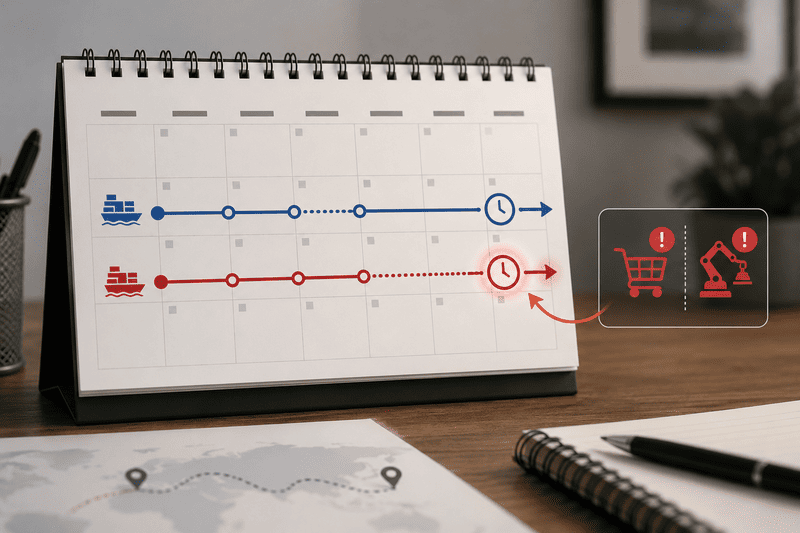
Based on the China-to-USA services reviewed in our 2026 operations, faster OA services on several major routes have tracked their published schedules more closely than some slower services. That does not mean an alliance or carrier guarantees faster or more reliable performance on every shipment.
The better comparison is the specific carrier service and route available for your cargo-ready date. Our China-to-USA sea freight transit time guide provides the detailed route and service data used for transit planning.
Cargo can be rolled to a later sailing because of capacity constraints, schedule changes, operational disruptions, or other carrier-related factors. Port conditions and inland connections can also affect the total door-to-door lead time.
A slightly higher freight rate can still be economical if the service reduces the risk of disruptions that affect inventory availability, production schedules, or customer delivery commitments.
For a purchasing or logistics manager, the practical questions are:
- Which service is being booked?
- What routing does it use?
- Does it involve transshipment?
- What is the published schedule?
- How does that service fit the required delivery date?
- What happens after the container reaches the U.S. gateway?
The ocean leg should therefore be evaluated as part of the complete logistics plan, not in isolation.
When Does Door-to-Door Shipping Make Sense?
Door-to-door shipping can make sense when you want one logistics coordinator to manage the transportation process from the agreed China origin to the agreed U.S. delivery point. It can reduce handoff complexity and centralize communication, but the exact included charges and responsibilities still depend on the quotation.
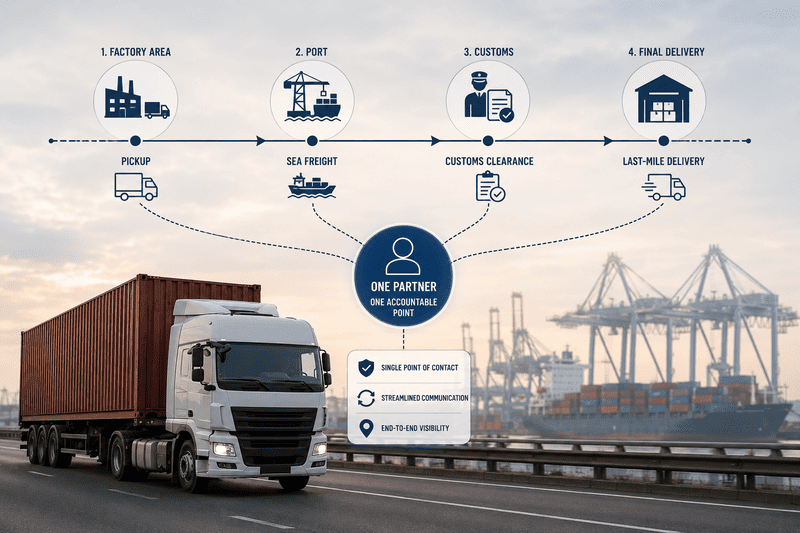
Using one logistics coordinator can simplify communication and reduce handoff complexity, but the important factor is not simply the number of vendors. Responsibilities for booking, customs coordination, inland transportation, delivery, milestone tracking, and exception handling should be clearly assigned.
A coordinated service can provide:
- Fewer communication handoffs
- Clearer responsibility
- Centralized shipment updates
- Customs-clearance coordination
- Inland rail or trucking coordination
- Final-delivery planning
- Exception handling
Understanding how container shipping works from China to the USA also helps you identify where those responsibilities change during the shipment.
Is Door-to-Door the Same as DDP?
No. Door-to-door describes the coordinated transportation scope from the agreed China origin to the agreed U.S. delivery point. The exact included charges and responsibilities depend on the quotation.
DDP is an Incoterm that allocates specific seller and buyer responsibilities under the sales transaction.3 Door-to-door transportation does not automatically mean the forwarder or seller assumes every DDP obligation.
Import duty can often be estimated separately when the required customs information is available. Customs examinations, demurrage, detention, storage, and other exception-related costs may remain conditional unless the quotation specifically states otherwise.
A good door-to-door quote should therefore answer:
Who coordinates each stage, what normal logistics charges are included, how estimated duty is handled, and which costs are conditional?
How Does Shipping to an Inland U.S. Destination Differ?
A coastal delivery and an inland delivery can require different transportation chains. A Los Angeles-area delivery may involve ocean transport followed by local drayage, while an inland destination such as Chicago can add an intermodal rail leg and another truck move. This creates additional handoffs, timing dependencies, and cost components.
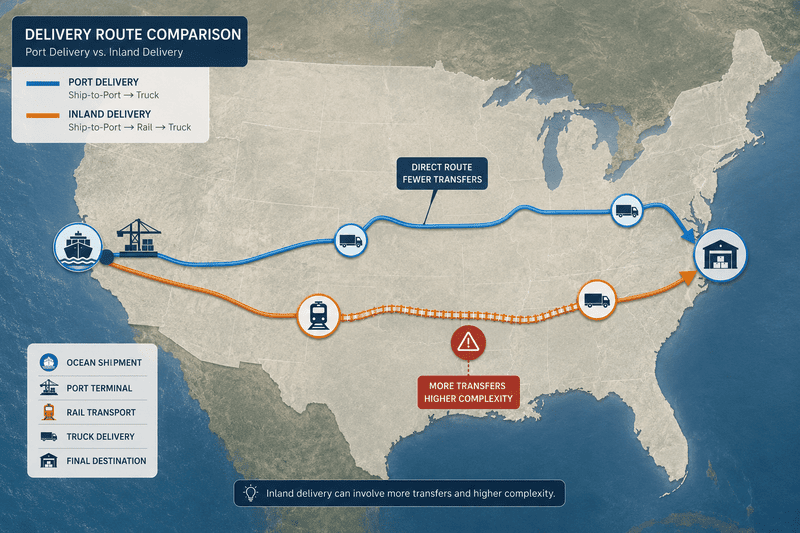
For an inland shipment, the U.S. seaport is the ocean gateway—not necessarily the final destination. The container may move from the gateway by rail to an inland ramp and then by truck to the consignee's warehouse.
| Factor | Coastal Delivery | Inland Delivery |
|---|---|---|
| Transportation chain | Ocean + local truck may be sufficient | Ocean + rail and/or longer truck movement may be required |
| Handoffs | Usually fewer inland handoffs | May include port, rail, ramp, and final truck handoffs |
| Quote scope | Gateway and local delivery costs | Inland transportation and final delivery must be included |
| Timing | Depends on vessel, terminal, customs, and truck availability | Also depends on inland connection and ramp operations |
| Planning | Final delivery conditions matter | Rail/ramp coordination and final delivery conditions matter |
For example, a buyer with a warehouse in Dallas may receive a low port-to-port rate to a U.S. gateway, but that rate does not represent the full cost of moving the container to the final warehouse.
The better question is not simply, “Which U.S. port is cheapest?” It is:
Which complete routing gives you the right balance of total delivered logistics cost, timing, and operational reliability to your final ZIP code?
How Do You Evaluate a China Freight Forwarder?
Choose a China freight forwarder by evaluating quote transparency, routing knowledge, carrier and service selection, customs coordination, inland-delivery capability, exception handling, and communication. The lowest ocean rate alone is not enough to determine whether a forwarder is the right fit.
A useful forwarder should be able to explain:
| Area | What You Should Expect |
|---|---|
| Cargo planning | FCL/LCL and equipment recommendations based on the shipment |
| Routing | A clear explanation of the ocean gateway and inland plan |
| Carrier/service | The actual service options and relevant schedule considerations |
| Quote structure | Included, estimated, excluded, and conditional costs |
| Customs | Clear coordination responsibilities and required documentation |
| Inland delivery | Rail, drayage, truck, appointment, and unloading requirements |
| Tracking | Defined shipment milestones and communication |
| Exceptions | A process for exams, delays, missed connections, or delivery problems |
A forwarder cannot control every vessel schedule, terminal, railroad, customs decision, or warehouse condition. What matters is whether the transportation plan defines responsibilities and gives you a clear process when something changes.
This guide to choosing a freight forwarder in China provides a more detailed checklist for evaluating providers before booking.
Get a China-to-USA Shipping Plan
The right shipping plan depends on your cargo, route, delivery requirements, and timing. With complete shipment information, normal logistics costs can generally be quoted in advance and import duty can often be estimated before shipment when sufficient customs information is available.
For an FCL quote, provide:
- Product name
- HS/HTS code, if available
- Material/product description
- China pickup location or FOB port
- U.S. delivery ZIP code
- 20GP or 40HQ
- Gross weight
- Cargo-ready date
- FOB or EXW
- Cargo value
For an LCL quote, provide:
- Product name
- HS/HTS code, if available
- Material/product description
- China pickup location
- U.S. delivery ZIP code
- Package quantity
- Dimensions
- CBM
- Gross weight
- Cargo-ready date
- Cargo value
Dingshang Logistics can use these details to compare the appropriate FCL or LCL scope, carrier service, routing, inland delivery plan, expected logistics costs, and estimated import duty where sufficient information is available.
References
U.S. Customs and Border Protection — [Determining Duty Rates](https://www.cbp.gov/trade/programs-administration/determining-duty-rates) ↩
Federal Maritime Commission — [Detention and Demurrage](https://www.fmc.gov/detention-and-demurrage/) ↩
International Trade Administration, U.S. Department of Commerce — [Know Your Incoterms](https://www.trade.gov/know-your-incoterms) ↩
Leave a Comment