
How to Ship a Container from China to Detroit?
To ship a container from China to Detroit, you normally plan the shipment as a combined ocean-and-inland move. Detroit has marine port facilities and a major freight network, but it is not a typical U.S. gateway for containerized ocean imports from China. In most cases, the container enters through a major U.S. container port and then continues toward Detroit by rail, truck, or a combination of both.12
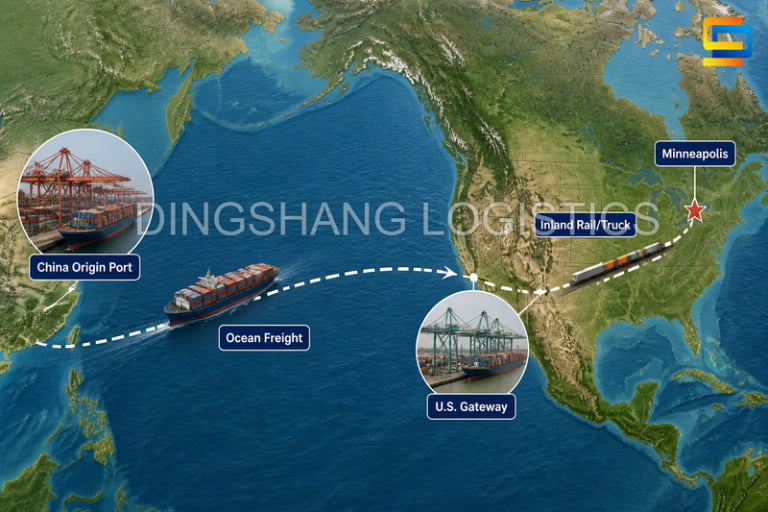
A practical route usually looks like this:
China supplier → China loading port → U.S. container gateway → U.S. customs clearance → inland rail/truck → Detroit-area delivery
The best route depends on the China origin, container type, cargo weight, cargo-ready date, carrier service, final delivery ZIP code, and how much schedule variability your business can accept.
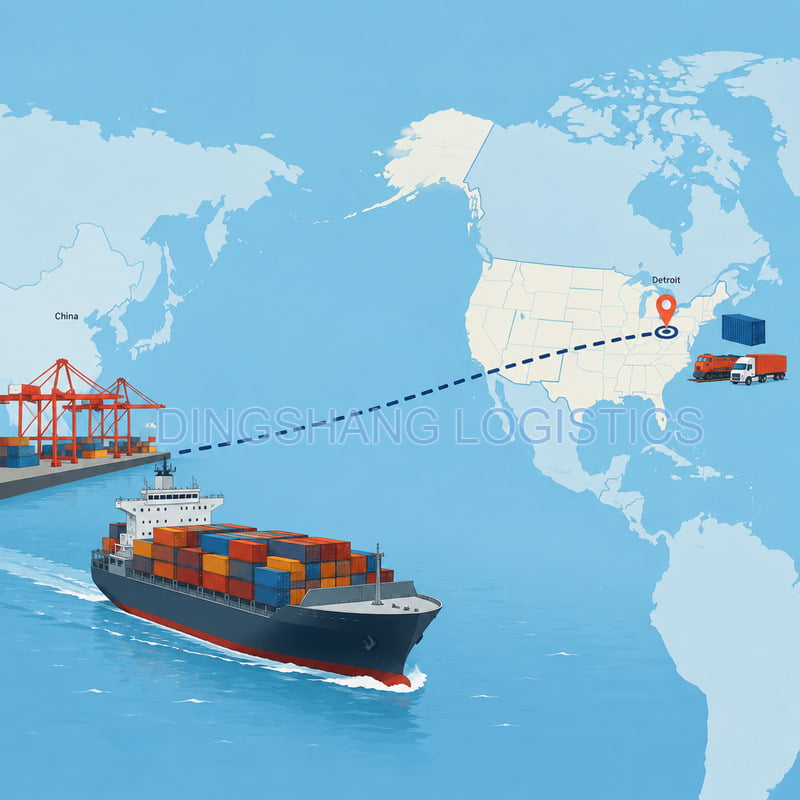
When I quote an inland shipment to Detroit, I compare the complete transportation chain rather than ocean freight alone. For a manufacturing or distribution customer, the route that produces the lowest ocean rate is not always the route that produces the best delivered cost or the most reliable warehouse arrival.
How Does Container Shipping from China to Detroit Work?
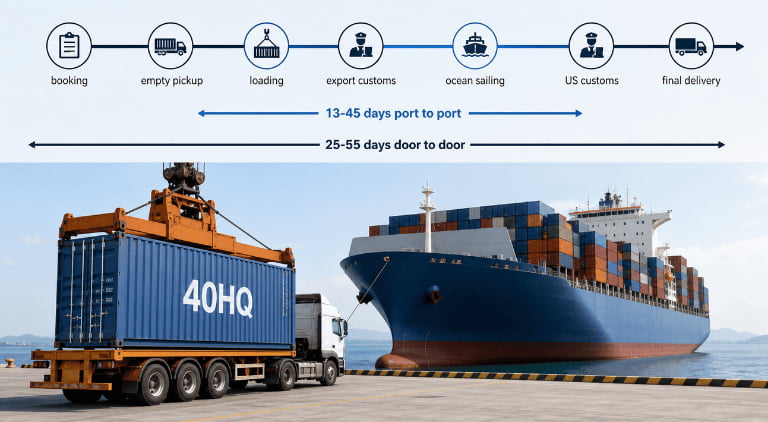
Container shipping from China to Detroit usually combines ocean freight with inland transportation. Your cargo moves from the supplier to a China loading port, crosses the ocean to a U.S. gateway, clears customs, and then continues inland toward the Detroit area.
If you are new to the overall process, see how container shipping works from China to the USA for the full shipment sequence.
This distinction matters when you compare quotes. A rate ending at Los Angeles, New York/New Jersey, Savannah, or another U.S. port is not directly comparable with a quote that includes inland transportation and delivery to your Detroit warehouse.
Is Detroit a Seaport?
Detroit has marine freight infrastructure on the Detroit River, so it would be inaccurate to say that Detroit is simply “not a port.” Michigan also recognizes the Detroit/Wayne County Port Authority within its transportation programs.3
For China-origin containerized imports, however, Detroit is not normally used like Los Angeles/Long Beach, New York/New Jersey, Savannah, or other major U.S. container gateways. The practical planning model is usually to enter through a container gateway and continue inland.
Detroit is also a significant intermodal freight market. The Michigan Department of Transportation’s Detroit Intermodal Freight Terminal program is intended to improve freight transportation opportunities and intermodal efficiency in Southeast Michigan.1
What Does a Typical China-to-Detroit Route Look Like?
For FCL, a typical route may look like:
Ningbo / Shanghai / Shenzhen / Qingdao → U.S. gateway → inland rail or truck → Detroit-area warehouse
The shipment normally involves:
- China pickup or supplier delivery to the origin port
- Export handling and customs procedures in China
- Ocean freight to a U.S. gateway
- U.S. customs clearance
- Inland rail and/or trucking
- Final delivery to the Detroit-area receiver
- Empty-container return for FCL shipments
For LCL, consolidation and deconsolidation steps are also required before final delivery.
Which U.S. Gateway Is Best for Detroit?
There is no single U.S. gateway that is always best for Detroit. West Coast, East Coast, and other routings can produce different combinations of ocean freight, inland cost, transit time, rail availability, and delivery reliability.
The right comparison is:
ocean cost + inland cost + transit time + operational risk + final delivery requirements
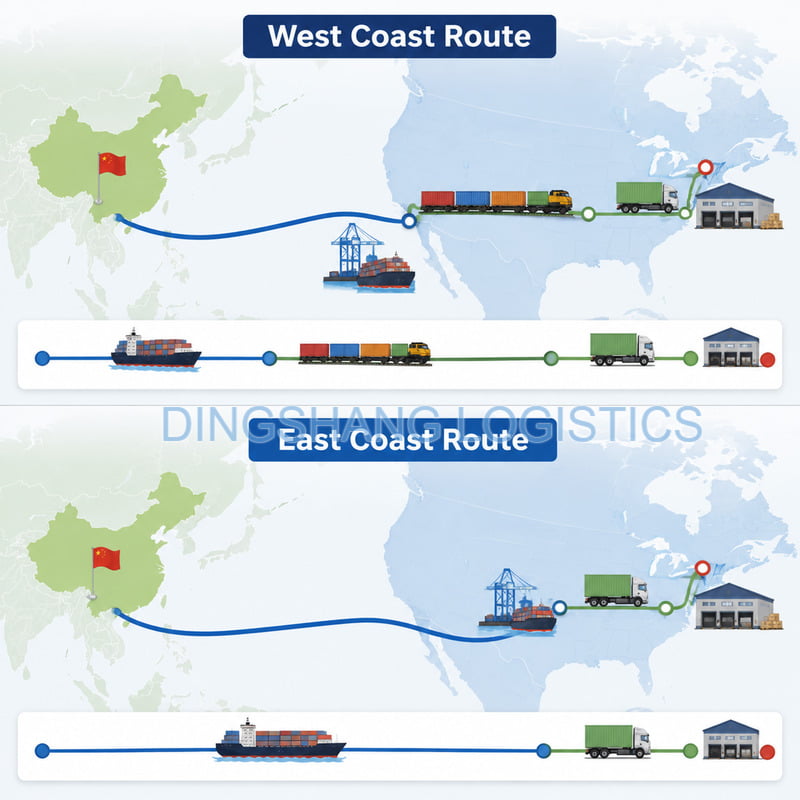
West Coast Gateway + Inland Intermodal
A West Coast strategy may use Los Angeles/Long Beach or another suitable gateway, followed by inland rail movement toward the Midwest and truck delivery for the final leg.
This option can make sense when:
- Trans-Pacific ocean pricing is competitive
- Sailing frequency from China is favorable
- Inland rail capacity fits the shipment
- The importer accepts an intermodal transfer
- The complete delivered cost is competitive
Michigan has an extensive freight rail network. MDOT reports approximately 3,600 miles of rail corridors in the state, with four of the seven Class I railroads operating in Michigan.4
For another example of China-to-Midwest inland container routing, see our guide to shipping a container from China to Chicago.
That does not mean every ocean container has a direct rail service to the exact Detroit delivery point. The actual inland routing must still be confirmed for the carrier, gateway, equipment, and shipment date.
East Coast Gateway + Inland Transportation
An all-water service to an East Coast gateway can also be compared. The ocean portion may be longer than a West Coast service, but the inland transportation profile is different.
This option may be worth reviewing when:
- West Coast inland conditions are unfavorable
- The all-water ocean rate is competitive
- The delivery schedule allows a longer ocean leg
- Inland rail or trucking from the selected gateway works well for the Detroit destination
Do not assume that a shorter ocean transit automatically creates an earlier Detroit delivery. Port discharge, rail connection, customs status, equipment availability, and final delivery appointments all affect the actual warehouse arrival.
Detroit Has Real Intermodal Infrastructure
Detroit is not simply an inland point at the end of a truck route. It has established intermodal infrastructure.
MDOT describes the Detroit Intermodal Freight Terminal project as a program designed to improve freight transportation opportunities and efficiencies for business and industry.1 Michigan has also invested in improvements to the Livernois Intermodal Facility, a Detroit facility used to transfer shipping containers between rail and road transportation.5
This matters because a China-to-Detroit shipment should be evaluated as an intermodal logistics plan, not simply an ocean rate plus an arbitrary trucking number.
Should You Use 20GP, 40HQ, or LCL to Detroit?
A 20GP is often practical for dense cargo, a 40HQ for higher-volume cargo, and LCL for smaller shipments that do not justify a dedicated container. The correct choice depends on CBM, gross weight, packaging, cargo value, handling sensitivity, and total delivered cost.
| Shipping Option | Often Suitable For | Main Advantage | Main Watchout |
|---|---|---|---|
| 20GP FCL | Dense or heavy cargo | Dedicated container with manageable cubic capacity | Weight can become the limiting factor |
| 40HQ FCL | Larger-volume, lighter cargo | More usable cubic capacity | You pay for the full container even if partly empty |
| LCL | Smaller shipments | Pay for shared container space | More handling and destination-side steps |
When 20GP Makes Sense
A 20GP can be a strong option for dense products such as metal parts, some machinery, tooling, or industrial components.
Do not select a container based only on cubic capacity. Heavy cargo may reach practical road-weight constraints before the container is physically full.
Federal highway rules include axle and gross vehicle weight limits, including an 80,000-pound gross vehicle weight limit on the Interstate system in the general federal framework.6 Actual legal movement also depends on the truck configuration, axle spacing, state rules, permits, and route.
When 40HQ Makes Sense
A 40HQ is usually better when the cargo is volume-driven rather than weight-driven.
Examples may include furniture, packaging products, plastic products, light industrial assemblies, building products, and large quantities of relatively light components.
Before booking, check the actual packing plan rather than assuming that every large shipment should use a 40HQ.
When LCL Makes Sense
LCL can be practical when the shipment is too small to justify a dedicated container.
For LCL, provide the number of packages, dimensions, total CBM, gross weight, stackability, product description, and final Detroit-area ZIP code.
LCL involves consolidation at origin and deconsolidation at destination, so the lowest per-CBM line does not always represent the complete delivered cost.
How Much Does It Cost to Ship a Container from China to Detroit?
There is no reliable universal price for shipping a container from China to Detroit. The cost changes with the China origin, container type, U.S. gateway, inland route, cargo weight, commodity, cargo-ready date, customs requirements, and final delivery ZIP code.
For Detroit, ocean freight is only one part of the delivered logistics cost. If you are building a landed-cost budget, our guide to what you are really paying to ship a container from China explains the main cost layers in more detail.
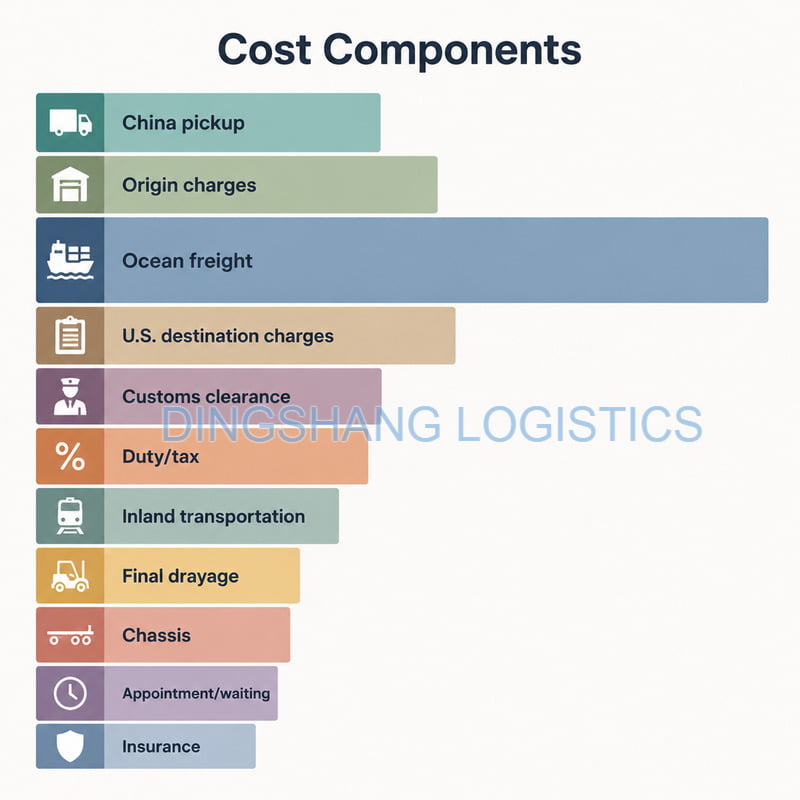
Main Cost Components
| Cost Component | What It Covers |
|---|---|
| China pickup | Supplier/factory to loading point |
| Origin charges | Export handling, documentation, local terminal charges |
| Ocean freight | China loading port to U.S. gateway |
| U.S. destination charges | Arrival and terminal-related costs |
| Customs clearance | Entry processing and broker services |
| Duty/tax | Government charges based on classification, value, and applicable tariff treatment |
| Inland transportation | Rail and/or truck movement toward Detroit |
| Final drayage | Delivery to the final warehouse |
| Chassis | Equipment used to move the container by truck |
| Appointment/waiting | Delivery scheduling or truck waiting where applicable |
| Insurance | Cargo coverage where included |
Costs Importers Often Miss
Before booking, check whether the quotation includes or excludes customs bond, ISF filing, import duties and additional tariffs, destination terminal charges, inland rail, final drayage, chassis, pre-pull, storage, truck waiting, delivery appointments, demurrage, detention, customs exams, and re-delivery.
Some charges cannot be guaranteed in advance because they depend on events such as customs inspection, storage time, or receiver delays. They should still be identified as possible exceptions before booking.
Free Time, Demurrage, and Detention
Free time should be reviewed before the container reaches the U.S. gateway or inland terminal.
The Federal Maritime Commission regulates aspects of demurrage and detention billing practices and requires specified information and timing for compliant invoices.7
For an inland Detroit shipment, timing should be coordinated across port availability, customs release, rail movement, inland terminal availability, chassis availability, delivery appointment, container unloading, and empty return.
Why the Detroit Delivery ZIP Code Matters
“Detroit” alone is not enough for a precise door-to-door quote.
The final ZIP code affects drayage distance, truck availability, appointment requirements, warehouse access, waiting time, empty-return planning, and potential special equipment.
How Long Does Shipping from China to Detroit Take?
China-to-Detroit transit time depends on the China loading port, carrier service, U.S. gateway, vessel schedule, customs clearance, inland rail/trucking, and final delivery appointment. The useful number for an importer is the estimated door-to-door timeline, not vessel transit alone.
For broader planning ranges by U.S. gateway and route, see our China-to-USA sea freight transit time guide.
A complete timeline can include supplier preparation, China pickup, origin port handling, ocean transit, U.S. discharge, customs clearance, inland rail/trucking, inland terminal handling, and final delivery.
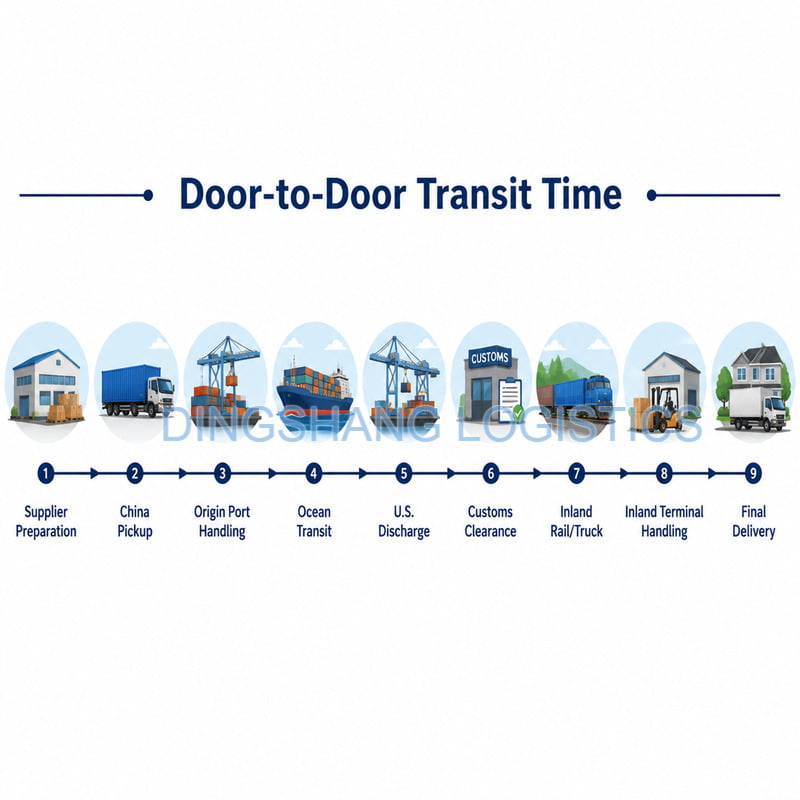
Build a Buffer Around the Required Delivery Date
If the cargo supports manufacturing, installation, retail launch, or another fixed business deadline, do not plan around the shortest advertised transit time.
Instead, work backward from:
Required Detroit delivery date → receiving appointment → inland movement → customs → vessel arrival → vessel departure → China cargo-ready date
This approach makes the logistics plan more useful for purchasing and production teams.
What Should Automotive and Industrial Importers Consider When Shipping to Detroit?
Detroit-area automotive and industrial shipments deserve extra attention to cargo weight, production deadlines, packaging, receiving requirements, and delivery reliability. A shipment that is inexpensive on the ocean leg can still become costly if it creates an overweight, unloading, or production-delay problem.
Michigan’s freight policy specifically recognizes that an efficient and dependable transportation system supports business competitiveness and just-in-time inventory systems.2
Heavy Cargo Can Change the Container Decision
Industrial cargo can be dense. Examples include auto parts, metal components, CNC or industrial machinery, tooling, molds, hardware, and equipment parts.
A 40HQ may have more cubic space, but that does not automatically make it the best container for dense cargo. The road-legal weight of the truck, chassis, container, and cargo must be considered together.6
For heavy cargo, provide the gross cargo weight before the quote is finalized.
Production Deadlines Matter More Than the Fastest Ocean Schedule
If the cargo feeds a production line, a missed delivery can cost much more than a small freight-rate difference.
For production-sensitive shipments, confirm the required delivery date, cargo-ready date, vessel cutoff, planned U.S. gateway, inland transportation mode, delivery appointment, receiving hours, and contingency time.
Packaging Still Matters in FCL
A dedicated container reduces some handling compared with LCL, but it does not eliminate cargo movement inside the container.
Industrial products should be packed for ocean vibration, inland rail/truck movement, forklift handling, moisture exposure, blocking and bracing requirements, and weight distribution.
What Information Is Needed for a China-to-Detroit Quote?
For an accurate Detroit quote, provide the product, supplier location, final delivery ZIP code, cargo size and weight, trade term, cargo-ready date, and customs information. FCL quotes also require the container type, while LCL quotes require package dimensions and total CBM.
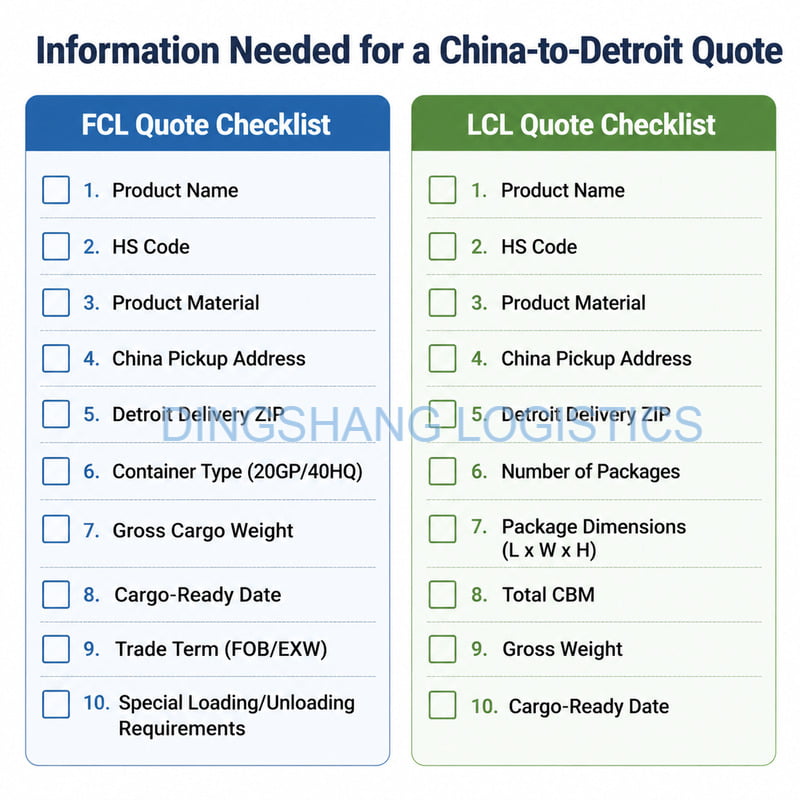
FCL Quote Checklist
- Product name
- HS code, if available
- Product material
- China pickup address or ZIP code
- Detroit-area delivery address or ZIP code
- Container type: 20GP or 40HQ
- Gross cargo weight
- Cargo-ready date
- Trade term: FOB or EXW
- Special loading or unloading requirements
LCL Quote Checklist
- Product name
- HS code, if available
- Product material
- China pickup address or ZIP code
- Detroit-area delivery address or ZIP code
- Number of packages
- Package dimensions
- Total CBM
- Gross weight
- Cargo-ready date
FOB vs. EXW
Your Incoterm changes the scope of the freight quote.
Under EXW, the buyer takes on transportation responsibility from a much earlier point at the seller’s premises. Under FOB, the seller has responsibilities through loading the goods on board at the named port of shipment. Incoterms define the allocation of tasks, costs, and risks between buyer and seller.8
For current terminology, use the applicable Incoterms rule rather than the older DDU term. DAP (Delivered at Place) and DDP (Delivered Duty Paid) are among the current Incoterms 2020 rules.8
What U.S. Customs Information Should Be Prepared?
U.S. customs preparation should begin before the shipment departs China. The importer should have accurate product descriptions, values, classification information, and importer details ready for the customs broker.
First-time importers can also review our step-by-step guide to importing products from China to the USA.
Common information includes the commercial invoice, packing list, bill of lading instructions, Importer of Record information, HS/HTS classification information, customs bond information, country of origin, and product-specific certificates where applicable.
Importer Security Filing for Ocean Cargo
For U.S.-bound ocean cargo, Importer Security Filing (ISF), commonly called “10+2,” must be handled according to CBP filing requirements.
Most required ISF data must generally be submitted no later than 24 hours before the cargo is laden aboard a vessel destined for the United States.9
Do not wait until the vessel is close to the U.S. to start collecting ISF information.
Product Classification and Other Agencies
Some commodities can be subject to requirements from agencies in addition to CBP, including FDA, EPA, FCC, DOT, or other U.S. regulatory agencies depending on the product.
How Should You Compare China-to-Detroit Freight Quotes?
Compare Detroit freight quotes by scope, not by the largest ocean-freight number on the page. Check origin services, U.S. destination charges, customs scope, inland transportation, delivery, insurance, free time, and exception conditions.
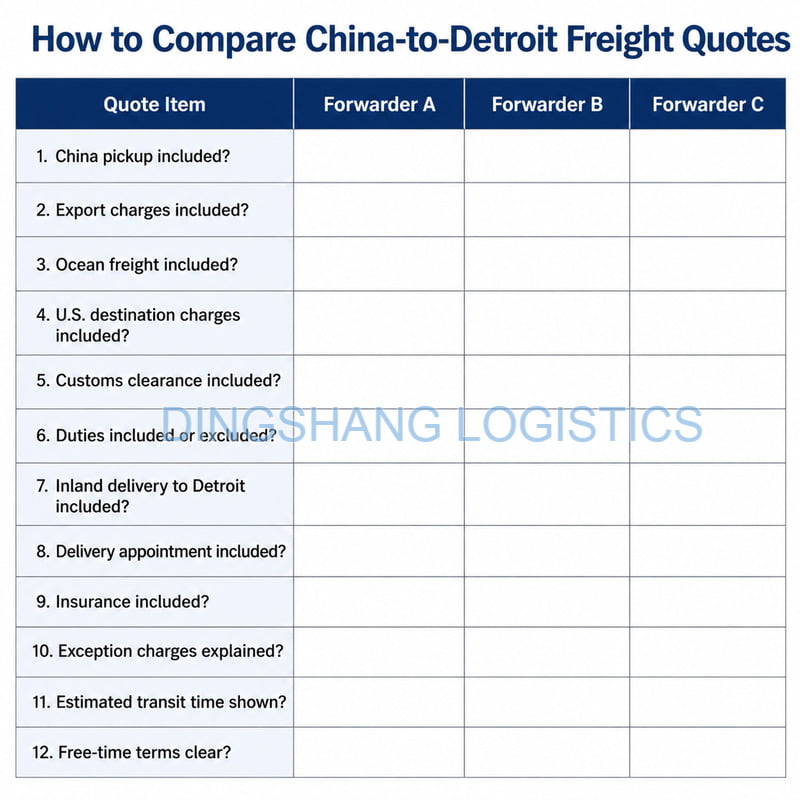
| Quote Item | Forwarder A | Forwarder B | Forwarder C |
|---|---|---|---|
| China pickup included? | |||
| Export charges included? | |||
| Ocean freight included? | |||
| U.S. destination charges included? | |||
| Customs clearance included? | |||
| Duties included or excluded? | |||
| Inland delivery to Detroit included? | |||
| Delivery appointment included? | |||
| Insurance included? | |||
| Exception charges explained? | |||
| Estimated transit time shown? | |||
| Free-time terms clear? |
When I review another quote for comparison, I focus first on what the quote excludes. A lower price can be completely valid, but only if the service scope is the same.
Can Dingshang Logistics Arrange Door-to-Door Shipping to Detroit?
Yes. Dingshang Logistics supports B2B FCL and LCL ocean freight from China to U.S. destinations, including inland door delivery to the Detroit area.
Depending on the shipment, the service can be coordinated from China pickup through ocean freight, U.S. customs clearance, duty handling, inland transportation, and final delivery.
For a quotation, send:
FCL: supplier location + product + HS code + 20GP/40HQ + gross weight + FOB/EXW + cargo-ready date + Detroit delivery ZIP.
LCL: supplier location + product + HS code + package quantity + dimensions + CBM + gross weight + cargo-ready date + Detroit delivery ZIP.
Frequently Asked Questions
Can a container ship directly from China to Detroit?
Detroit has marine port facilities, but it is not normally used as a direct gateway for containerized ocean imports from China. A typical China-origin container enters through a major U.S. container gateway and then continues toward Detroit by rail, truck, or both.13
Is Detroit an IPI destination?
Detroit can be served within intermodal freight networks, but the exact inland service depends on the ocean carrier, U.S. gateway, railroad, equipment, and current routing. MDOT identifies Detroit as an important intermodal freight market and has programs focused on improving freight-terminal efficiency.15
Is 20GP or 40HQ better for industrial cargo?
It depends on volume and weight. A 20GP can be practical for dense cargo, while a 40HQ provides more cubic capacity for lighter, bulky products. Heavy cargo should be checked against road-weight and equipment constraints before booking.6
Is FCL better than LCL for Detroit?
FCL is generally better for larger shipments or cargo that benefits from reduced consolidation handling. LCL can be economical for smaller shipments. Compare the complete delivered cost because LCL includes additional consolidation, deconsolidation, and destination handling steps.
How much does a 40HQ from China to Detroit cost?
There is no dependable fixed price. The cost depends on the China loading port, cargo-ready date, U.S. gateway, inland routing, cargo weight, commodity, customs scope, and Detroit-area delivery ZIP code.
How long does shipping from China to Detroit take?
The total timeline depends on origin preparation, vessel schedule, U.S. gateway, customs clearance, inland rail/truck movement, and final delivery appointment. For purchasing or production planning, use the estimated door-to-door timeline rather than ocean transit alone.
Who pays U.S. import duties?
Responsibility depends on the sales terms and import arrangement. Under many standard import transactions, the U.S. importer is responsible for duties and import compliance. If DDP is being offered, confirm exactly who acts as importer, how duties are handled, and what the quotation includes.
What is the biggest operational risk for Detroit delivery?
For inland container shipping, one important risk is poor coordination between customs release, inland transportation, terminal availability, trucking, warehouse appointments, unloading, and empty-container return.
Conclusion
To ship a container from China to Detroit, plan the shipment as a complete ocean-and-inland logistics chain.
Detroit has real marine and intermodal freight infrastructure, but most China-origin containerized imports still require a major U.S. container gateway before inland movement toward Southeast Michigan.13
For a B2B importer, compare:
China origin → U.S. gateway → customs → inland transportation → Detroit delivery
For automotive, machinery, metal, and other industrial cargo, also check cargo weight, production deadlines, packaging, receiving conditions, and legal truck movement before booking.
If you need a China-to-Detroit FCL or LCL quote, send your supplier location, product, HS code if available, shipment size/weight, FOB or EXW term, cargo-ready date, and Detroit delivery ZIP code.
References
[Michigan DOT — Detroit Intermodal Freight Terminal](https://www.michigan.gov/mdot/projects-studies/studies/environmentally-cleared-projects/dift) ↩
[Michigan DOT — Freight](https://www.michigan.gov/mdot/travel/mobility/freight) ↩
[Michigan DOT — Passenger Rail, Freight Rail and Ports Investment](https://www.michigan.gov/mdot/programs/planning/five-year-transportation-program/revenue-impacts/public-transportation-investment-strategy) ↩
[Michigan DOT — Rail](https://www.michigan.gov/mdot/travel/mobility/rail) ↩
[State of Michigan — Livernois Intermodal Facility Improvements](https://www.michigan.gov/whitmer/issues/michigan-infrastructure-office/mio-press-release/2024/10/30/michigan-department-of-transportation-secures-over-%2467-million) ↩
[Federal Highway Administration — Bridge Formula Weights](https://ops.fhwa.dot.gov/freight/publications/brdg_frm_wghts/index.htm) ↩
[Federal Maritime Commission — Detention and Demurrage Billing Practices](https://www.fmc.gov/articles/fmc-publishes-final-rule-on-detention-and-demurrage-billing-practices/) ↩
[International Trade Administration — Know Your Incoterms](https://www.trade.gov/know-your-incoterms) ↩
[U.S. Customs and Border Protection — Importer Security Filing (ISF)](https://www.help.cbp.gov/s/article/Article-1868) ↩
Leave a Comment