
Shipping a Container from China to Minneapolis: Cost, Routes & Delivery
Shipping a container from China to Minneapolis requires both ocean freight and inland transportation. The key planning question is not simply the ocean rate to the United States, but the complete route and service scope from the China supplier to the final Minnesota delivery address.
Quick Answer: How Do You Ship a Container from China to Minneapolis?
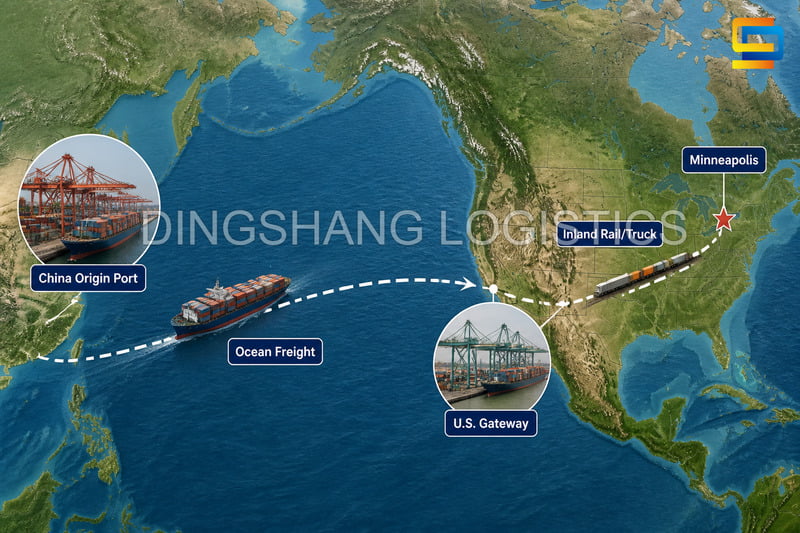
You cannot plan a China-to-Minneapolis shipment as a direct ocean voyage to Minneapolis. For international container shipping, Minneapolis should be treated as an inland destination: cargo moves from a China origin port to a U.S. coastal gateway, then inland toward the Twin Cities by rail and/or truck, followed by local drayage or final truck delivery.
A complete FCL transportation plan normally needs to address:
- Factory pickup or container loading in China
- Transport to the China origin port
- China export procedures
- Ocean freight to a suitable U.S. gateway
- U.S. customs clearance or properly arranged in-bond movement
- Inland rail or truck transportation
- Container availability at the applicable Twin Cities terminal or ramp
- Local drayage to the consignee
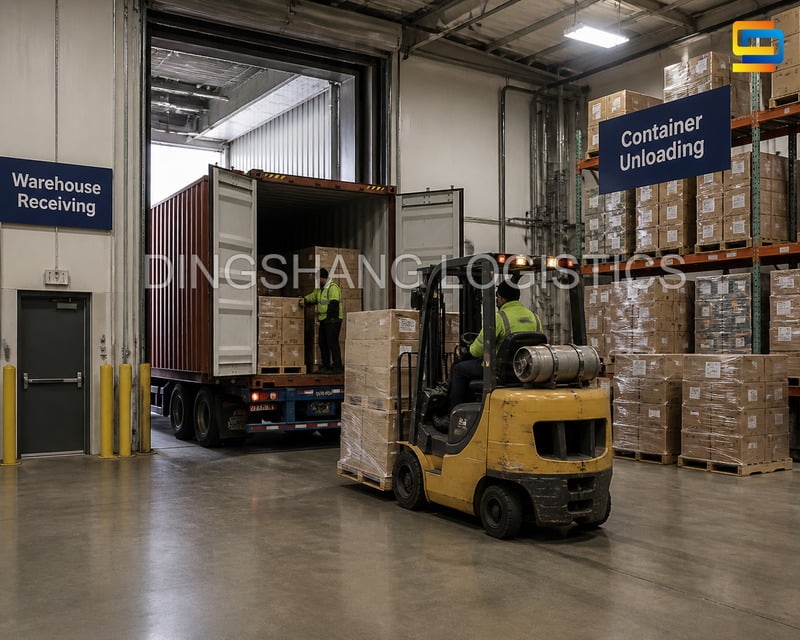
- Container unloading
- Empty-container return
If you are planning an inland intermodal move, Dingshang Logistics also provides an overview of China-to-USA sea-rail intermodal shipping.
What Does “Port of Minneapolis” Mean for China Container Shipping?
“Port of Minneapolis” should not be interpreted as a direct ocean container gateway for vessels arriving from China. Minneapolis has freight infrastructure connected with rail, trucking, waterways, and other transportation modes, but China-origin ocean containers normally enter through a coastal U.S. gateway before continuing inland.
Minnesota's freight system is explicitly multimodal. The Minnesota Department of Transportation identifies truck, rail, water, and air as freight modes, and its State Freight Plan identifies intermodal terminals in the Twin Cities region.1
For an importer, the important distinction is:
Ocean gateway ≠ Minneapolis destination
Depending on the carrier service and inland transportation plan, a shipment may enter through a West Coast, East Coast, or other suitable U.S. gateway before continuing inland to Minnesota.
That distinction affects your freight quote because an ocean rate ending at a coastal port does not include the same transportation scope as a quote ending at your Minnesota warehouse.
How Does a Container Reach Minneapolis After the Ocean Leg?
A container can reach the Minneapolis–St. Paul market through inland rail, trucking, or a combination selected for the actual shipment. Minnesota has established intermodal rail infrastructure, but the existence of a terminal does not mean every ocean carrier, gateway, or booking has a usable through-rail service to that facility.
MnDOT's 2024 State Freight Plan identifies four intermodal rail terminals available to Minnesota businesses. In the Twin Cities, these include BNSF Midway Yard in St. Paul, CPKC Shoreham Yard in northeast Minneapolis, and Union Pacific's Twin Cities Intermodal Terminal.2
That infrastructure makes the Twin Cities different from a generic inland destination. However, the specific terminal and rail movement must be confirmed against the actual carrier booking and inland service.
A simplified intermodal flow may look like:
China supplier → China origin port → U.S. coastal gateway → inland rail → Twin Cities terminal/ramp → local drayage → warehouse
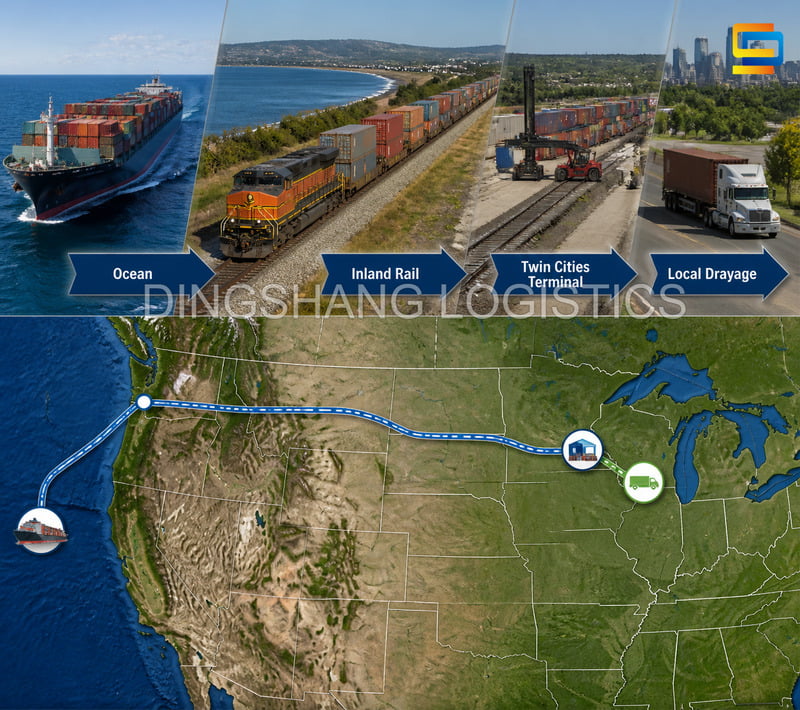
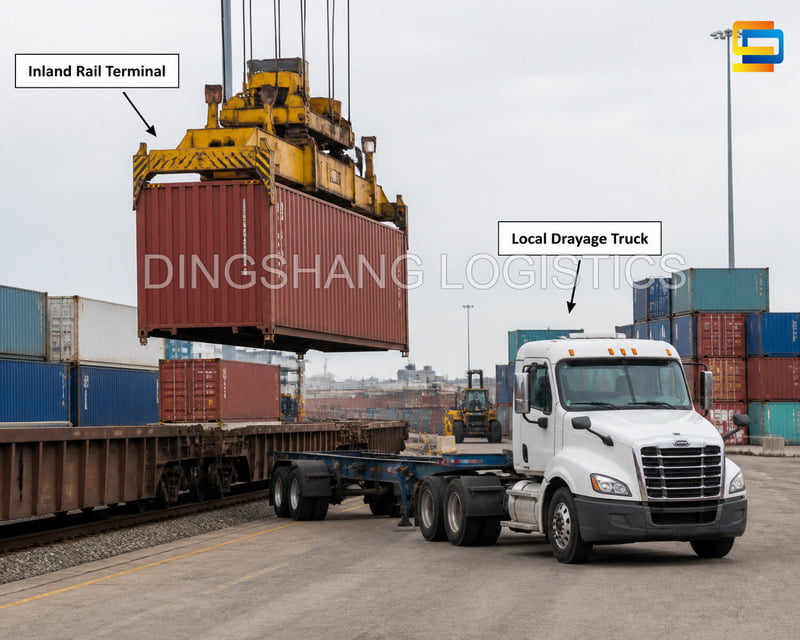
An inland rail ramp is not the same as door delivery. Once the container becomes available at the inland terminal, someone still needs to coordinate the final truck move.
For a Minneapolis-area FCL shipment, that means checking:
- container availability
- applicable rail free time and storage terms
- chassis arrangement
- drayage distance
- warehouse appointment requirements
- commercial receiving hours
- truck and container access
- unloading method
- expected unloading time
- empty-container return location and timing
The final delivery address matters because a warehouse in Minneapolis, St. Paul, or another Twin Cities suburb may have a different drayage plan from a facility farther outside the metro area.
Which U.S. Gateway Should You Use for Minneapolis?
There is no permanent best U.S. gateway for every Minneapolis shipment. The correct gateway depends on the China origin, current carrier service, ocean freight, inland connection, equipment and capacity, cargo characteristics, shipment timing, and final Minnesota delivery address.
Examples that may be evaluated include Los Angeles/Long Beach, Tacoma, New York/New Jersey, or other suitable U.S. container gateways.
| Routing Factor | What to Evaluate |
|---|---|
| China factory location | Pickup cost and practical China loading port |
| China origin port | Available sailings, cutoff, equipment, and routing |
| U.S. gateway | Ocean service and connection to the inland plan |
| Inland mode | Rail availability versus truck alternatives |
| Cargo weight | Container loading and inland transportation feasibility |
| Equipment | Container and chassis availability for the actual move |
| Final ZIP code | Drayage distance and delivery requirements |
| Warehouse | Appointment, access, unloading, and receiving conditions |
| Total cost | Complete transportation chain rather than ocean freight alone |
A low ocean rate does not automatically produce a low delivered cost. An importer should compare the ocean and inland legs together.
For broader route planning, see Dingshang's China-to-USA sea freight guide.
How Do You Ship a Container from China to Minneapolis Step by Step?
The process starts with the cargo and final delivery requirement, not with choosing a U.S. port. Once the shipment specifications are known, the forwarder can evaluate container size, China origin, U.S. gateway, customs arrangement, inland transportation, and final delivery as one transportation chain.
1. Confirm the Shipment Specifications
Start with the actual product and packing information.
For an FCL shipment, confirm:
- product name
- HS/HTS code, if available
- material or composition
- supplier or pickup location in China
- carton or pallet configuration
- total cargo volume
- gross cargo weight
- cargo-ready date
- FOB or EXW term
- final U.S. delivery address
- special loading, unloading, or delivery requirements
“Minneapolis” alone is not enough for an accurate door-delivery quotation.
A full delivery address is better than a ZIP code alone because it helps determine drayage distance, truck access, receiving hours, appointment requirements, unloading conditions, and whether direct container delivery is practical.
2. Choose a 20GP or 40HQ Container
For full-container shipments, 20GP and 40HQ are the main equipment options Dingshang Logistics evaluates.
| Container Type | Practical Planning Volume | Typical Use |
|---|---|---|
| 20GP | Around 28 CBM | Often evaluated for denser or heavier cargo |
| 40HQ | Around 68 CBM | Often evaluated for higher-volume cargo |
These are practical planning figures rather than guaranteed loading capacities. Actual usable space depends on carton dimensions, pallet configuration, loading method, cargo weight, and weight distribution.
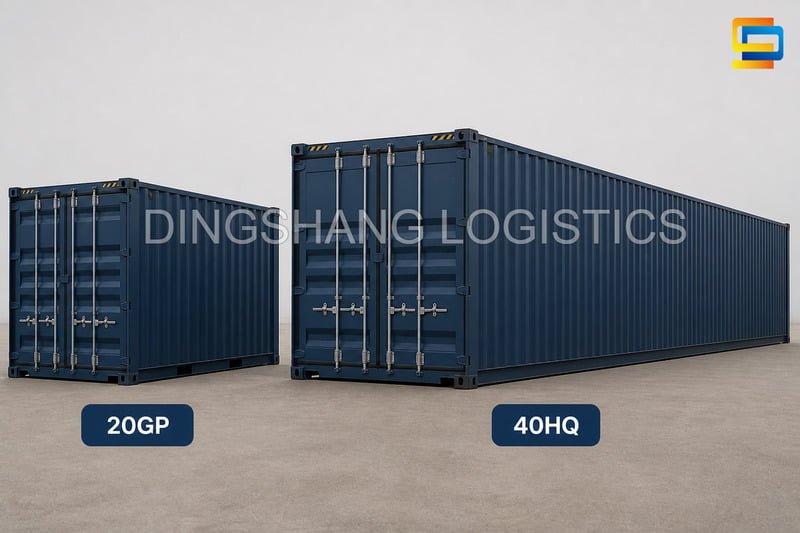
Do not choose between 20GP and 40HQ from CBM alone. Also consider:
- gross weight
- cargo density
- carton dimensions
- pallet dimensions and height
- loading method
- weight distribution
- inland road and equipment constraints
- warehouse receiving conditions
- total delivered cost
A 40HQ does not need to cost twice as much as a 20GP. The useful comparison is the total shipping cost for the required cargo volume, weight, route, and delivery scope.
Importers specifically evaluating larger equipment can also review the 40HQ container cost factors from China to the USA.
3. Select the China Origin Port
Ningbo, Shanghai, Shenzhen, and Qingdao are among Dingshang Logistics' main China origin ports. The appropriate loading port should be selected from the supplier location and actual transportation plan rather than simply asking the U.S. buyer to choose one.
The most suitable China loading port depends on:
- factory location
- available carrier service
- equipment
- vessel cutoff
- cargo-ready date
- routing
- origin trucking
- total delivered cost
For example, proximity to a port can be an important factor, but it does not mean every supplier in a particular province should automatically use the same port.
The buyer normally needs to provide the factory or pickup address, cargo details, and cargo-ready date. The forwarder can then evaluate the origin-port options.
If your supplier has quoted different trade terms, see FOB vs. EXW for U.S. importers before defining the pickup scope.
4. Arrange the U.S. Gateway and Inland Transportation
After the ocean routing is selected, confirm exactly what happens after vessel discharge.
Depending on the booking, the container may:
- continue inland under an intermodal arrangement;
- move inland by truck;
- use a combination of rail and truck; or
- follow another shipment-specific arrangement.
Customs clearance should not be described as occurring at one fixed point for every shipment. CBP provides for Immediate Transportation (IT) movements that allow eligible imported merchandise to move under bond from an arrival port to another U.S. port for final entry and clearance.3
Accordingly, customs entry may be completed at the first U.S. port of arrival or, where properly arranged, after an authorized in-bond movement. The appropriate procedure should be confirmed by a qualified U.S. customs broker for the actual shipment.
5. Arrange Final Drayage and Empty Return
For an FCL container reaching a Twin Cities inland terminal, the inland move is not finished when the rail leg ends.
Local delivery planning should confirm:
- when the container becomes available;
- whether a chassis is available or separately arranged;
- when the warehouse can receive the container;
- whether an appointment is required;
- how the consignee will unload;
- how long unloading is expected to take; and
- where and when the empty container must be returned.
This is why the final ZIP code and warehouse receiving conditions should be reviewed before the shipment leaves China—not after the container reaches Minnesota.
How Much Does It Cost to Ship a Container from China to Minneapolis?
There is no responsible single fixed price for shipping a container from China to Minneapolis without shipment details and a current quote. The delivered cost depends on the China pickup location, container size, cargo-ready date, U.S. gateway, inland route, cargo weight, customs scope, final ZIP code, and receiving requirements.
Ocean freight is only one part of the total China-to-Minneapolis logistics cost.
A complete cost review may include:
- China factory pickup
- origin handling
- export procedures
- ocean freight
- U.S. destination charges
- customs-clearance service
- inland rail, where used
- long-haul or local trucking
- chassis
- final drayage
- empty-container return
- applicable conditional charges
The basic distinction is:
Ocean freight ≠ total delivered logistics cost
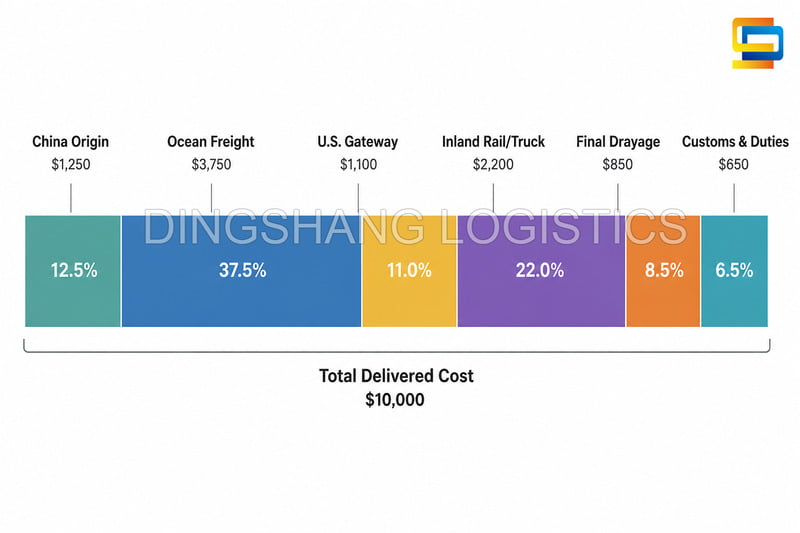
A lower ocean rate can be offset by a more expensive inland move, additional handling, or a less practical final-delivery arrangement.
What Should a Complete China-to-Minneapolis Quote Include?
A useful quotation should make its transportation boundary clear. A port-to-port quote and a door-to-door quote are not directly comparable.
| Cost Area | What to Confirm |
|---|---|
| China origin | Factory pickup, origin handling, export services |
| Ocean transportation | Origin port, destination gateway, container type |
| U.S. arrival | Destination and terminal-related charges included in the quote |
| Customs | Brokerage/clearance scope and responsibility |
| Inland transportation | Rail and/or trucking scope |
| Final delivery | Ramp-to-door drayage, appointment, chassis, unloading assumptions |
| Equipment return | Empty-container return responsibility |
| Conditional charges | Exams, storage, demurrage, detention, waiting time, special handling |
When comparing quotes, use the same China pickup point, same container type, same customs assumptions, and same final Minnesota address.
Are Customs Duties Included?
Customs duty should be treated separately from the freight rate unless the quotation explicitly states how duty is being handled.
Duty can often be estimated before shipment when the HTS classification, customs value, country of origin, and applicable tariff measures are known. The U.S. International Trade Commission publishes the Harmonized Tariff Schedule used to identify tariff classifications and applicable tariff provisions.4
The actual duty assessment depends on the import facts and applicable U.S. requirements. Classification can also affect additional tariffs or other measures, so the importer and customs broker should verify the current treatment of the product before shipment.
Customs clearance and duty are also different concepts:
- Customs clearance is the process of entering and obtaining release of imported merchandise.
- Duty is an amount assessed under the applicable tariff and import rules.
Do not assume that a freight quotation automatically includes duties simply because customs-clearance coordination is included.
What Conditional Charges Should You Watch?
For an inland destination such as Minneapolis, terminal timing, container availability, chassis, rail storage, delivery scheduling, and empty return can have a significant financial impact.
Important conditional charges can include:
- ocean-terminal demurrage
- container detention
- rail storage
- chassis-related charges
- customs exams
- truck waiting time
- additional delivery attempts
- special appointment or handling charges
- storage caused by delayed pickup or receiving
Demurrage and detention are not interchangeable. Broadly, demurrage relates to cargo/container time at a terminal beyond applicable free time, while detention generally concerns equipment held outside the terminal beyond the allowed period. Actual terms and billing should be checked against the applicable carrier, terminal, contract, and current rules.
The Federal Maritime Commission regulates ocean-carrier and marine-terminal demurrage and detention billing practices, including invoice requirements under its current rule.5
Rail storage is a separate inland issue. Do not assume that ocean-terminal free time automatically applies at a Twin Cities rail terminal.
How Long Does Container Shipping from China to Minneapolis Take?
China-to-Minneapolis lead time depends on the China origin, carrier schedule, U.S. gateway, transshipment if applicable, customs status, inland rail or truck connection, terminal availability, and final delivery appointment. A fixed transit-time range should not be assumed without checking the actual booking.
Importers should distinguish:
Ocean transit ≠ total door-to-door lead time
A complete timeline may include:
- supplier preparation
- China pickup
- vessel cutoff
- origin handling
- ocean transit
- transshipment, if applicable
- U.S. discharge
- customs processing or examination
- inland connection
- rail dwell or trucking
- container availability
- final delivery appointment
- unloading
If your inventory has a required delivery date, plan backward from the warehouse receiving date rather than using the vessel ETA as the expected Minneapolis delivery date.
How Dingshang Logistics Coordinates China-to-Minneapolis Shipments
Dingshang Logistics can coordinate the major transportation stages for qualifying China-to-Minneapolis shipments, with the exact scope defined in the quotation.
Depending on the shipment, the service may include:
- China factory pickup
- China export procedures
- ocean freight
- U.S. customs-clearance and duty-payment coordination where included in the agreed service scope
- inland rail where suitable and available
- inland trucking
- final warehouse delivery
- cargo insurance for qualifying door-to-door shipments
Dingshang Logistics provides both FCL and qualifying LCL ocean freight services from China to the United States. For full-container shipments to the Minneapolis area, 20GP and 40HQ are the main FCL options.
Dingshang Logistics does not provide express courier service. Very small commercial shipments, particularly those below about 2 CBM, may not always fit the company's normal LCL service model and should be evaluated separately rather than treated as a universal industry cutoff.
The key point is that the routing should be shipment-specific. Not every Minneapolis container must move by rail, not every shipment is DDP, and Dingshang Logistics should not be assumed to act as Importer of Record for every product or transaction.
Which Service Mode Should You Use for Minneapolis Container Shipping?
For cargo that already justifies a dedicated container, 20GP or 40HQ FCL is the main focus of this guide. Smaller qualifying commercial shipments can also be evaluated as LCL, but LCL has a different handling and pricing structure.
| Service Mode | How It Works | Main Minneapolis Consideration |
|---|---|---|
| 20GP FCL | Dedicated 20-foot container | Useful to evaluate for denser cargo; check weight and inland delivery |
| 40HQ FCL | Dedicated high-cube container | Useful for higher-volume cargo; confirm receiving and unloading |
| LCL | Cargo shares container space | Consolidation/deconsolidation and cargo-level inland delivery apply |
| FCL intermodal | Ocean container continues inland by rail where available | Confirm actual booking, terminal, drayage, and empty return |
| FCL with trucking | Container or cargo continues inland by truck | Compare distance, equipment, weight, and total delivered cost |
There is no universal CBM point where every importer should switch from LCL to FCL. Compare the complete delivered cost and handling requirements.
For a more detailed mode comparison, see when to choose FCL instead of LCL.
Port-to-Port vs. Door-to-Door Shipping to Minneapolis
Port-to-port and door-to-door quotations cover different parts of the transportation chain. For an inland destination such as Minneapolis, this distinction is especially important because the ocean gateway may be hundreds of miles from the final receiver.
| Service Scope | Typical Transportation Boundary | Importer Should Confirm |
|---|---|---|
| Port-to-port | China port to U.S. ocean gateway | Customs, inland transport, drayage, delivery |
| Inland-ramp service | China/ocean routing through an inland terminal | Final drayage and warehouse delivery |
| Door-to-door | China pickup through final U.S. delivery under the quoted scope | Customs, duty, unloading, accessorials, exclusions |
Port-to-port can work well for importers that already have their own customs broker, destination agent, inland transportation provider, and drayage arrangements.
Door-to-door is useful when the importer wants one forwarder to coordinate more of the transportation chain.
However:
Door-to-door does not automatically mean DDP, and it does not automatically mean every possible cost is fixed or included.
The quotation should state the Incoterm, transportation scope, customs responsibility, duty treatment, delivery assumptions, and conditional charges.
What Information Is Needed for a China-to-Minneapolis Freight Quote?
For an accurate Minneapolis FCL quotation, provide enough information to plan both the ocean leg and the inland delivery. The final address, cargo weight, and FOB/EXW term are particularly important.
Send:
- Product name
- HS/HTS code, if available
- Material or composition
- China factory or pickup address / postal code
- Final U.S. delivery ZIP code or full address
- Preferred or expected container type: 20GP or 40HQ, if known
- Gross cargo weight
- Total cargo volume or packing list
- Cargo-ready date
- Trade term: FOB or EXW
- Special handling or delivery requirements
If you are unsure which container size is appropriate, provide the packing list, gross weight, and cargo dimensions so the 20GP and 40HQ options can be compared.
If the exact volume is not available, send the supplier's packing list.
You do not need to decide whether the shipment should load in Ningbo, Shanghai, Shenzhen, or Qingdao before asking for a quote. The supplier address, cargo information, ready date, and trade term provide the information needed to evaluate the China origin.
Frequently Asked Questions
Is Minneapolis a direct ocean container port?
No. Minneapolis has inland freight and transportation infrastructure, but it is not a direct ocean container gateway for vessels arriving from China. China-origin containers normally enter through a U.S. coastal gateway and continue inland toward the Twin Cities.
How does a container from China reach Minneapolis?
A typical shipment moves from the China supplier to a China origin port, crosses the ocean to a U.S. gateway, and then continues inland by rail, truck, or a combination of both. If rail is used, local drayage is still required from the Twin Cities terminal to the final warehouse.
How long does container shipping from China to Minneapolis take?
There is no single reliable transit time for every shipment. Total lead time depends on the China origin, vessel schedule, gateway, customs status, inland connection, terminal availability, trucking, and warehouse appointment. Ocean transit should not be confused with the complete door-to-door timeline.
Is a 20GP or 40HQ better for a Minneapolis shipment?
A 20GP is often evaluated for denser or heavier cargo, while a 40HQ is often evaluated for higher-volume cargo. The decision should also consider weight, carton or pallet dimensions, loading method, inland transportation, warehouse receiving conditions, and total delivered cost.
Can one freight forwarder handle customs and delivery to Minneapolis?
Yes, a freight forwarder can coordinate multiple stages of a China-to-Minneapolis shipment, including ocean freight, customs-clearance coordination, inland transportation, and final delivery, depending on the agreed service scope.
Is customs duty included in a China-to-Minneapolis freight quote?
Not automatically. Duty should be treated separately unless the quotation specifically states that duty handling or payment is included. The applicable amount depends on the product's classification, value, origin, and current tariff measures.
Can I get a fixed all-in shipping cost before departure?
Many transportation costs can be quoted before departure, but a responsible quotation should distinguish fixed or quoted items from conditional charges. Customs exams, storage, demurrage, detention, waiting time, and other shipment-specific events may create additional costs depending on the circumstances.
What information do I need for a Minneapolis container shipping quote?
Provide the product name, material, HS/HTS code if available, China pickup location, final U.S. address or ZIP code, preferred container type if known, gross weight, cargo volume or packing list, cargo-ready date, FOB or EXW term, and any special delivery requirements. If you are unsure whether you need a 20GP or 40HQ, provide the packing list and cargo details so the options can be compared.
Get a China-to-Minneapolis Container Shipping Quote
Shipping a container from China to Minneapolis requires more than booking an ocean freight leg. The shipment normally moves through a U.S. coastal gateway and then continues inland by rail, truck, or a combination of both to the Minneapolis–St. Paul area.
For an accurate 20GP or 40HQ plan, compare the complete transportation chain rather than ocean freight alone.
For a Minneapolis-area quotation, send your product name, China factory or pickup location, container type, gross cargo weight, cargo-ready date, FOB or EXW term, and final U.S. ZIP code or delivery address.
If you have a packing list, send it with the inquiry so the shipment can be reviewed more accurately.
References
[Minnesota Department of Transportation — Freight, Railroads, and Waterways](https://www.dot.state.mn.us/ofrw/) ↩
[Minnesota Department of Transportation — Minnesota State Freight Plan: Assets, Conditions and Performance](https://www.dot.state.mn.us/minnesotago/freight/3-assets-conditions-performance.html) ↩
[U.S. Customs and Border Protection — Immediate Transportation Entry (IT) and Assignment of In-Bond Number Procedures](https://www.help.cbp.gov/s/article/Article-1150?language=en_US) ↩
[U.S. International Trade Commission — Harmonized Tariff Information](https://www.usitc.gov/harmonized_tariff_information) ↩
[Federal Maritime Commission — Detention and Demurrage Billing Practices](https://www.fmc.gov/articles/fmc-publishes-final-rule-on-detention-and-demurrage-billing-practices/) ↩
Leave a Comment