
How to Ship a Container from China to Port of Chicago?
To ship a container from China to Port of Chicago, I first correct one important misunderstanding: Chicago is an inland destination, not a normal ocean port.1 If you plan only around an ocean freight rate, you may miss rail, truck, customs, destination charges, and delivery risks. The better solution is to plan the full intermodal route from China to the final Chicago-area address.
Shipping a container from China to “Port of Chicago” usually means moving cargo by ocean from a China port to a U.S. coastal port, then by rail or truck to Chicago. Importers should compare total delivered cost, not only ocean freight, including origin charges, customs clearance, duties, destination fees, inland rail/truck, and final delivery.
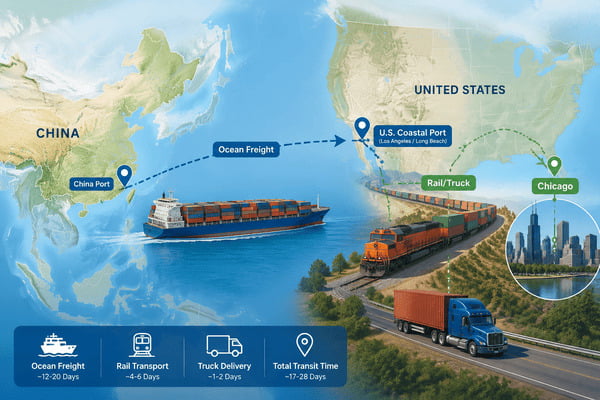
Many importers ask me for “the rate to Chicago” as if Chicago works like Los Angeles or New York. I understand why. The phrase “Port of Chicago” appears in logistics conversations. However, the real work is designing a reliable ocean + inland rail/truck route with clear responsibility at every handoff.
What Does It Really Mean to Ship a Container from China to Port of Chicago?
A common misunderstanding I see is that a vessel can sail directly from Shanghai, Ningbo, Shenzhen, or Qingdao to Chicago. That assumption can create wrong budgets and missed deadlines. I always explain the real route first so the buyer knows where costs and risks appear.
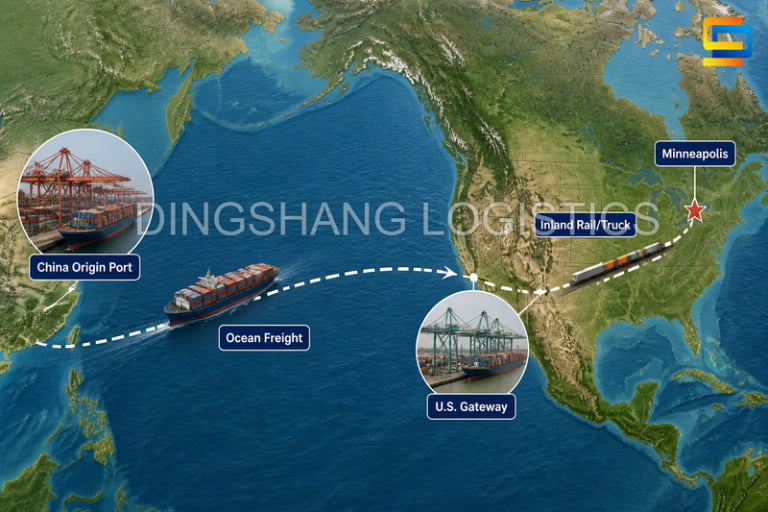
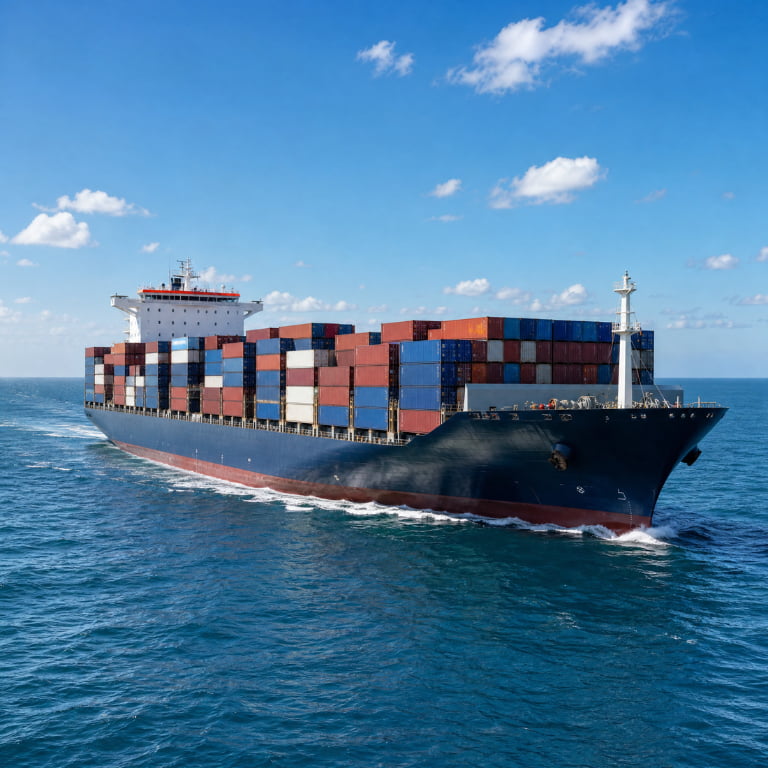
Shipping to Chicago means using an intermodal supply chain: China pickup or loading port, ocean freight to a U.S. coastal port, customs clearance, inland rail or truck transfer, and final delivery to a Chicago warehouse or business address. Chicago should be treated as an inland destination, not a standard ocean port.
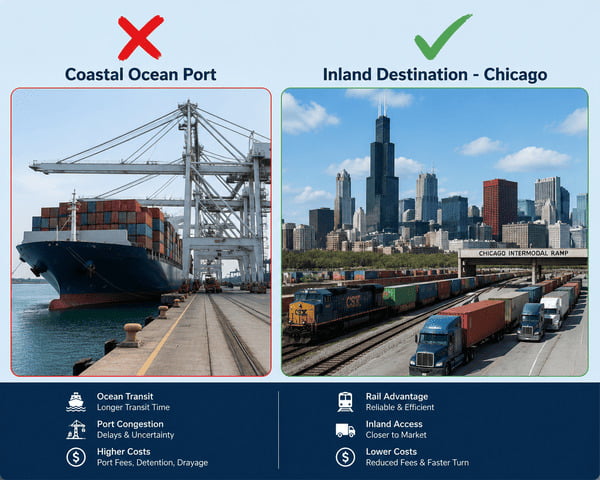
Chicago Is Not the Same as a Coastal Ocean Port
When I help customers plan a China-to-Chicago shipment, I do not treat Chicago as the first U.S. vessel arrival point. Instead, I treat it as the final inland destination. The vessel normally arrives at a coastal port first. Then the container or consolidated cargo moves inland.
A typical route looks like this:
- China supplier pickup or warehouse loading
- Export handling at a China port such as Ningbo, Shanghai, Shenzhen, or Qingdao
- Ocean freight to a U.S. coastal port
- U.S. customs clearance and destination processing
- Rail movement or truck transfer to Chicago
- Delivery appointment and final truck delivery
- Empty container return, if the shipment is FCL
This structure matters because each stage has a different cost owner, document requirement, and risk point.
Typical U.S. Entry Routes for Chicago Cargo
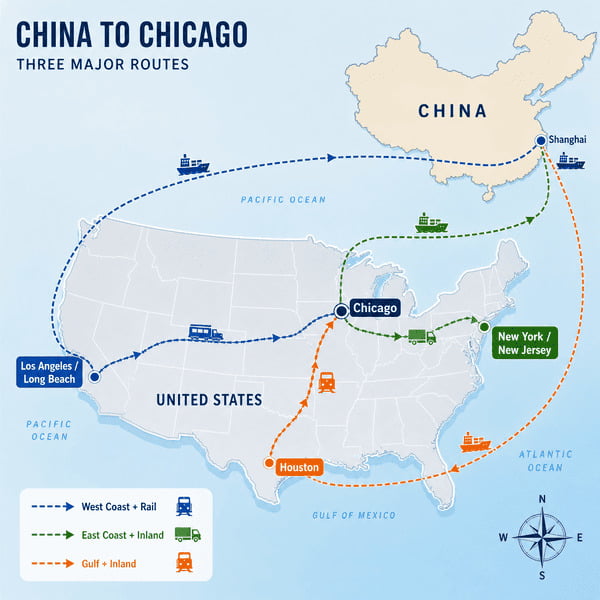
For Chicago-area importers, I often review several route options. The best option depends on price, schedule stability, port congestion, rail availability, and delivery deadline.
| Route Type | Common Use | Main Advantage | Main Risk |
|---|---|---|---|
| West Coast + rail to Chicago | Many Asia-to-Midwest shipments | Often strong transit options | Port/rail congestion can affect timing |
| East Coast + inland move | Some cargo bound for Midwest/East | Useful for certain carrier services | Longer ocean transit in many cases |
| Gulf route + inland truck/rail | Some specialized routing | Can fit certain destination networks | Availability varies by carrier and season |
I never assume one route is always best. For example, a low ocean rate to one coastal port may lose its advantage if the inland rail cost, terminal wait, chassis availability, or final trucking cost is high.
> In my experience, the cheapest ocean leg does not always create the cheapest delivered shipment.
Where Responsibility Changes
The buyer must understand the responsibility boundary. Under some Incoterms, the supplier handles export arrangements. Under others, the buyer or forwarder handles more of the route.2 In practical freight planning, I usually clarify these questions:
- Who pays China origin charges?
- Who controls the ocean booking?
- Who arranges customs clearance?
- Who pays duties and taxes?
- Who handles rail or truck inland transportation?
- Who schedules the Chicago warehouse appointment?
- Who is responsible for detention, demurrage, storage, or waiting time?
These details decide the real cost. They also decide who solves problems when a container is delayed, exams are requested, or a warehouse appointment changes.
Which Route Is Best to Ship a Container from China to Port of Chicago?
Many importers want the fastest or cheapest route, but that question is too narrow. A route that looks cheap on paper may create extra charges if the rail ramp is congested or the final warehouse has strict receiving rules. I prefer to choose routes by total reliability.
The best route to ship a container from China to Port of Chicago is usually the route with the best balance of ocean schedule, U.S. port performance, rail connection, customs timing, and final delivery feasibility. The right answer depends on origin city, cargo type, delivery address, timeline, and budget preference.
Main Route Design Factors
Before I recommend a routing plan, I look at more than the carrier name. I want to know how the shipment will behave from factory door to Chicago door.
The main factors include:
- China origin city: A supplier in Yiwu, Suzhou, Dongguan, or Qingdao may point to different loading ports.
- China loading port: Ningbo, Shanghai, Shenzhen, and Qingdao each have different schedules and carrier strengths.
- Cargo volume and weight: Heavy cargo can affect rail or truck options.
- Final Chicago delivery address: A commercial warehouse, Amazon-style facility, distribution center, or job site may require different planning.
- Delivery appointment rules: Some warehouses charge penalties for missed or late appointments.
- Customs risk: Some products need more document checking than others.
- Budget vs. timing: A buyer may prefer a slower but stable plan or a faster premium option.
Common China-to-Chicago Flow
In many cases, I build the flow like this:
| Stage | What Happens | Main Cost/Risk |
|---|---|---|
| China pickup | Cargo moves from supplier to warehouse or port | Trucking cost, pickup timing, packing quality |
| Export handling | Customs export and port handling occur | Document accuracy, cut-off time |
| Ocean freight | Container sails to U.S. coastal port | Sailing schedule, blank sailings, transshipment |
| U.S. arrival | Cargo reaches first U.S. port | Terminal fees, exams, congestion |
| Inland rail/truck | Cargo moves toward Chicago | Rail schedule, chassis, ramp availability |
| Final delivery | Truck delivers to warehouse | Appointment, unloading time, access limits |
I like this table because it changes the conversation. The buyer stops asking only, “What is the ocean freight?” and starts asking, “What is included, what is excluded, and who is responsible?”
West Coast Versus East Coast Considerations
For Chicago cargo, West Coast entry followed by rail is common because many Asia services connect efficiently into inland rail networks.3 However, I still compare options. Sometimes an East Coast route can make sense if the carrier schedule, port situation, or inland capacity is better for that specific shipment.
I usually look at:
- Transit time range, not a guaranteed fixed day count
- Carrier service stability, especially during peak season
- Rail connection quality into Chicago-area ramps
- Likelihood of extra fees, such as storage or chassis charges
- Final truck delivery complexity after rail arrival
I avoid promising fixed transit times because shipping conditions change. Weather, port congestion, customs exams, rail delays, and warehouse appointments can affect the actual delivery date. A responsible quote should give an estimated transit window and explain what can change.
Why Final Address Matters
The phrase “Chicago” is too broad. A delivery to a warehouse near Joliet, a distribution center near Naperville, a facility near O’Hare, or a business address in the city can have different trucking costs and appointment requirements.
Before quoting, I usually ask for the full delivery ZIP code. If the buyer cannot provide the exact address yet, I ask for at least the city and ZIP estimate. This helps me avoid misleading numbers. A few miles can matter when appointment time, liftgate needs, limited access, or live unloading are involved.
How Much Does It Cost to Ship a Container from China to Port of Chicago?
The biggest pricing mistake I see is comparing only the ocean freight rate. That number may look attractive, but it does not show the full delivered cost. Importers need to understand origin charges, destination charges, customs, duties, inland transportation, and final delivery fees.
The cost to ship a container from China to Port of Chicago depends on cargo size, weight, China origin, U.S. entry route, customs requirements, inland rail/truck cost, and delivery address. Importers should request an all-in quotation that clearly separates freight, local charges, customs clearance, duties, and final delivery.
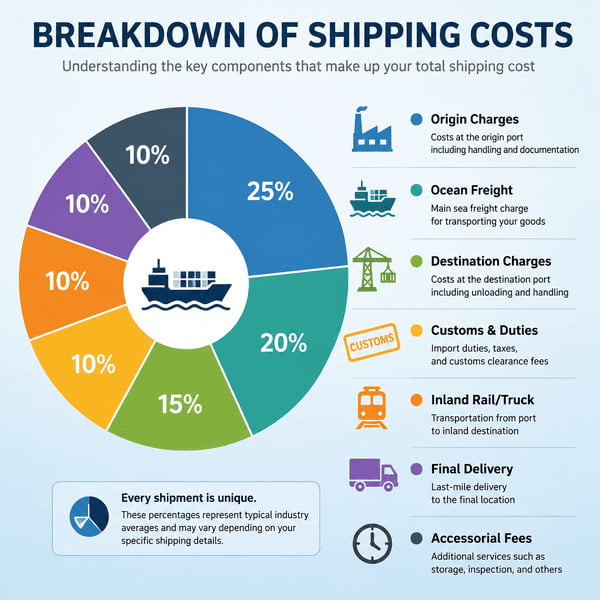
The Real Cost Is a Delivered Cost
When I prepare a quote for a Chicago-area shipment, I prefer to show the cost structure instead of hiding everything inside one vague number. This helps the importer compare options correctly.
A complete cost picture may include:
- China pickup fee, if cargo is collected from the supplier
- China export/origin charges
- Ocean freight
- Bill of lading and documentation fees
- U.S. destination terminal charges
- Customs clearance service fee
- Duties, taxes, and possible additional tariffs
- Customs bond, if needed
- Exam fees, if customs or other agencies inspect the cargo
- Inland rail or truck transportation
- Chicago-area final delivery
- Warehouse appointment or waiting time
- Detention, demurrage, storage, or chassis fees, if delays occur
Not every shipment has every charge. However, every shipment should be checked for these possibilities.
Sample Cost Categories
I do not recommend using any online number as a final freight cost because rates change frequently. Still, a cost category table helps importers understand what they are buying.
| Cost Category | Applies To | Who Usually Handles It |
|---|---|---|
| Origin charges | Export handling in China | Supplier or forwarder, depending on terms |
| Ocean freight | Main sea leg | Forwarder or carrier |
| Destination charges | U.S. terminal/arrival handling | Forwarder, customs broker, or consignee |
| Customs clearance | Import declaration | Licensed customs broker |
| Duties/taxes | Government charges | Importer of record |
| Inland rail/truck | U.S. coastal port to Chicago area | Forwarder, carrier, or trucker |
| Final delivery | Ramp/terminal to warehouse | Trucking provider |
| Accessorial charges | Waiting, storage, exams, detention | Depends on cause and contract terms |
Why “All-In” Still Needs Details
I often provide transparent all-in quotations, especially for door-to-door shipments. However, “all-in” should not mean “anything that ever happens is included.” A professional quote should state what is included and what is not included.
For example, an all-in door-to-door quote may include standard customs coordination, normal terminal handling, inland delivery, and free cargo insurance for eligible door-to-door shipments. But it may exclude:
- Customs duties and taxes, unless specifically included as duty handling
- Customs exams or government agency inspection fees
- Storage caused by late documents
- Waiting time caused by missed delivery appointments
- Extra services such as liftgate, inside delivery, or pallet exchange
- Detention caused by slow unloading or late empty return
This is why I ask customers to review the quotation line by line. A low quote with unclear exclusions can become expensive after arrival.
Duty and Customs Cost Warning
I am a freight forwarder, not a customs attorney or tax authority. Duties and import requirements must be checked case by case based on the HS code, product description, declared value, country of origin, and importer status.
Before quoting or arranging customs coordination, I usually ask for:
- Product name
- Material and usage
- HS code, if available
- Declared value
- Manufacturer or supplier details
- Importer of record information
- Any special compliance documents
Accurate product information reduces the risk of customs delays. It also helps the importer estimate duty exposure before the cargo leaves China.
Should I Use FCL or LCL When Shipping from China to Chicago?
Some buyers choose FCL or LCL only by container size. That can create problems. Cargo volume matters, but weight, delivery timing, handling risk, and total cost matter too. I always compare both options when the shipment is near the break-even point.
Use FCL when your cargo volume, urgency, damage risk, or delivery control justifies a dedicated container. Use LCL when your shipment is smaller and you can accept consolidation handling. For China-to-Chicago cargo, the best choice depends on CBM, weight, product fragility, schedule, and final delivery needs.
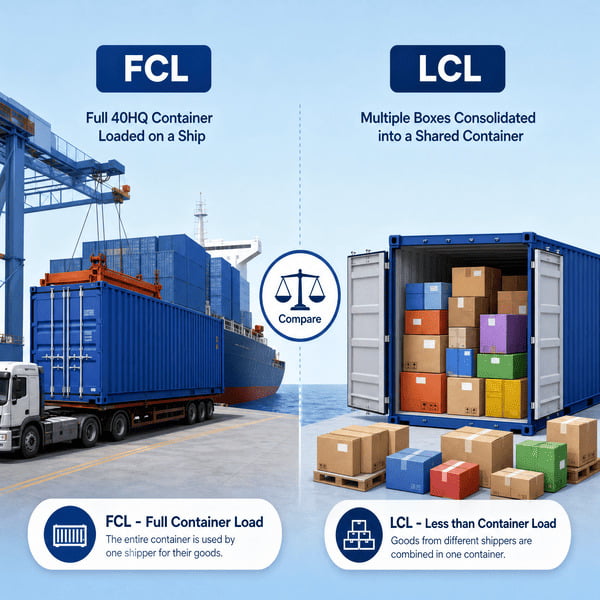
FCL: Best for Volume, Control, and Lower Handling
FCL means Full Container Load. The cargo occupies a dedicated container, such as a 20GP or 40HQ. The container may be loaded at the supplier’s factory, a forwarder’s warehouse, or near the port.
FCL is often better when:
- Cargo volume is high
- Cargo is heavy or fragile
- The importer wants fewer cargo touches
- The shipment needs better schedule control
- The supplier can load efficiently
- The final warehouse can receive a container delivery
Common container references include:
| Container Type | Typical Use | Notes |
|---|---|---|
| 20GP | Heavy cargo, smaller volume | Weight limit must be checked |
| 40GP | General cargo | Less common than 40HQ for many importers |
| 40HQ | Larger volume cargo | Popular for furniture, household goods, bulky products |
A 40HQ is often attractive for bulky products because it provides more cubic capacity. However, the correct choice depends on cargo dimensions, weight, packaging, and loading plan.
LCL: Useful for Smaller Shipments
LCL means Less than Container Load. Your cargo shares container space with other shipments. It is usually priced by cubic meter or weight, depending on which is greater.
LCL can work well when:
- The cargo volume is too small for FCL
- The buyer wants to test a supplier
- Inventory needs are modest
- Budget matters more than speed
- The buyer can accept extra handling
However, LCL has more touchpoints. Cargo may be handled at the origin warehouse, consolidation warehouse, destination CFS, and final trucking stage. This can increase damage risk for fragile goods if packaging is weak.
Break-Even Thinking
I do not use one fixed CBM number for every shipment, but I do pay close attention when cargo reaches a volume where LCL becomes less economical. The break-even point changes with market rates, season, cargo density, and routing.
Here is a practical comparison:
| Factor | FCL | LCL |
|---|---|---|
| Cost basis | Per container | Per CBM/weight |
| Handling | Lower | Higher |
| Damage risk | Usually lower | Usually higher |
| Transit predictability | Often better | Can vary due to consolidation |
| Best for | Larger or sensitive cargo | Smaller shipments |
| Final delivery | Container or transload | Usually pallet/carton delivery |
Damage and Delay Risk
I once handled a shipment where the buyer wanted LCL because the cargo did not fill a full container. The product was fragile, and the packaging was not strong enough for multiple handoffs. After reviewing the details, I suggested either improved packaging or FCL if the value justified it. That kind of decision is not only about freight price. It is about protecting the commercial result.
For Chicago-bound cargo, LCL may also involve deconsolidation before final delivery. If the consignee has a strict delivery appointment, this extra step needs planning. Good communication with the warehouse can prevent missed appointments and surprise waiting charges.
What Should I Confirm Before I Ship a Container from China to Port of Chicago?
Many delays start before the shipment is even booked. Missing cargo details, unclear Incoterms, wrong delivery addresses, and incomplete importer information can create problems later. I prefer to slow down before quoting so the shipment moves faster after booking.
Before you ship a container from China to Port of Chicago, confirm cargo volume, weight, pieces, supplier location, loading port, final Chicago delivery address, product name, HS code, declared value, importer details, customs needs, delivery appointment rules, target timeline, and budget preference. These details allow an accurate route and quote.
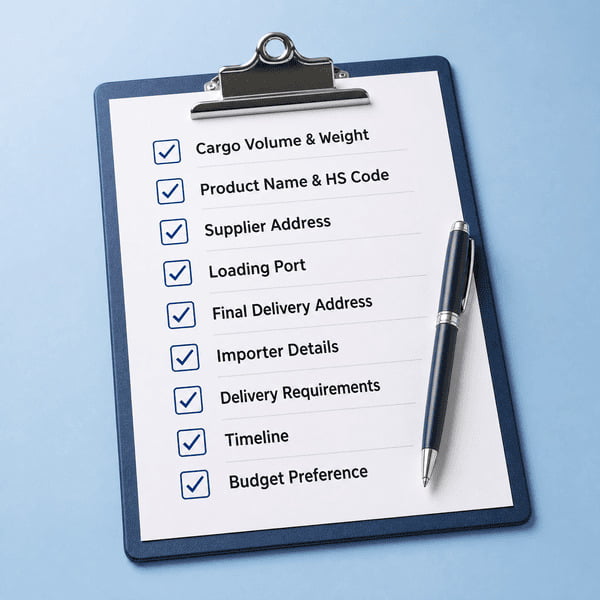
My Pre-Quote Checklist
Before quoting, we usually confirm the basic cargo and delivery facts first. This avoids vague pricing and reduces later disputes.
I normally ask for:
- Cargo volume: Total CBM or carton dimensions
- Gross weight: Total weight and weight per package if heavy
- Number of pieces: Cartons, pallets, crates, or machines
- Product name: Clear commercial description
- HS code: If available
- Declared value: For customs and insurance reference
- Supplier address: City and pickup location in China
- Preferred loading port: Ningbo, Shanghai, Shenzhen, Qingdao, or another port
- Final delivery address: Full Chicago-area address and ZIP code
- Delivery requirements: Appointment, dock, forklift, liftgate, limited access
- Importer information: EIN, company name, bond status, broker preference
- Timeline: Ready date, target arrival, urgent or flexible
- Budget preference: Cheapest workable route or more stable service
Documents Usually Needed
The exact document set depends on the product and importer, but common documents include:
| Document | Purpose |
|---|---|
| Commercial invoice | Shows seller, buyer, product, value, and terms |
| Packing list | Shows packages, weight, volume, and details |
| Bill of lading | Transport document for ocean shipment |
| Arrival notice | Helps coordinate destination processing |
| Customs entry documents | Used for import declaration |
| Power of attorney | Allows broker to file customs entry |
| ISF information | Required before ocean departure for U.S. imports |
The Importer Security Filing (ISF) is especially important for U.S. ocean imports. Late or inaccurate filing can create risk.4 I always remind importers to prepare details early, not after the vessel sails.
Delivery Appointment Planning
Chicago final delivery is not just “send a truck.” Many B2B warehouses require appointments. Some facilities accept only specific receiving windows. Some require driver check-in numbers, pallet counts, or delivery references.
I usually confirm:
- Does the warehouse need a delivery appointment?
- Can the warehouse unload a floor-loaded container?
- Is a dock available?
- Is a forklift available?
- Is the delivery live unload or drop trailer/container?
- How long does unloading usually take?
- Are there penalties for late arrival?
- Can the consignee accept partial LCL delivery?
These questions protect the importer from unnecessary accessorial charges. They also help the trucker plan equipment correctly.
Risk Control Before Booking
I like to identify risk before the shipment leaves China. That is much cheaper than solving problems after arrival.
Important risk checks include:
- Packaging strength: LCL cargo needs stronger packaging because it is handled more.
- Cargo weight distribution: Heavy cargo must be loaded safely.
- HS code accuracy: Wrong classification can delay customs.
- Declared value consistency: Customs documents should match commercial records.
- Supplier readiness: Cargo should be ready before the cut-off date.
- Peak season planning: Space can tighten before holidays or tariff deadlines.
- Insurance: Cargo insurance should be considered, especially for high-value goods.
For our door-to-door shipments, we can include free cargo insurance in many cases. Still, I always tell customers that insurance does not replace good packaging, correct documents, and realistic delivery planning.
Frequently Asked Questions
Is there a direct ocean vessel from China to Chicago?
No. Chicago is an inland destination, not a standard ocean vessel arrival port. Cargo usually moves by ocean from China to a U.S. coastal port, then continues inland by rail or truck to a Chicago-area rail ramp, warehouse, or final delivery address.
How long does China to Chicago shipping take?
Transit time depends on the China loading port, carrier service, U.S. entry port, rail connection, customs status, and final delivery appointment. I recommend treating any timeline as an estimate, not a guarantee. Customs exams, port congestion, rail delays, and warehouse scheduling can change the final delivery date.
Is FCL cheaper than LCL for Chicago shipments?
FCL is not always cheaper, but it can become more economical when cargo volume is large enough. LCL can save money for small shipments, but it has more handling and possible destination charges. I usually compare both options when the shipment is near the break-even point.
What information do I need for a China-to-Chicago quote?
You should provide cargo volume, weight, pieces, product name, HS code, declared value, supplier address in China, preferred loading port, final Chicago delivery address, importer details, delivery requirements, ready date, and budget preference. These details help create an accurate all-in quote.
Can a freight forwarder handle customs and door-to-door delivery?
Yes, a freight forwarder can coordinate ocean freight, customs clearance, duty handling, inland rail or truck transportation, and door-to-door delivery through the right partners. Customs duties, taxes, and compliance requirements still need to be checked case by case based on the product and importer.
Conclusion
To ship a container from China to Port of Chicago, you need more than an ocean freight booking. You need an intermodal plan that covers China origin handling, ocean freight, U.S. customs, duties, inland rail or truck movement, destination charges, and final warehouse delivery. I recommend comparing total delivered cost, not just the cheapest ocean rate. If you import regularly from China to the Chicago area, Dingshang Logistics can help you review FCL, LCL, customs coordination, duty handling, and door-to-door delivery options with a transparent all-in quote.
"Illinois International Port District (Port of Chicago)", https://www.greatlakesports.org/aglpa-members/iipd-port-of-chicago/. An encyclopedic geographic source identifying Chicago as an inland city on Lake Michigan supports the article’s distinction between Chicago and coastal ocean gateway ports. Evidence role: definition; source type: encyclopedia. Supports: Chicago is geographically inland and associated with Great Lakes/river port facilities rather than a coastal ocean container gateway.. Scope note: This supports the geographic and logistical context, but it does not by itself prove the absence of every possible vessel service to Chicago. ↩
"Know Your Incoterms", https://www.trade.gov/know-your-incoterms. International Chamber of Commerce materials on Incoterms support the article’s statement that different trade terms allocate export, transport, cost, and risk responsibilities differently between seller and buyer. Evidence role: definition; source type: institution. Supports: Incoterms rules define seller and buyer responsibilities for costs, risks, delivery, and certain clearance obligations.. ↩
"Demands on the Transportation System - FHWA Operations", https://ops.fhwa.dot.gov/freight/freight_analysis/freight_story/demands.htm. Government freight-flow data showing West Coast port gateways and intermodal rail links to inland U.S. markets provide contextual support for the article’s statement that West Coast-plus-rail routing is common for Asia-to-Midwest cargo. Evidence role: general_support; source type: government. Supports: U.S. West Coast ports serve as major gateways for Asian containerized trade and are linked to inland markets by intermodal rail.. Scope note: The evidence would support the general routing pattern, not establish that it is the best route for a specific shipment. ↩
"CBP Dec. 09−26 Guidelines for the Assessment and ...", https://www.cbp.gov/sites/default/files/documents/CBPDec09-26.pdf. U.S. Customs and Border Protection guidance on Importer Security Filing enforcement supports the article’s warning that late or inaccurate ISF submissions create compliance risk. Evidence role: general_support; source type: government. Supports: CBP may enforce penalties or liquidated damages for late, inaccurate, or incomplete ISF filings.. ↩
Leave a Comment