
Shipping a container from China to Port of Cleveland sounds simple, but many importers discover that the real challenge is not the ocean booking. The harder part is choosing a workable route, understanding who pays which charges, and getting the container delivered to the Cleveland-area warehouse without surprise costs.
To ship a container from China to Port of Cleveland, I first confirm whether the importer truly needs port delivery or final-door delivery in the Cleveland area. Then I compare China origin ports, U.S. entry ports, inland rail or truck routes, customs clearance, destination charges, and final delivery costs before quoting a complete FCL logistics plan.
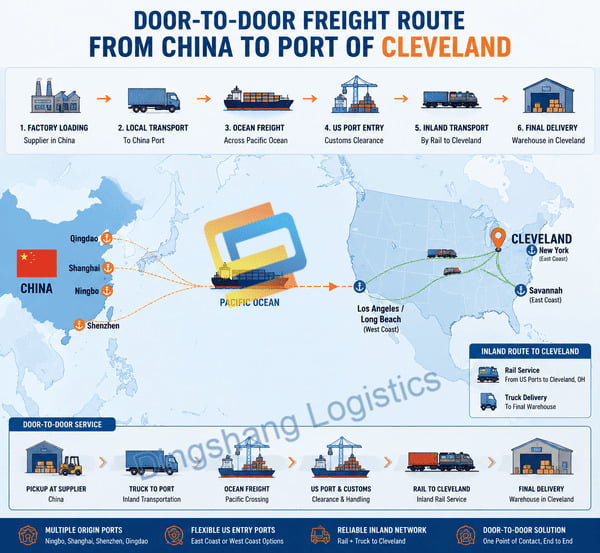
In my day-to-day work as a China-based freight forwarder, I often see buyers ask for “Port of Cleveland” when they actually mean “deliver my container to my facility near Cleveland.” That small difference can change the route, cost structure, responsibility, and timeline.
What Does It Really Mean to Ship a Container from China to Port of Cleveland?
Many importers start with a port name because ocean freight feels port-based. That assumption can create problems. If the real destination is a warehouse, showroom, factory, or distribution center near Cleveland, a port-to-port quote may leave out major parts of the shipment.
To ship a container from China to Port of Cleveland in a practical way, I treat Cleveland as the final delivery area unless the importer specifically needs cargo discharged at the port. I verify current service options, compare U.S. entry routes, and build the quote around the final delivery address.
Why the “Port of Cleveland” Question Can Be Misleading
When someone asks me, “Can you ship a container from China to Port of Cleveland?” I usually ask one follow-up question first:
“Do you need the container delivered to the port, or do you need it delivered to your final address in the Cleveland area?”
That question matters because Cleveland is not always handled like Los Angeles, New York, Savannah, or Houston for regular China-origin container routing. Current sailing options, inland connections, seasonal service, carrier coverage, and terminal handling availability must be confirmed for each shipment.1
For most importers, the actual goal is not “port arrival.” The goal is:
- The container is loaded at a supplier or warehouse in China.
- The cargo clears export and ocean shipping procedures.
- The shipment enters the United States through a suitable gateway.
- U.S. customs clearance is completed.
- The container moves inland by rail, truck, or a combination.
- The cargo arrives at the Cleveland-area consignee.
That is a door-to-door FCL logistics plan, not just a port-to-port ocean rate.
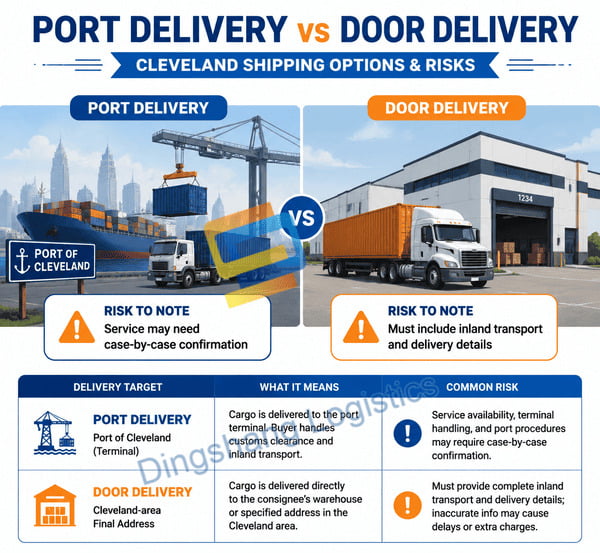
Port Delivery vs. Door Delivery
The difference is simple, but the cost impact can be large.
| Delivery Target | What It Means | Common Risk If Misunderstood |
|---|---|---|
| Port of Cleveland delivery | Cargo is routed for discharge or handling at the port, if service is available and suitable | Service may need case-by-case confirmation |
| Cleveland-area door delivery | Container is delivered to a business address, warehouse, or final consignee | Quote must include inland transport and delivery details |
| U.S. entry port only | Container arrives at another U.S. port such as New York, Norfolk, Savannah, or others | Importer may still need rail/truck to Ohio |
| Rail ramp delivery | Container moves by rail to an inland ramp, then truck to final address | Drayage, chassis, appointment, and unloading time still matter |
I have seen importers compare a supplier’s CIF quote with a forwarder’s door-to-door quote and assume the supplier is cheaper. Later, they realize the CIF quote only covers arrival at a U.S. port and does not include destination charges, customs clearance, rail, truck, or Cleveland delivery.
That is why I always reframe the question early. If you want to ship a container from China to Port of Cleveland, the first decision is whether you are buying transport to a port name or transport to a usable final destination.
Which Route Should I Use to Ship a Container from China to Port of Cleveland?
Route choice is where many shipping mistakes happen. A lower ocean rate does not always mean a lower total cost. A route with a cheap port-to-port rate may become expensive if inland rail, chassis, storage, or final truck delivery is inefficient.
The best route to ship a container from China to Port of Cleveland depends on the Chinese origin, container size, cargo weight, U.S. entry port, rail availability, final delivery address, and required timing. I usually compare several route options before recommending one.
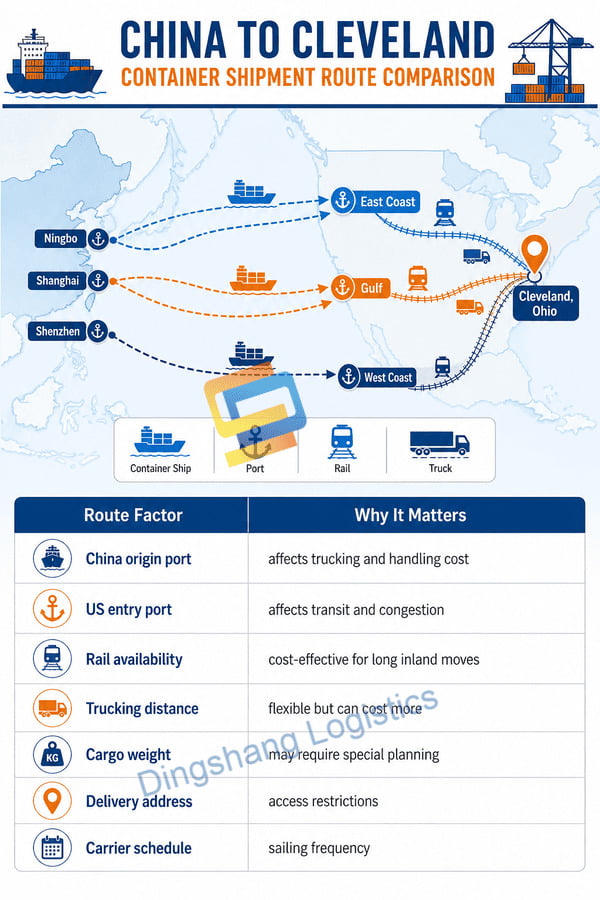
Common Route Logic for Cleveland-Area FCL Shipments
For a Cleveland-area delivery, I do not start by asking, “Which ocean port is cheapest?” I start by mapping the full movement.
A workable plan usually includes:
-
China pickup or factory loading
- Supplier city
- Loading address
- Cargo ready date
- Container type: 20GP, 40GP, or 40HQ
-
China loading port
- Ningbo
- Shanghai
- Shenzhen/Yantian
- Qingdao
- Other ports depending on factory location
-
U.S. entry strategy
- East Coast port
- Gulf port
- West Coast port with rail
- Other gateways depending on carrier service and inland network
-
Inland move to Ohio
- Rail to an inland ramp
- Truck from port or ramp
- Intermodal route if cost and timing make sense
-
Final Cleveland-area delivery
- Delivery appointment
- Live unload or drop trailer/container
- Unloading time
- Residential or commercial restrictions
- Access for container truck
Why I Compare More Than One Route
A shipment from Shanghai to Cleveland may not follow the same route as a shipment from Shenzhen to Cleveland. A heavy 20GP container may also need a different inland plan than a light 40HQ of household goods, furniture, packaging, machinery parts, or consumer products.
Here is a simplified way I compare route options:
| Route Factor | Why It Matters |
|---|---|
| China origin port | A nearby loading port can reduce China trucking and origin handling cost |
| U.S. entry port | It affects ocean transit, port congestion risk, destination fees, and inland distance |
| Rail availability | Rail can be cost-effective for long inland moves, but timing and ramp availability matter2 |
| Trucking distance | Long-haul trucking may be flexible but can cost more |
| Cargo weight | Heavy containers may face road weight limits or require special planning3 |
| Delivery address | A Cleveland warehouse near major highways is easier than a restricted downtown or remote site |
| Carrier schedule | Sailing frequency and reliability must be checked for the shipping window |
A Practical Example
Suppose a U.S. importer buys one 40HQ of building materials from a supplier near Ningbo. The final consignee is in the Cleveland area. The importer asks for a quote to “Port of Cleveland.”
Before quoting, I would check:
- Is the cargo ready near Ningbo or another inland city?
- Is FOB Ningbo offered, or does the supplier quote CIF/CFR?
- Does the importer need customs clearance in the U.S.?
- Does the importer have a customs broker, or should I coordinate one?
- Is delivery to a warehouse required?
- Can the warehouse unload a 40HQ container?
- Is a live unload needed, and how many hours are required?
- Is the cargo heavy enough to trigger overweight concerns?
Only after that can I compare route possibilities. Sometimes the best plan may involve a major U.S. gateway and inland movement to Ohio. In other cases, another intermodal combination may be better. The right answer depends on live market conditions and shipment details.
So, when I help an importer ship a container from China to Port of Cleveland, I treat the route as a cost-risk decision, not only a sailing schedule decision.
What Costs Should Be Included When You Ship a Container from China to Port of Cleveland?
Many importers focus on the ocean freight rate because it is the most visible line item. That can be dangerous. The ocean rate is only one part of the logistics cost, and an incomplete quote can make a shipment look cheaper than it really is.
A usable quote to ship a container from China to Port of Cleveland should include origin charges, ocean freight, destination charges, customs clearance coordination, duties or taxes if arranged, inland rail or truck, and final delivery charges. The quote should also state what is excluded.
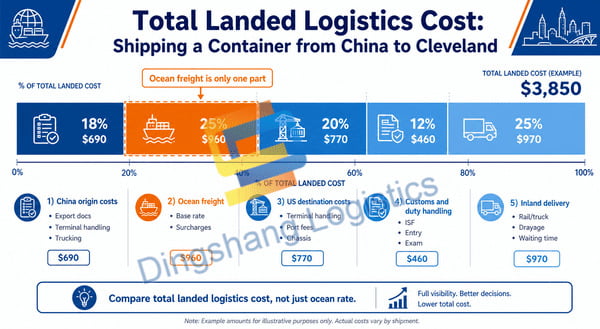
The Total Landed Logistics Cost Matters Most
I always tell customers that they should not compare quotes by the ocean freight line alone. They should compare the total landed logistics cost to their Cleveland-area destination.
A complete FCL quote may include:
-
China origin costs
- Export documentation
- Origin terminal handling
- Customs declaration in China
- Trucking from factory to port, if not covered by the supplier
- Container loading support, if needed
-
Ocean freight
- Base ocean rate
- Carrier surcharges
- Peak season surcharge if applicable
- Fuel-related surcharges
- Equipment or space-related charges, depending on market conditions
-
U.S. destination costs
- Terminal handling or destination service charges
- Documentation
- Port or ramp fees
- Chassis-related costs where applicable
- Demurrage or detention risk if delays happen
-
Customs and duty handling
- Customs entry coordination
- Importer security filing, commonly called ISF4
- Duty and tax calculation support
- Customs exams if selected by authorities
-
Inland delivery
- Rail or truck from port/ramp
- Drayage to Cleveland-area address
- Fuel surcharge
- Delivery appointment
- Waiting time, if unloading is delayed
- Additional charges for special delivery conditions
Why an “All-In” Quote Needs Clear Boundaries
An all-in quote is helpful only when it clearly defines what “all” means. I prefer transparent quotations because hidden charges damage trust. However, I still need shipment details before I can define the cost properly.
For example, a door-to-door FCL quote to Cleveland should state:
| Quote Item | Should It Be Clear? | Why It Matters |
|---|---|---|
| Container type | Yes | 20GP and 40HQ have different rates and weight limits |
| Origin port | Yes | Shanghai, Ningbo, Shenzhen, and Qingdao can price differently |
| Final address | Yes | Cleveland suburb delivery may differ from city delivery |
| Trade term | Yes | FOB, CIF/CFR, and DDP create different responsibilities |
| Customs clearance | Yes | Importer must provide accurate customs clearance docs |
| Duties/taxes | Yes | These are not always included in freight quotes |
| Free time | Yes | Demurrage and detention can become expensive |
| Unloading method | Yes | Live unload, drop, liftgate, and appointments affect trucking |
Common Charges Importers Miss
In my experience, importers often miss three cost areas.
First, they miss U.S. destination charges.
A CIF or CFR quote from a supplier may stop at the destination port, but local charges after arrival can still appear. These charges can surprise importers who thought “freight included” meant everything was paid.
Second, they miss inland delivery.
A container that arrives at a U.S. port is not the same as a container delivered to Cleveland. The rail or truck leg may be a major part of the final cost.
Third, they miss delay-related charges.
Demurrage, detention, chassis waiting, storage, and truck waiting time can occur if documents are late, customs holds the cargo, appointments are missed, or the warehouse cannot unload on time.5
When I quote door-to-door shipments from China to the U.S., I try to make these boundaries clear before the cargo moves. A good quote should help the importer budget, not just win attention with a low first number.
How Do Incoterms Affect a Container from China to Cleveland?
Incoterms are not just textbook definitions. They decide who controls the freight, who pays which part, and where surprise charges may appear. A wrong assumption about FOB, CIF, CFR, or DDP can change the real cost of a China-to-Cleveland shipment.
For a container from China to Cleveland, FOB usually gives the importer more control over international freight6, CIF/CFR may leave U.S. destination and inland costs uncovered, and DDP may hide unclear responsibilities unless the seller’s quote is detailed and compliant.
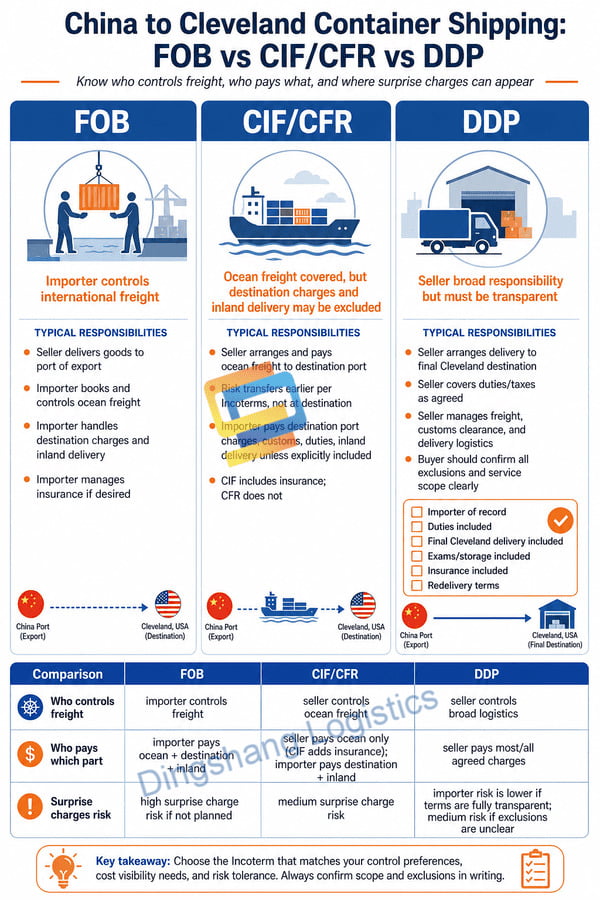
FOB: More Control for the Importer
Under FOB, the supplier usually handles export-side responsibilities up to the agreed Chinese loading port. The importer or the importer’s forwarder controls the international freight from that point.
For many U.S. importers, FOB is practical because it allows them to:
- Choose the freight forwarder
- Compare real door-to-door costs
- Control customs coordination
- Avoid unclear destination charges from supplier-controlled shipping
- Build a repeatable route for future orders
If an importer asks me to ship a container from China to Port of Cleveland under FOB terms, I can usually quote from the Chinese port to the Cleveland-area door, or from the factory if the importer wants pickup included separately.
CIF/CFR: Freight Included Does Not Mean Door Delivered
Under CIF or CFR, the supplier controls the main ocean freight to the named destination port. This can look convenient. However, it may not include the costs that matter most for Cleveland delivery.
The importer may still need to pay:
- U.S. destination charges
- Customs clearance
- ISF filing
- Duties and taxes
- Port or terminal charges
- Inland rail or truck to Ohio
- Final delivery to the warehouse
- Demurrage or detention if delays happen
This is where many problems start. A supplier may say, “Shipping is included,” and the buyer may hear, “Delivered to my warehouse.” Those are not the same thing.
DDP: Convenient, But It Must Be Transparent
DDP means the seller takes broad responsibility for delivery, including import-related costs. Some buyers like DDP because it sounds simple. However, I always advise importers to look closely at how the seller handles customs, duty, and delivery responsibility.
A DDP quote should clearly explain:
| DDP Question | Why You Should Ask |
|---|---|
| Who is the importer of record? | U.S. customs compliance depends on this |
| Are duties and tariffs included? | Product classification can change duty cost |
| Is final Cleveland delivery included? | Some “DDP” quotes still have delivery limits |
| Are exams or storage included? | Customs exams can create extra charges |
| Is insurance included? | Cargo risk should be clearly addressed |
| What happens if delivery fails? | Redelivery, waiting time, and storage can add cost |
I do not tell every importer to avoid DDP. I do tell them not to accept vague DDP quotes. If the shipment is high value, regulated, heavy, or time-sensitive, unclear DDP responsibility can create serious problems.
My Practical Rule
When I review a China-to-Cleveland inquiry, I ask for the trade term before I quote. The same container can have different quote scopes under FOB, CIF/CFR, or DDP.
A freight quote is only useful when it matches the trade term. If the term is unclear, the quote may be incomplete.
Should You Use FCL or LCL for Cleveland-Area Shipments?
The title focuses on container shipping, so most importers are thinking about FCL. Still, some buyers ask whether they can use LCL to reduce cost. That question is reasonable, but LCL and FCL should not be compared as if they are the same service.
For Cleveland-area shipments, FCL is usually suitable when the buyer has enough cargo for a full container or needs better control. LCL can work for smaller shipments, but it follows a different pricing, consolidation, handling, and delivery process.
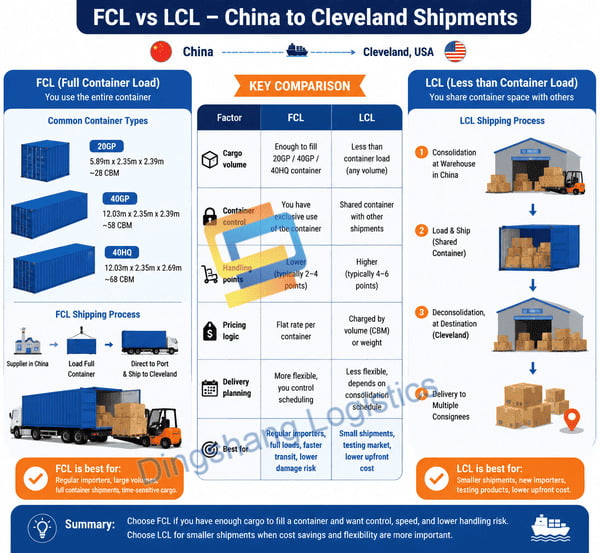
FCL: Best When You Need Container Control
FCL, or full container load, means the container is used for one shipper or consignee’s cargo. Common options include:
- 20GP
- 40GP
- 40HQ
A 20GP can be useful for heavy cargo. A 40HQ is often used for lighter, bulkier goods because it provides more cubic capacity. However, container choice depends on cargo dimensions, weight, loading method, and road weight limits.
FCL often gives importers more control because:
- The cargo is not mixed with other importers’ goods.
- The container can move under one routing plan.
- Delivery timing may be easier to manage.
- Handling risk may be lower than multiple warehouse transfers.
- The quote structure can be clearer for repeat shipments.
For regular importers, wholesalers, and distributors, FCL is often the better planning model. It supports predictable supply chain management, especially when shipments repeat every month or quarter.
LCL: Useful, But Different
LCL, or less than container load, means cargo is consolidated with other shipments. It can be a good option when the cargo volume is too small for FCL.
However, LCL to Cleveland follows a different logic. The shipment may involve:
- China consolidation warehouse
- Export handling
- Ocean freight to a consolidation destination
- U.S. deconsolidation
- Customs clearance
- Possible warehouse handling
- Final truck delivery
That means LCL pricing is often based on cubic meters, weight, minimum charges, warehouse fees, and delivery service. It should not be compared directly with FCL ocean freight.
Simple FCL vs. LCL Comparison
| Factor | FCL | LCL |
|---|---|---|
| Cargo volume | Larger shipments | Smaller shipments |
| Container control | Higher | Lower |
| Handling points | Fewer | More |
| Pricing logic | Per container and route | Per CBM/weight plus handling |
| Delivery planning | More direct | More warehouse-dependent |
| Best for | Regular importers, distributors, full loads | Trial orders, smaller purchases |
I usually recommend that importers compare FCL and LCL only after they know the cargo volume, weight, and delivery target. A shipment of 12 CBM may be suitable for LCL. A shipment of 50–60 CBM may make more sense as FCL, depending on product weight and routing.
So, if your real goal is to ship a container from China to Port of Cleveland, you are likely asking about FCL. If your shipment is smaller, then the better question may be, “What is the best LCL route from China to my Cleveland address?”
What Details Do I Need Before Quoting China to Cleveland FCL Shipping?
A quote without details is usually a guess. A guess can cause problems later. If I do not know the cargo, weight, pickup point, final address, or trade term, I cannot responsibly estimate the full DDP cost.
To quote China to Cleveland FCL shipping, I need the origin city or loading port, final delivery address, container type, cargo name, cargo weight and volume, trade term, customs clearance needs, duty handling needs, and whether the importer wants port delivery or final-door delivery.
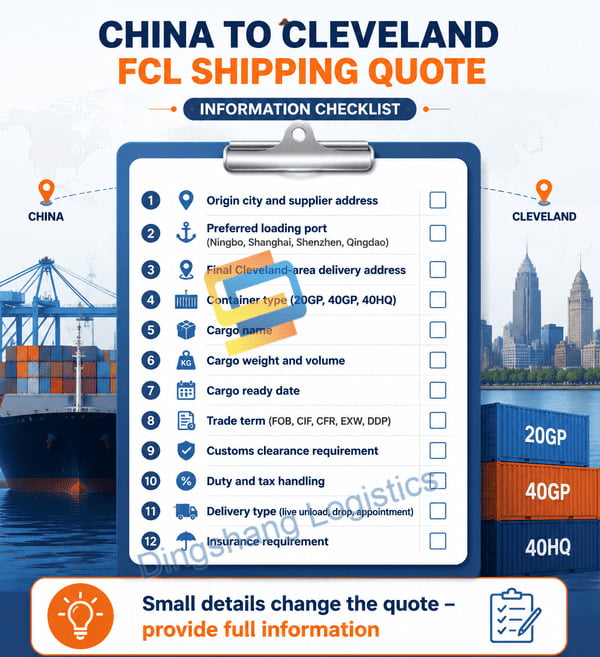
The Basic Quote Checklist
When a customer contacts me, I usually ask for these details:
-
Origin city and supplier address in China
- This helps me check the nearest loading port and local trucking cost.
-
Preferred loading port
- Common options include Ningbo, Shanghai, Shenzhen, and Qingdao.
-
Final Cleveland-area delivery address
- A ZIP code helps, but the full address is better for trucking accuracy.
-
Container type
- 20GP, 40GP, or 40HQ.
-
Cargo name
- Customs, insurance, and carrier acceptance may depend on the product.
-
Cargo weight and volume
- Weight affects container loading, inland routing, and road limits.
-
Cargo ready date
- Rates and schedules change, so timing matters.
-
Trade term
- FOB, CIF, CFR, EXW, or DDP affects quote scope.
-
Customs clearance requirement
- Some importers have their own broker. Others need coordination.
-
Duty and tax handling
- Duty is not always included in freight. It must be discussed clearly.
-
Delivery type
- Live unload, drop container, appointment delivery, or special handling.
-
Insurance requirement
- For door-to-door shipments, I often discuss cargo insurance options clearly before shipping.
Why Small Details Change the Quote
A Cleveland-area delivery address near a commercial warehouse is different from a restricted site with narrow access. A light 40HQ of plastic goods is different from a heavy 20GP of stone products. A shipment under FOB Shanghai is different from EXW pickup at a factory 300 kilometers inland.
These details change:
- China pickup cost
- Export handling requirements
- Container equipment choice
- Ocean routing options
- U.S. inland transport method
- Delivery appointment requirements
- Risk of extra charges
- Customs and compliance coordination
I once worked on an Ohio-area FCL inquiry where the buyer first asked only for an ocean rate. After a few questions, we discovered that the supplier’s term was EXW, the cargo was heavy, and the final warehouse needed appointment delivery with limited unloading hours. The first “simple” ocean quote would not have helped the buyer make a real budget.
That is why I prefer to build the quote from the final delivery need backward. For China-to-Cleveland shipments, the destination is not just a map point. It is a delivery operation.
Frequently Asked Questions
Is Port of Cleveland a direct container destination from China?
It should not be assumed. Current service availability, carrier routing, seasonal options, and terminal handling must be verified for the specific shipment. Many importers who mention Port of Cleveland actually need door delivery to a Cleveland-area warehouse, which may use another U.S. entry port plus inland transport.
How long does it take to ship a container from China to Cleveland?
Transit time depends on the China origin port, U.S. entry route, carrier schedule, rail or truck availability, customs clearance, and final delivery appointment. I do not recommend relying on a fixed timeline without checking the exact shipment window and route.
Is FOB better than CIF for China to Cleveland container shipping?
FOB often gives U.S. importers more control over the international freight and inland delivery plan. CIF may cover ocean freight to a named port but may leave destination charges, customs clearance, duties, inland transportation, and Cleveland delivery outside the supplier’s price.
Can I get a door-to-door quote from China to Cleveland?
Yes, a door-to-door quote can usually be built if the shipment details are clear. I need the China origin, final Cleveland-address, container type, cargo details, trade term, and delivery requirements.
Should I choose 20GP or 40HQ for my Cleveland shipment?
The right container depends on cargo volume, weight, dimensions. A 20GP is often used for heavier cargo, while a 40HQ is common for lighter and bulkier products. I always check cargo weight because inland road limits can affect delivery planning.
Conclusion
To ship a container from China to Port of Cleveland, I would not treat the job as a simple port-to-port booking. I would treat it as a full route, cost, and responsibility decision for your Cleveland-area delivery. The key is to confirm the real destination, compare route options, understand Incoterms, and quote the total landed logistics cost clearly. If you need help planning a China-to-Cleveland FCL shipment, send me your origin city/loading port, final address, container type, cargo name, weight/volume, trade term, and whether you require port delivery or final delivery. We can support China-to-U.S. FCL, door-to-door delivery planning.
"Shipping on the Great Lakes and St. Lawrence Seaway: An Update", https://www.congress.gov/crs-product/R47550. Official Great Lakes–St. Lawrence Seaway materials describe navigation seasons and service conditions that affect vessel access to Great Lakes ports, supporting the need to confirm Cleveland-specific sailing and terminal options for each shipment. Evidence role: general_support; source type: institution. Supports: Great Lakes and St. Lawrence Seaway shipping services operate within published navigation seasons and service conditions, making route confirmation necessary.. Scope note: This evidence supports the seasonal and operational context, but it does not verify a specific booking, carrier schedule, or terminal appointment. ↩
"Freight Rail Overview | FRA - Federal Railroad Administration", https://railroads.dot.gov/rail-network-development/freight-rail-overview. Government freight transportation sources describe intermodal rail as a common option for long-distance freight movement, while also noting that network, terminal, and service factors influence transit performance and suitability. Evidence role: general_support; source type: government. Supports: Public freight transportation sources explain that rail and intermodal rail are commonly used for long-distance freight movements, with service performance depending on network and terminal factors.. Scope note: This supports the general modal-choice logic but does not establish that rail is cheaper or faster for a specific Cleveland-bound container. ↩
"Compilation of Existing State Truck Size and Weight Limit Laws", https://ops.fhwa.dot.gov/Freight/policy/rpt_congress/truck_sw_laws/index.htm. Federal Highway Administration materials on commercial motor vehicle size and weight limits show that highway movements are subject to gross and axle-weight restrictions, which explains why heavy containers may require special planning or permits. Evidence role: mechanism; source type: government. Supports: Federal and state truck size and weight rules can limit how heavy containers move on highways and may require overweight permits or special planning.. ↩
"Importer Security Filing '10+2' - U.S. Customs and Border Protection", https://www.cbp.gov/border-security/ports-entry/cargo-security/importer-security-filing-102. U.S. Customs and Border Protection guidance identifies Importer Security Filing, commonly known as ISF or “10+2,” as a required advance data filing for most ocean cargo imported into the United States. Evidence role: definition; source type: government. Supports: U.S. Customs and Border Protection defines Importer Security Filing requirements for ocean cargo and identifies the filing as ISF.. ↩
"Interpretive Rule on Demurrage and Detention Under the Shipping Act", https://www.federalregister.gov/documents/2020/05/18/2020-09370/interpretive-rule-on-demurrage-and-detention-under-the-shipping-act. Federal Maritime Commission materials define demurrage and detention as charges connected to the use of terminal space or carrier equipment beyond allowed free time, supporting the article’s explanation that documentation, release, or delivery delays can create additional costs. Evidence role: mechanism; source type: government. Supports: Federal Maritime Commission materials define demurrage and detention in ocean shipping and explain that charges relate to use of terminal space or carrier equipment beyond allowed time.. Scope note: The source supports the charging mechanism generally; the exact chargeability and amount depend on the carrier tariff, terminal rules, contract terms, and facts of the delay. ↩
"Know Your Incoterms - International Trade Administration", https://www.trade.gov/know-your-incoterms. The International Chamber of Commerce’s Incoterms rules for FOB allocate delivery at the named port of shipment and place the main carriage risk and cost after that point on the buyer, which explains why importers often have greater control over the international freight arrangement under FOB. Evidence role: mechanism; source type: institution. Supports: Incoterms FOB allocates seller and buyer obligations so that the buyer generally arranges or bears the main carriage after delivery on board the vessel at the named port.. Scope note: Incoterms define default risk and cost allocation, but commercial contracts may add terms that affect operational control. ↩
Leave a Comment