
Shipping Entry Doors from China to USA: Container Cost, Packing & Delivery
Shipping entry doors from China to the USA by container requires more than comparing ocean freight rates. Importers should confirm container fit, protective packaging, cargo securing, customs and product details, wood-packaging compliance, insurance, and final delivery conditions before booking.
For most commercial entry-door shipments, the practical decision comes down to five questions:
- Will the packed doors fit efficiently and safely in the selected container?
- Is the packaging strong enough for ocean transport and unloading?
- What services and charges are included in the freight quote?
- Are the customs classification and any material-specific requirements confirmed before departure?
- Can the final U.S. location receive and unload the container?
The answers depend on the doors' materials, packed dimensions, quantity, weight, origin in China, trade terms, and final U.S. delivery address.
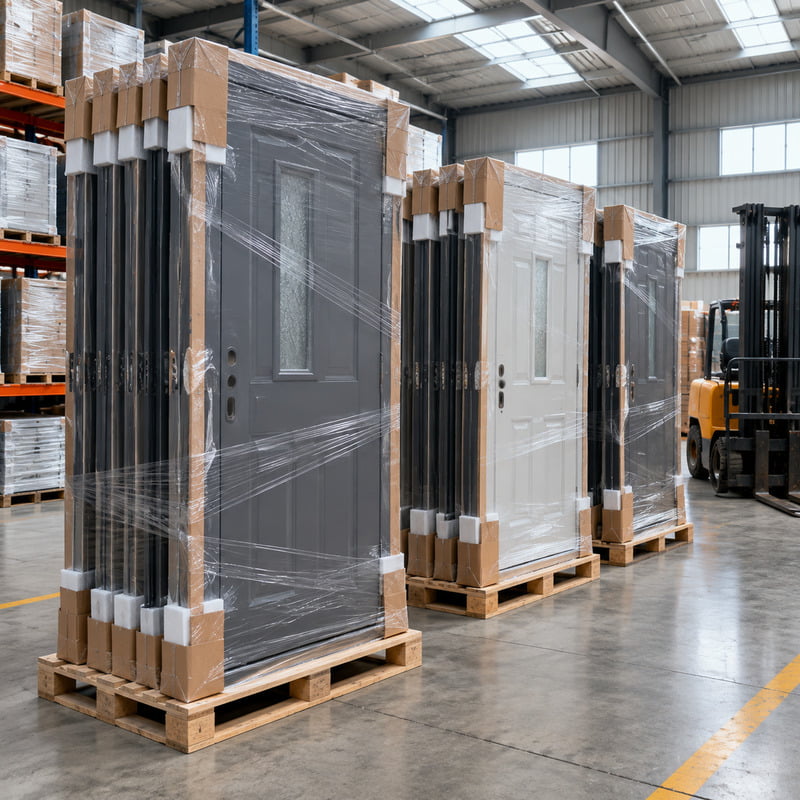
For a first-time importer, it helps to understand how container shipping from China to the USA works before comparing individual freight quotations.
How Much Does Shipping Entry Doors from China to USA Cost?
There is no single reliable container-shipping price for entry doors from China to the USA. The total logistics cost depends on the China pickup point, container size, ocean routing, U.S. gateway, customs requirements, inland transportation, final delivery address, and services included in the quotation.
Ocean freight is not the same as total delivered logistics cost. A low port-to-port rate may still leave substantial origin, destination, customs, inland, and delivery costs outside the quote.
For entry-door shipments, freight cost should be estimated from the packed shipment rather than the purchase quantity alone. The same number of doors can produce very different logistics costs depending on frame size, crate design, glass protection, stackability, container utilization, and final delivery conditions.
| Cost Driver | Why It Matters for Entry Doors |
|---|---|
| Packed dimensions | Frames, crates, sidelights, transoms, and protective packaging can create substantial dead space |
| Gross weight | Heavy doors, hardware, reinforced frames, and packaging can affect inland handling and trucking |
| Stackability | Non-stackable crates reduce usable container space |
| Glass and fragile panels | May require stronger protection, bracing, and handling controls |
| Frame configuration | Pre-hung or assembled frames can use significantly more space than knocked-down components |
| Final delivery site | Dock access, unloading equipment, transloading, and site restrictions can change final delivery cost |

Start With the Complete Cost Structure
Instead of asking only, "How much is a container?" ask:
What services and charges are included from the Chinese supplier to my final U.S. receiving location, and what remains my responsibility?
Depending on the shipment and Incoterm, the cost structure may include:
- Factory pickup in China
- Export handling and documentation
- Container loading or warehouse handling
- Origin terminal charges
- Ocean freight
- Cargo insurance
- U.S. destination charges
- Customs brokerage and clearance coordination
- Duties and other applicable import assessments
- Inland rail transportation when used
- Drayage or long-distance trucking
- Chassis and delivery-related charges
- Warehousing or transloading when required
- Delivery appointments or waiting time
- Storage, demurrage, or detention if incurred
- Special unloading or delivery equipment if separately arranged
Not every quotation includes every item. Before comparing offers, put the inclusions and exclusions side by side. For a broader breakdown, see what you are really paying to ship a container from China.
Compare Quotations by Scope, Not Just Price
| Cost area | What to confirm |
|---|---|
| China origin | Factory pickup, export handling, loading, and origin charges |
| Ocean transport | Container type, routing, carrier, quote validity, and included surcharges |
| U.S. arrival | Destination and terminal-related charges included in the quote |
| Customs | Brokerage scope and whether duties or other assessments are separate |
| Inland movement | Rail, drayage, or long-distance trucking included or excluded |
| Final delivery | Commercial dock, construction site, limited-access, or other receiving conditions |
| Insurance | Insured value, route covered, deductible, and exclusions |
| Exceptions | Exams, storage, waiting time, failed delivery, demurrage, or detention |
Freight rates and operational conditions can change with routing, capacity, equipment, fuel, congestion, and market conditions. Treat a freight quotation as shipment-specific and validity-limited rather than as a permanent rate.
Which Container Is Best for Shipping Entry Doors from China to USA?
The right container depends on the packed dimensions, total gross weight, loading orientation, stackability, and protection requirements of the doors—not simply the number of doors ordered. Bulky frames, sidelights, transoms, glass panels, crates, and non-stackable packages can use container space inefficiently.
For commercial orders, 20GP and 40HQ FCL are common options to evaluate. LCL may also be possible for smaller shipments, but entry doors can be vulnerable to the additional handling associated with consolidation.
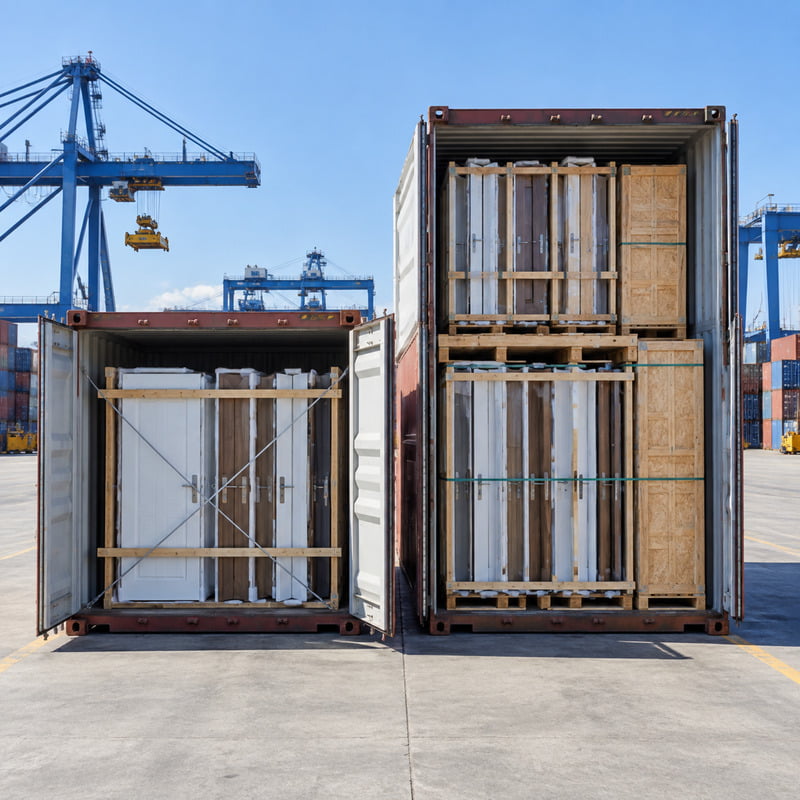
20GP vs. 40HQ vs. LCL
| Option | When it may make sense | Main issue to evaluate |
|---|---|---|
| 20GP FCL | Smaller full-container orders | Floor space, package orientation, and weight |
| 40HQ FCL | Larger volumes of bulky doors, frames, and crates | Loading efficiency and destination access |
| LCL | Smaller orders that do not justify FCL | Additional handling, chargeable volume, and destination costs |
| Door-to-door FCL | Importer wants coordinated inland delivery | Site access, unloading, appointments, and quote exclusions |
There is no universal CBM threshold at which an entry-door shipment should switch from LCL to FCL. Compare packed volume, gross weight, handling requirements, destination charges, all-in cost, damage sensitivity, and current FCL pricing. For more detail, see when to choose FCL instead of LCL and the guide to LCL shipping from China to the USA.
Container specifications vary by equipment provider, and theoretical cubic capacity is not the same as usable cargo space. Doors can create substantial dead space because frames, crates, glass protection, and required bracing restrict how packages can be positioned.
If you are comparing full-container options, review the separate guides to 20GP container cost from China to the USA and 40HQ container cost from China to the USA for container-specific planning.
Use Packed Dimensions, Not Bare-Door Dimensions
Before choosing a container, collect:
- Number of doors, frames, sidelights, transoms, and accessory packages
- Packed length, width, and height of each package type
- Gross weight per package
- Total shipment gross weight
- Packaging photos or drawings
- Stackability restrictions
- Glass, hardware, or decorative-panel details
- Whether the doors are shipped as slabs, pre-hung units, fully assembled systems, or knocked-down components
- Whether the frames are shipped assembled or knocked down
- Proposed loading orientation
- Factory or pickup location in China
- Complete U.S. delivery address and unloading method
Pre-hung doors and assembled frames can consume substantially more container space than door slabs or knocked-down frame components, so this should be confirmed before selecting container size.
A supplier's statement that an order "fits in one 40HQ" should be supported by a loading calculation or layout.
Entry-door shipments are often cube-limited because frames, crates, glass protection, and non-stackable packaging can consume usable container space quickly. However, gross weight still needs to be checked, especially for dense doors, hardware, reinforced frames, or heavy packaging.
Plan the Unloading While Planning the Loading
Container utilization should not be optimized only for origin loading. The receiving team also needs to remove the doors safely.
For example, if frames must stay upright or glass-containing crates cannot support other cargo, those restrictions affect both loading density and unloading sequence. Small cartons containing handles, locks, hinges, or installation hardware should not be positioned where they can be lost or damaged during unloading.
How Should Entry Doors Be Packed for Container Shipping?
Entry doors should be packed according to their materials, finish, fragility, stacking method, and unloading plan. Importers should specifically review surface protection, reinforced corners, glass protection, frame support, moisture exposure, pallet or crate strength, forklift access, and container securing.
FCL reduces some handling compared with consolidated cargo, but FCL does not make entry doors damage-proof. Damage can still result from weak packaging, poor weight distribution, cargo movement, condensation, or unsuitable unloading.
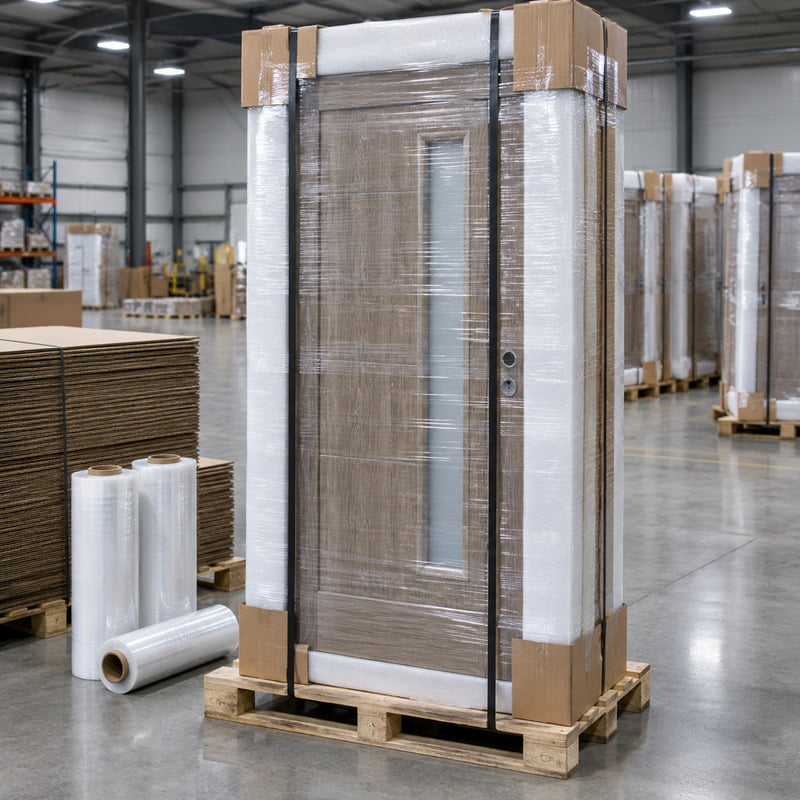
Match Protection to the Door Material
Common entry-door shipments may include:
- Steel doors
- Fiberglass doors
- Solid or engineered wood doors
- Aluminum components
- Glass panels, sidelights, or transoms
- Composite materials
- Mixed-material door systems
- Frames and hardware
These materials do not share the same damage risks. Finished metal surfaces can scratch or dent. Frames can deform under uneven pressure. Wood products may be sensitive to moisture. Glass requires protection from both impact and concentrated loads.
The manufacturer should design and validate packaging appropriate for the actual product. High-value, unusually large, or fragile door systems may justify review by a qualified packaging specialist or cargo surveyor.
Packaging Checklist for Importers
Before loading, confirm:
- Non-abrasive protection covers finished surfaces.
- Corners and exposed edges are reinforced.
- Glass is protected from direct pressure and movement.
- Frames are supported against bending or twisting.
- Handles, locks, hinges, and loose hardware cannot damage finished surfaces.
- Accessory cartons are labeled and secured.
- Pallets or crates can support the intended load.
- Forklift entry points do not expose the doors to fork damage.
- Packages can withstand the proposed stacking arrangement.
- Moisture and condensation risk has been considered.
- Package labels remain visible during unloading.
For pre-hung units, sidelights, or transoms, the packaging should also help prevent twisting or racking of the assembled frame during handling and ocean movement.
Wood Packaging Requires Special Attention
Regulated wood packaging material used to support, protect, or carry cargo entering the United States must comply with applicable U.S. ISPM 15 requirements. USDA APHIS states that applicable wood packaging material must be pest-free, debarked, appropriately treated, and marked with the ISPM 15 certification mark.1
This includes regulated wood packaging such as pallets, skids, crates, boxes, and dunnage. It should not be confused with every wood-containing or engineered-wood product; APHIS identifies several processed materials, including plywood, pressboard, and oriented strand board, as alternatives not subject to its wood-packaging-material regulation.1
Importers using regulated wood crates, pallets, or dunnage for entry doors should confirm applicable ISPM 15 compliance with the supplier before loading.
Secure the Cargo Inside the Container
Strong crates alone are not enough. The loading team should consider:
- Weight distribution
- Fore-and-aft movement
- Side-to-side movement
- Gaps between packages
- Contact between finished surfaces
- Stack stability
- Pressure on glass or frames
- Conditions during unloading
Suitable blocking, bracing, straps, airbags, or other securing methods may be needed depending on the load.
Documenting the loading process is also useful. Photos can record:
- Empty-container condition
- Container number
- Packages before loading
- Initial cargo rows
- Blocking and bracing
- Final loaded condition
- Container closure and seal
These records can help with receiving, quality control, and documentation if cargo damage is later discovered.
What Customs Documents and Import Information Are Needed for Entry Doors?
A U.S. entry-door import normally requires accurate commercial and transportation documentation plus sufficient product information for customs classification and any applicable agency requirements. Importers should give their customs broker the door's material, construction, intended use, origin, value, and component details before shipment.
CBP advises importers to provide detailed merchandise information for customs purposes.2 Do not select an HTS classification simply because another importer used it for a visually similar door.

Provide Precise Product Information
The customs broker may need to know whether the shipment contains:
- Complete doors
- Door slabs
- Pre-hung door units
- Door frames
- Sidelights
- Transoms
- Glass inserts
- Hardware
- Separate components
Product information should identify:
- Primary material
- Secondary materials
- Construction
- Intended use
- Quantity
- Unit value
- Country of origin
- Brand or model where relevant
A steel door, wood door, aluminum component, glass insert, or hardware set should not automatically be assumed to share the same classification or duty treatment.
If doors, frames, glass inserts, sidelights, transoms, or hardware are invoiced separately, provide the customs broker with enough product detail to determine whether separate classifications or duty treatment may apply.
The U.S. International Trade Commission publishes the Harmonized Tariff Schedule of the United States. Because HTS provisions and tariff measures can change, the actual classification and duty treatment should be reviewed for the shipment rather than copied from an old invoice or online example.3
Core Documentation and Information
| Document or information | Why it matters |
|---|---|
| Commercial invoice | Product description, value, seller/buyer, and transaction information |
| Packing list | Package count, weights, dimensions, and packing details |
| Bill of lading instructions | Transportation parties and shipment information |
| Importer information | Supports U.S. entry and filing requirements |
| Material/construction details | Helps classification and agency-requirement review |
| Product specifications/photos | Clarifies complex door assemblies |
| Trade terms | Defines commercial responsibility between buyer and seller |
| Wood-packaging information | Helps identify ISPM 15 compliance issues |
| Broker instructions | Supports pre-arrival customs preparation |
Importers new to the process can also review the broader step-by-step process for importing products from China to the USA.
Depending on the door type and intended use, separate U.S. building-code, fire-rating, energy-performance, impact-resistance, safety-glazing, or product-certification requirements may apply. These product-compliance requirements are separate from freight forwarding and customs transportation arrangements and should be confirmed with the buyer's qualified compliance, construction, or product professional before import.
Customs clearance should not be treated as confirmation that a door satisfies separate building-code or product-performance requirements.
Do Wooden Entry Doors Require a Lacey Act Declaration?
Some wooden or plant-containing door products may require a Lacey Act declaration, but the requirement depends on the product's plant content, HTS classification, entry type, and current APHIS criteria. Do not assume that every wooden entry door requires a declaration—or that wooden doors are automatically exempt.
APHIS states that a declaration is required when the product contains plant material, is classified under an APHIS-listed HTS code, is imported as a formal entry, and falls under an applicable entry type.4
Requirements should be checked against the current APHIS schedule and the actual product classification. APHIS provides its current Lacey Act filing and implementation information for importers and brokers.5
For doors containing wood or other plant material, give the customs broker the product composition early enough to check the current APHIS requirements.
Remember the Importer Security Filing
For U.S.-bound cargo arriving by vessel, the Importer Security Filing (ISF, commonly called "10+2") is an important pre-departure requirement. CBP states that eight of the required data elements are generally due no later than 24 hours before the cargo is laden aboard the vessel at the foreign port; the remaining two data elements follow their applicable timing rules.6
This should not be simplified to "24 hours before vessel departure." The filing deadline is tied to cargo lading for the applicable eight data elements.
Review Documents Before Vessel Departure
The commercial invoice, packing list, product description, bill of lading instructions, and physical cargo should be consistent.
If the supplier changes package count, materials, quantities, or other material shipment information, update the documents and inform the customs broker. Early review gives the importer more time to resolve discrepancies before the container is already moving.
Freight-forwarding guidance does not replace advice from a licensed customs broker, attorney, engineer, building-code professional, or product-certification specialist where those services are required.
How Can Importers Prevent Final Delivery Problems?
Importers should qualify the final U.S. receiving location before booking door-to-door container delivery. Confirm truck access, dock availability, forklift or unloading equipment, appointments, receiving hours, container handling method, and any site restrictions.
Door-to-door transportation does not automatically mean unloading is included. A standard container delivery may place the container only where the driver and equipment can legally and safely access the property. Labor, forklifts, cranes, transloading, or other special services require separate planning.
A liftgate is not a universal unloading solution for entry-door shipments. Large door crates, long frames, pre-hung units, or heavy packages may require a dock, forklift, crane, transloading facility, or another unloading plan.
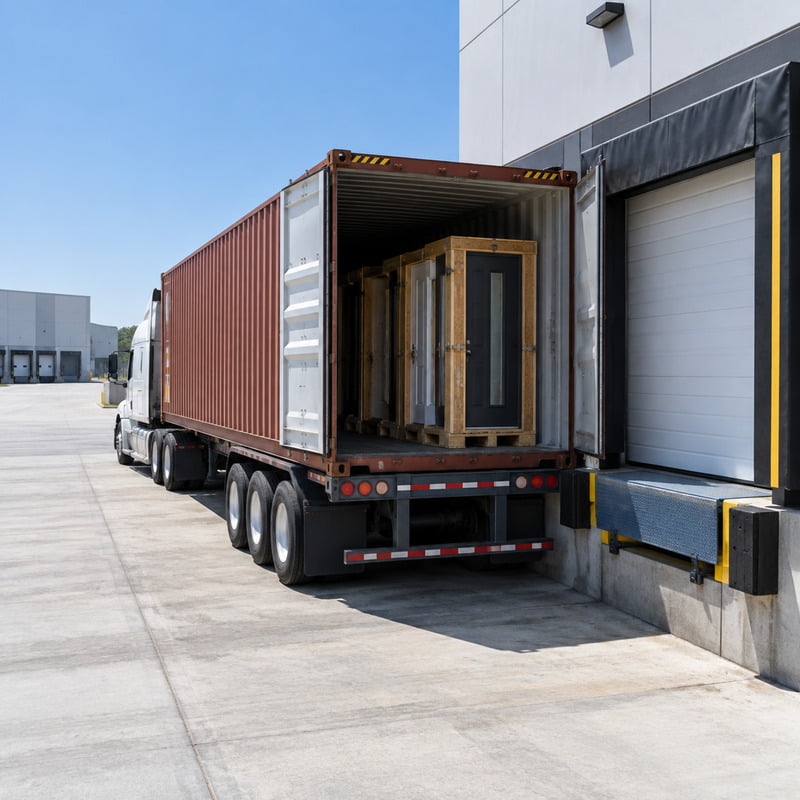
A ZIP Code Is Not Enough
Before booking final delivery, provide the complete address and identify whether the destination is:
- A distribution warehouse
- A commercial building with a dock
- A commercial facility without a dock
- A construction site
- A storage facility
- A residential or limited-access property
- A facility requiring delivery appointments
Then confirm:
- Can a tractor and container enter the property?
- Is there adequate turning space?
- Does the property permit container trucks?
- Is a loading dock available?
- Is suitable unloading equipment available?
- How will large door crates, frames, sidelights, or transoms be removed?
- Is a live unload or container drop required?
- How long is unloading expected to take?
- Are appointments required?
- Are there gate, height, operating-hour, or other access restrictions?
When Direct Container Delivery Is Not Practical
Some importers purchase doors for construction projects, showrooms, smaller commercial facilities, or other locations designed for ordinary delivery trucks rather than container equipment.
If the container cannot safely or practically reach the receiving point, transloading may be an alternative. The container can be unloaded at a suitable facility and the doors transferred to equipment better suited to the final delivery.
That adds handling and cost, so it should be evaluated before booking rather than after the container reaches the United States.
Gateway and Inland Routing Depend on the Final Address
China-to-USA FCL shipments may move through different U.S. gateways depending on origin, destination, carrier service, current routing availability, inland transportation options, and total cost.
For example, an importer delivering in Southern California may evaluate a route through Los Angeles, while an importer serving the Northeast may evaluate East Coast options. See the guides to shipping a container from China to Los Angeles and shipping a container from China to New York for destination-specific planning considerations.
For inland destinations, rail may form part of the routing, but an inland rail ramp is not the same as warehouse delivery. Additional drayage is normally required from the ramp to the final receiver. A Chicago-area importer, for example, can review the separate guide to shipping a container from China to Chicago.
The actual routing should always be confirmed against the current booking and service availability.
How Long Does It Take to Ship Entry Doors from China to USA?
There is no single transit time that applies to every entry-door shipment. Timing depends on the China origin, U.S. gateway, carrier service, transshipment if any, customs processing, inland transportation, terminal availability, and final delivery appointment.
West Coast ocean services generally have a shorter ocean leg than East Coast or Gulf Coast routings, but total delivery time can change significantly once customs, terminal availability, inland rail or trucking, and final delivery appointments are included.
Most importantly:
Ocean transit time is not the same as total door-to-door lead time.
The total logistics timeline can include:
- Factory pickup and origin handling
- Container loading
- Vessel cutoff and departure
- Ocean transit
- Transshipment when applicable
- U.S. terminal availability
- Customs clearance or examination
- Inland rail or trucking
- Final delivery appointment
- Unloading
For route-planning context, see the guide to China-to-USA sea freight transit time. Shipment-specific timing should still be confirmed when the booking is made.
What Information Is Required for an Accurate Entry-Door Shipping Quote?
An initial entry-door freight quote does not require every document and receiving detail needed for final booking. Start with the information that determines cargo size, origin, shipping mode, and destination; then provide more detailed packaging, customs, and delivery information before booking or arranging door delivery.

Initial Quote Information
Cargo
- Product name
- Door material
- Door type: slab / pre-hung / assembled / knocked-down
- Number of doors
- Number of frames, sidelights, transoms, and accessory cartons
- Package count
- Packed dimensions
- Gross weight
- Stackability restrictions, if known
- HS code, if available
China Origin
- Supplier or factory city
- Pickup address or location
- Cargo-ready date
- FOB or EXW
U.S. Destination
- Final delivery ZIP code
- 20GP / 40HQ / LCL requirement, if already known
This is normally enough information to begin evaluating container fit, shipping mode, origin requirements, and the basic U.S. routing without making the first inquiry unnecessarily complicated.
Additional Details Before Booking or Door Delivery
When relevant, provide:
- Packaging photos
- Glass-panel details
- Loading plan
- Full delivery address
- Facility type
- Dock availability
- Forklift or other unloading equipment
- Appointment requirements
- Access restrictions
- Live unload or drop requirement
- Importer of Record information
- Customs broker details
- Customs bond status where relevant
- Insurance requirements
- Product-specific compliance documents where applicable
These details become more important as the shipment moves from an initial estimate to a confirmed booking and final delivery plan.
Why Door Count Alone Is Not Enough
Two orders containing the same number of entry doors can require very different logistics plans.
One shipment might contain stackable door slabs on reinforced pallets. Another might contain pre-hung units, assembled frames, sidelights, transoms, decorative glass, and non-stackable crates. The second order may require substantially more container space even though both purchase orders show the same door quantity.
Packed cargo data—not unit count—is therefore the basis for reliable container planning.
Frequently Asked Questions
Is a 20GP or 40HQ better for entry doors?
Neither container is automatically better. The correct choice depends on packed dimensions, total gross weight, loading orientation, stackability, door and frame configuration, and delivery conditions. Compare actual loading plans rather than choosing a 40HQ simply because it has more cubic capacity.
Can entry doors be shipped by LCL?
Yes, LCL can be considered for smaller entry-door orders. However, large packages can create significant chargeable volume, and consolidated cargo generally undergoes more handling than FCL. Compare packed volume, weight, handling risk, destination charges, and the current all-in FCL alternative rather than using a universal CBM threshold.
Does door-to-door shipping include customs duties and unloading?
Not automatically. "Door-to-door" describes the transportation scope, but the quotation must state whether customs brokerage, duties, examinations, special equipment, unloading labor, storage, or other charges are included or excluded.
Do wood pallets and crates need ISPM 15 treatment?
Regulated wood packaging material entering the United States must meet applicable ISPM 15 treatment, certification, and marking requirements.1 Importers using regulated solid-wood pallets, crates, skids, or dunnage should confirm compliance with the Chinese supplier before loading.
Do wooden entry doors require a Lacey Act declaration?
Some may. Applicability depends on factors including plant content, HTS classification, formal-entry status, entry type, and current APHIS requirements.4 Give your customs broker the door's detailed material composition and product information so the current requirement can be checked.
How can I reduce damage to imported entry doors?
Use packaging appropriate to the door material and finish, reinforce vulnerable corners and frames, protect glass from direct loads, secure hardware, control movement inside the container, and plan unloading before loading. Pre-hung units, sidelights, and transoms also need protection against frame twisting or racking during handling.
How long does shipping entry doors from China to the USA take?
There is no universal transit time. The total lead time depends on origin handling, vessel schedule and routing, ocean transit, customs status, inland transportation, terminal availability, and final delivery. Do not treat an ocean-transit estimate as the complete door-to-door timeline.
Request an Entry-Door Shipping Quote
Send the packed dimensions, package count, gross weight, door material, supplier location in China, container requirement, cargo-ready date, and U.S. delivery ZIP code to receive a shipment-specific routing and cost review.
Include the HS code, if available, along with any known stackability or special handling restrictions.
Request an Entry-Door Shipping Quote
References
[USDA APHIS — Import ISPM 15-Compliant Wood Packaging Material into the United States](https://www.aphis.usda.gov/plant-imports/wood-packaging-material/import) ↩
[U.S. Customs and Border Protection — Tips for New Importers and Exporters](https://www.cbp.gov/trade/basic-import-export/importer-exporter-tips) ↩
[U.S. International Trade Commission — Harmonized Tariff Information](https://www.usitc.gov/harmonized_tariff_information) ↩
[USDA APHIS — Lacey Act Declaration Requirements](https://www.aphis.usda.gov/plant-imports/file-lacey-act-declaration/requirements) ↩
[USDA APHIS — File a Lacey Act Declaration](https://www.aphis.usda.gov/plant-imports/file-lacey-act-declaration) ↩
[U.S. Customs and Border Protection — Importer Security Filing Timing](https://www.help.cbp.gov/s/article/Article-1868) ↩



Leave a Comment