
Container Shipping Rates from China to USA: What Should Importers Expect?
There is no single fixed container shipping rate from China to the USA. A 20GP generally has a lower total freight cost than a 40HQ, while a 40HQ can provide a lower shipping cost per CBM when its additional capacity is used efficiently. For comparable port-to-port services, West Coast routes are often lower than East Coast or Gulf Coast routes. Inland door-delivery rates involve a broader service scope and should be evaluated separately. Actual pricing depends on origin, destination, container size, sailing date, cargo details, and service scope.
How Much Does It Cost to Ship a Container from China to the USA?
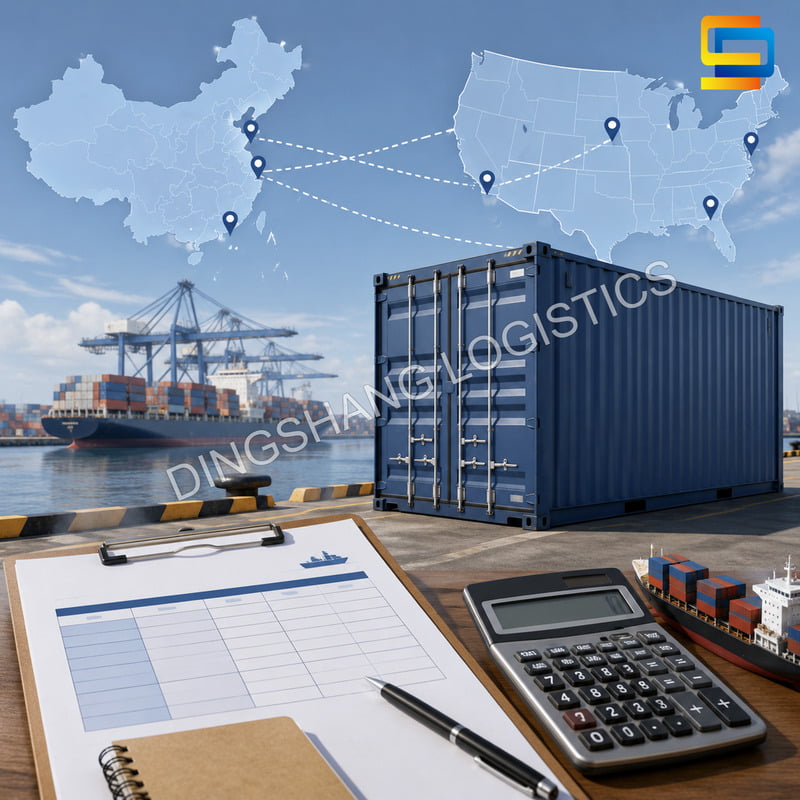
The cost depends on the exact route and service being purchased. Based on Dingshang Logistics' 2026 planning ranges, the examples below show 20GP and 40HQ pricing for specific China-to-USA routes. Port-to-port rates and door-delivery rates should never be compared as though they cover the same transportation scope.
| Route | Container | Service Scope | 2026 Planning Range |
|---|---|---|---|
| Ningbo → Los Angeles | 20GP | Port-to-Port | USD 4,700–5,100 |
| Ningbo → Los Angeles | 40HQ | Port-to-Port | USD 5,400–6,600 |
| Shanghai → New York | 20GP | Port-to-Port | USD 6,300–7,000 |
| Shanghai → New York | 40HQ | Port-to-Port | USD 7,800–8,500 |
| Ningbo → Chicago | 20GP | Door Delivery | USD 6,500–7,000 |
| Ningbo → Chicago | 40HQ | Door Delivery | USD 8,000–8,800 |
| Shenzhen → Los Angeles | 20GP | Port-to-Port | USD 4,700–5,100 |
| Shenzhen → Los Angeles | 40HQ | Port-to-Port | USD 5,400–6,600 |
| Qingdao → Savannah | 20GP | Port-to-Port | USD 6,300–7,000 |
| Qingdao → Savannah | 40HQ | Port-to-Port | USD 7,800–8,500 |
Important: Ningbo → Chicago is a door-delivery example. The other routes in the table are port-to-port examples. A Chicago door quote includes a different transportation scope and therefore cannot be compared directly with a Los Angeles, New York, or Savannah port-to-port quote.
These are 2026 planning examples based on Dingshang Logistics' China-to-USA shipment pricing experience. They are not fixed booking offers or market-wide averages. Actual rates must be reconfirmed based on the sailing date, carrier space, cargo details, origin, destination, and service scope.
The table also shows why the destination matters. Los Angeles/Long Beach is often one of the more cost-efficient U.S. gateways for China-origin ocean freight, while East Coast routes generally involve longer ocean transportation and can carry higher ocean freight in many market periods. Inland destinations such as Chicago require additional inland transportation, and the final U.S. ZIP code can materially affect a door-delivery quote.
For inventory planning, remember that China-to-USA sea freight transit time is a separate question from freight price. A lower rate does not automatically mean a better schedule.
20GP vs. 40HQ Container Shipping Rates from China to USA
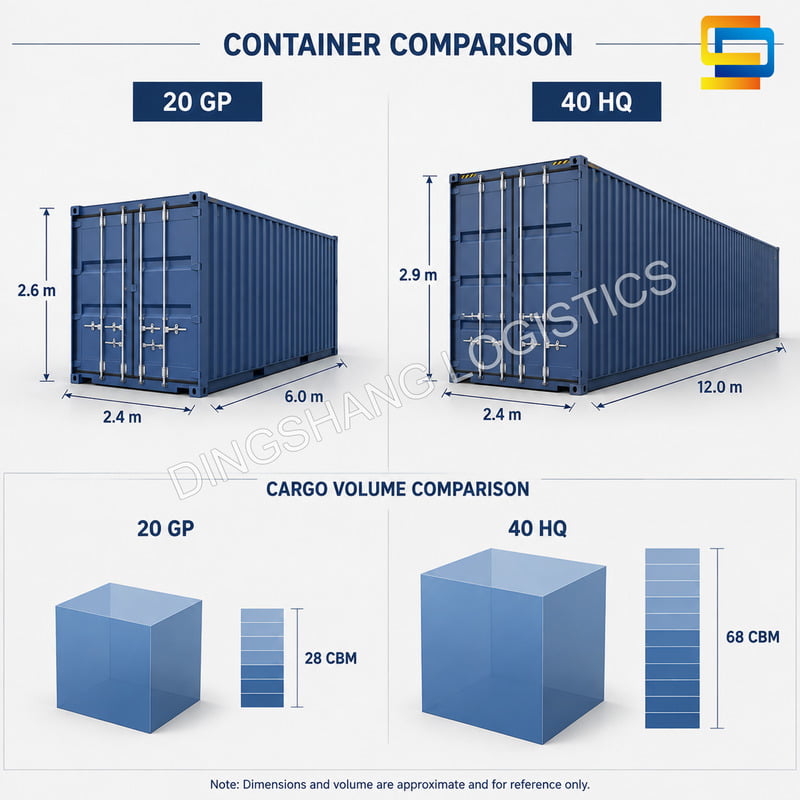
A 20GP normally costs less in total than a 40HQ on a comparable route and service scope. A 40HQ, however, provides substantially more cubic capacity and can produce a lower logistics cost per CBM or per product unit when the cargo can use that capacity efficiently. Weight, packaging, and loading conditions still need to be checked before choosing equipment.
| Comparison | 20GP | 40HQ |
|---|---|---|
| Total freight cost | Generally lower | Generally higher |
| Practical planning volume | Around 28 CBM for many general-cargo loads | Around 68 CBM for many general-cargo loads |
| Typical planning consideration | Smaller or denser FCL shipments | Higher-volume, relatively lighter cargo |
| Cost per CBM | Can be higher compared with a well-utilized 40HQ | Can be lower when capacity is used efficiently |
| Main weight consideration | Dense cargo can become weight-limited before space is filled | Large cubic capacity does not mean all available space can be used for heavy cargo |
The 28 CBM and 68 CBM figures are practical working estimates for shipment planning, not guaranteed loading capacities. Actual loading depends on the cargo and packing configuration, including:
- Carton dimensions
- Pallets
- Cargo shape
- Stackability
- Packaging
- Loading method
- Cargo weight
- Cargo-securing requirements
A 20GP is often considered for dense cargo because its smaller cubic capacity can match weight-heavy shipments efficiently. However, container payload capacity does not automatically equal the practical or legal U.S. road weight, so heavy shipments require route-specific weight planning.
For deeper equipment-specific planning, see the dedicated guides to 20GP container cost and capacity and 40HQ container shipping cost from China to the USA.
Container Shipping Rates by China–USA Route
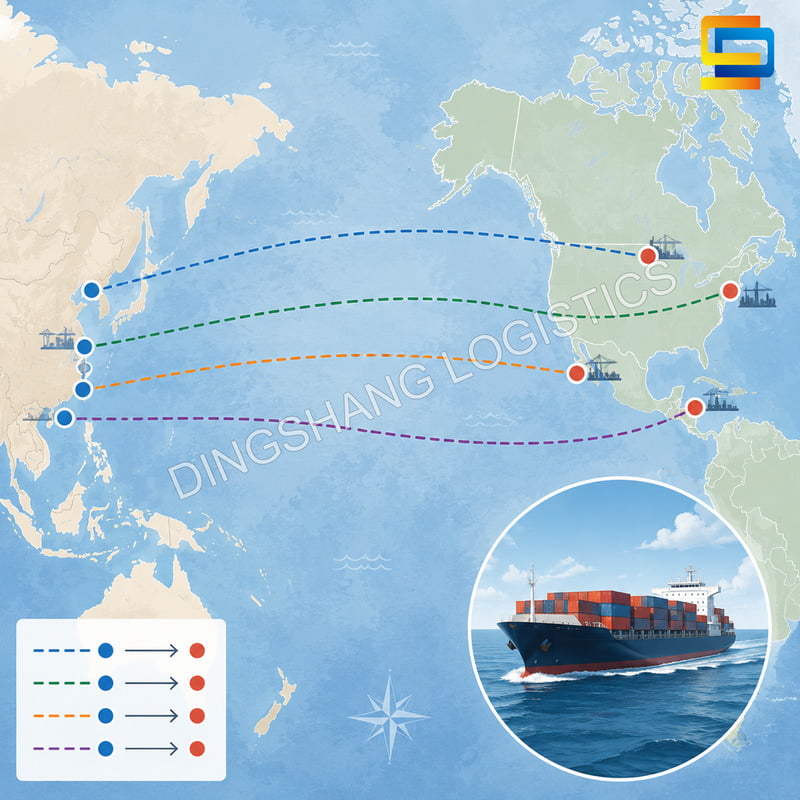
China-to-USA container pricing changes by corridor because the loading port, U.S. gateway, inland destination, sailing options, and service scope are different. Ningbo → Los Angeles and Ningbo → Chicago, for example, are not simply two prices for the same shipment: one example ends at a seaport, while the other continues to an inland door.
Ningbo → Los Angeles
The planning examples are USD 4,700–5,100 for a 20GP and USD 5,400–6,600 for a 40HQ, port-to-port.
This route can be useful for importers sourcing in Zhejiang and nearby manufacturing areas. If the shipment continues beyond the port, the inland portion should be priced separately or included in a clearly defined door-delivery quotation.
Shenzhen → Los Angeles
The supplied planning ranges are also USD 4,700–5,100 for a 20GP and USD 5,400–6,600 for a 40HQ, port-to-port.
Do not assume the same pricing will apply to every South China shipment or sailing. Factory location, cargo-ready date, carrier space, routing, and origin arrangements still affect the actual booking.
Shanghai → New York
The planning range is USD 6,300–7,000 for a 20GP and USD 7,800–8,500 for a 40HQ, port-to-port.
For comparable service scope, an East Coast route can carry higher ocean freight than a West Coast route in many market periods. It also has a different transit-time profile, so price and inventory timing should be evaluated together.
Qingdao → Savannah
The supplied planning range is USD 6,300–7,000 for a 20GP and USD 7,800–8,500 for a 40HQ, port-to-port.
For North China cargo, the correct route should be evaluated from the supplier location through the actual U.S. destination rather than selecting a gateway only because its ocean freight line looks attractive.
Ningbo → Chicago
The planning range is USD 6,500–7,000 for a 20GP and USD 8,000–8,800 for a 40HQ, door delivery.
Chicago is an inland destination, so this example represents a different scope from the port-to-port examples above. The actual inland routing and final-mile cost depend on the booked service and delivery ZIP code.
If you are unfamiliar with how the stages connect, the China-to-USA container shipping process explains the overall movement from origin through U.S. delivery.
Why Do Container Shipping Rates from China to USA Change?
China-to-USA container rates change because a quotation is tied to a specific shipment and booking window. The origin, destination, container type, cargo-ready date, carrier space, season, cargo weight, service scope, and inland transportation can all change the price you receive.
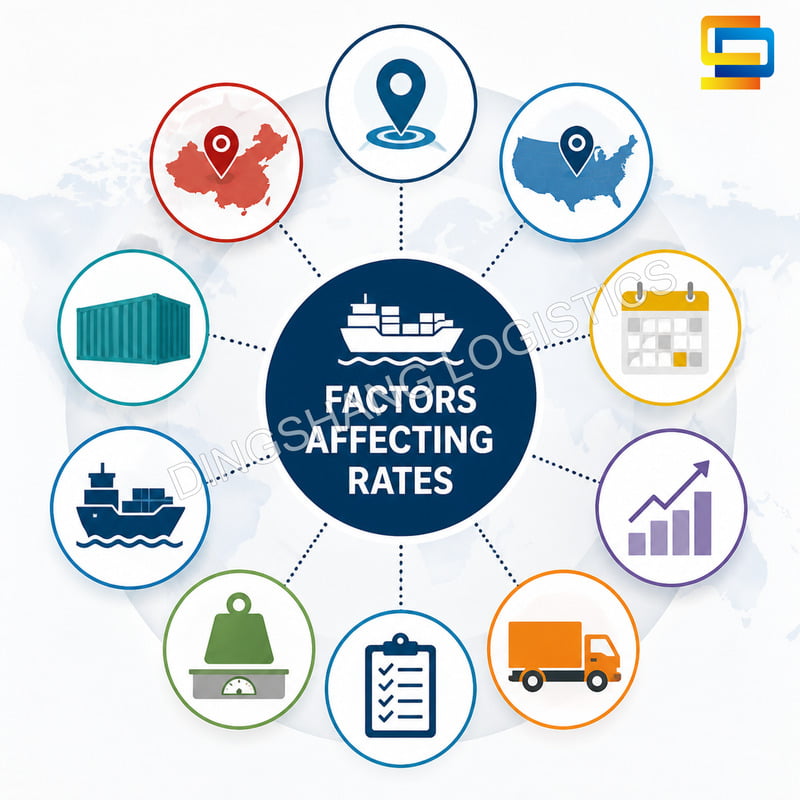
The main variables are:
- China origin: Ningbo, Shanghai, Shenzhen, Qingdao, and other origins can have different ocean and local cost structures.
- U.S. destination: A coastal port, inland rail point, and final warehouse are different endpoints.
- Container type: 20GP and 40HQ are priced differently.
- Sailing date: Freight pricing is time-sensitive and should match your actual cargo-ready window.
- Carrier space and routing: Available services and booking conditions can change.
- Season and market conditions: Demand and capacity conditions affect pricing.
- Cargo weight: Dense cargo can change equipment and inland transportation planning.
- Service scope: Port-to-port, port-to-door, and door-to-door quotations cover different responsibilities.
- Inland transportation: Rail, drayage, trucking, appointments, and final delivery can materially change total delivered logistics cost.
A reference rate is therefore useful for budgeting, but it should not be treated as a booking rate until the shipment assumptions and sailing window are confirmed.
What Is Included in a China-to-USA Container Shipping Quote?
A China-to-USA container quote should clearly state which transportation and logistics services are included. Depending on the scope, that may cover China pickup, origin charges, export procedures, ocean freight, U.S. destination handling, customs-clearance service, inland rail or trucking, final delivery, and cargo insurance. Import duty and conditional charges should be identified separately where applicable.

A practical quote may address:
| Cost or Service | What You Should Confirm |
|---|---|
| China pickup | Included from the supplier or starting at the loading port? |
| Origin/local charges | Which export and local handling charges are included? |
| Export procedures | Included in the origin scope? |
| Ocean freight | Route, equipment, sailing window, and rate validity |
| U.S. destination handling | Included, excluded, or separately quoted? |
| Customs-clearance service | Included or arranged separately? |
| Inland rail/trucking | Included if the destination is inland? |
| Final delivery | Exact delivery address or ZIP code covered? |
| Cargo insurance | Included, optional, or separately arranged? |
Door-to-door describes the transportation service scope. It does not automatically mean DDP under Incoterms® rules. Incoterms® address commercial responsibilities between buyer and seller and should not be confused with the transportation scope shown in a freight quotation.1
For a detailed breakdown of individual cost components, see what you are really paying to ship a container from China.
Quoted logistics cost, duty, and conditional charges are different
One of the most useful distinctions when reviewing a quote is:
Quoted logistics cost ≠ estimated duty ≠ conditional charge.
Normal quoted logistics charges are the expected transportation and handling costs included within the agreed service scope. If normal destination handling or final delivery is part of that scope, those expected costs should be identified in advance rather than treated as a surprise after arrival.
Import duty can often be estimated before shipment when the HTS classification, customs value, country of origin, applicable tariff measures, and applicable additional duties are known. CBP explains that the HTS provides the applicable tariff framework and that duty determination depends on the merchandise classification and other import facts.23
For simple ad valorem duty planning:
Estimated Duty = Applicable Duty Rate × Customs Value
This is a planning formula, not a complete calculation for every import. Additional duties, fees, tariff measures, or other entry-specific requirements may apply, and final duty assessment remains subject to U.S. Customs and Border Protection and the actual entry circumstances.23
Conditional or exception charges occur only when the relevant condition arises. Examples may include:
- Customs examination
- Demurrage
- Detention
- Storage caused by delay
- Truck waiting time
- Redelivery
- Special handling
Demurrage and detention, for example, are time-related charges associated with terminal space or carrier equipment under applicable conditions; they are not automatic charges on every shipment.4
A conditional charge is not necessarily a hidden fee. The problem is when the quotation does not clearly explain its scope, exclusions, or the circumstances that can trigger additional costs.
Freight and logistics are also only part of landed cost. Landed cost may include product purchase cost, import duty, applicable tariffs, government fees, and other import-related expenses. When you are comparing freight quotations, total delivered logistics cost is usually the more precise term.
Why Isn't a 40HQ Twice the Price of a 20GP?
A 40HQ is usually more expensive than a 20GP, but its price does not increase in proportion to its cubic capacity. Documentation, customs-clearance service, booking work, and some operational costs do not simply double because the container is larger. As a result, a 40HQ can provide a lower logistics cost per CBM when the cargo volume is suitable.
Some shipment costs are container-size sensitive, while others are shipment-level costs or change much less than cubic capacity.
Examples can include:
- Documentation
- Booking and administrative work
- Customs-clearance service
- Some terminal or operational charges
- Parts of inland coordination
Ocean freight and trucking still vary by equipment type, route, carrier, destination, and market conditions. There is therefore no fixed percentage by which a 40HQ should cost more than a 20GP.
The business decision is straightforward: compare total shipment cost with the amount of cargo you can actually load. A well-utilized 40HQ can sometimes produce a lower logistics cost per CBM or per product unit even though its total shipment cost is higher. That does not make a 40HQ automatically more cost-effective for every shipment.
How Should You Compare FCL and LCL Costs?
There is no universal CBM threshold at which FCL automatically becomes cheaper than LCL. You should compare the actual all-in LCL and FCL costs for the route, including cargo volume, gross weight, W/M charging, destination/CFS charges, inland delivery, handling sensitivity, stackability, and the current FCL rate.
FCL means Full Container Load: the container is dedicated to one shipper's cargo. It does not mean the container must be physically full.
LCL means Less than Container Load: your cargo shares container space with other shipments and normally involves consolidation and deconsolidation.
When comparing them, check:
- Total CBM
- Gross weight
- LCL weight/measurement (W/M) basis
- Origin and destination CFS charges
- Final delivery cost
- Cargo stackability
- Handling sensitivity
- Current 20GP or 40HQ FCL rate
- Receiving requirements at destination
A shipment can be small enough for LCL but still justify FCL because of handling, destination costs, or operational requirements. Conversely, paying for a dedicated container may not make sense when the cargo volume and route economics favor LCL.
For a more detailed decision framework, see when to choose FCL instead of LCL.
How Do U.S. Inland Destinations Change the Total Cost?
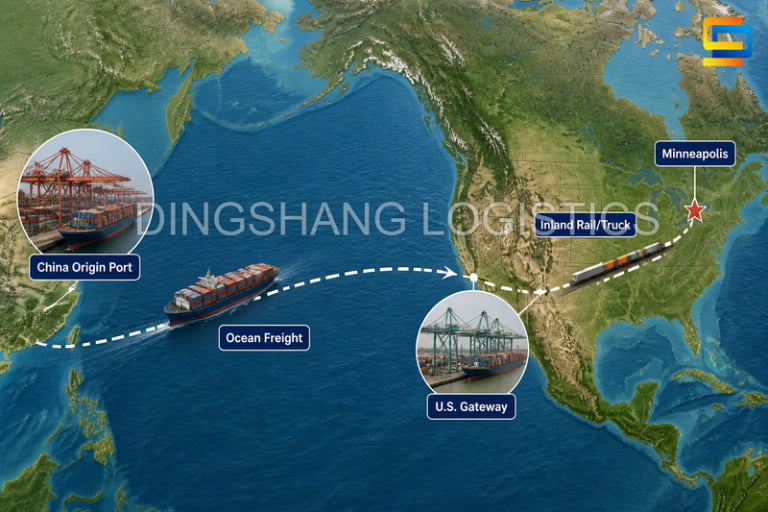
An inland U.S. destination adds transportation beyond the ocean gateway. A China → Los Angeles port quote ends at a different point from a China → Chicago door quote. For an inland shipment, the container may move through an ocean gateway, continue by rail to an inland facility, and then require truck delivery to the consignee.
A possible inland flow is:
China origin → U.S. ocean gateway → rail → inland ramp → truck → final warehouse
The actual routing must be confirmed for the booking because carrier services and inland arrangements vary.
Two distinctions are especially important:
Port arrival ≠ warehouse delivery.
Inland rail ramp ≠ final door delivery.
For example, a container that reaches an inland Chicago rail facility may still require local drayage to the consignee's warehouse. The final ZIP code, drayage, warehouse appointment, receiving conditions, cargo weight, and local delivery requirements can all affect the delivered cost.
That is why the Ningbo → Chicago door-delivery rates in the planning table should not be compared directly with Ningbo → Los Angeles port-to-port rates. They represent different endpoints and different service scopes.
What Information Is Needed for an Accurate Container Quote?
For an accurate FCL quote from China to the USA, provide enough information to price the actual route, equipment, cargo, and delivery scope. A port name alone is not enough when pickup, weight, customs requirements, or inland delivery can change the transportation plan.
Provide:
- Product name
- HS code, if available
- Material or composition
- China pickup address or loading port
- U.S. delivery address or ZIP code
- Container type: 20GP or 40HQ
- Cargo-ready date
- Trade term: FOB or EXW
- Estimated gross weight
These details allow the forwarder to determine the appropriate route and define whether the quotation should cover port-to-port transportation, inland transportation, or final door delivery.
If customs-clearance coordination is required, provide accurate commercial and product information early. U.S. import entry and release requirements must be completed before the cargo can proceed through the applicable delivery process. For broader preparation beyond freight pricing, see the step-by-step China-to-USA import process.
A practical way to compare container quotes
When you receive multiple quotations, put them on the same basis before comparing the totals.
| Comparison Point | Quote A | Quote B | Quote C |
|---|---|---|---|
| Same China origin? | |||
| Same U.S. destination/ZIP? | |||
| Same 20GP or 40HQ equipment? | |||
| Same service scope? | |||
| China pickup included? | |||
| Origin charges included? | |||
| Ocean freight included? | |||
| U.S. destination charges included? | |||
| Customs-clearance service included? | |||
| Duty shown separately? | |||
| Inland transportation included? | |||
| Final delivery included? | |||
| Conditional charges identified? | |||
| Rate validity confirmed? |
The lowest ocean freight quote may not produce the lowest total delivered logistics cost if the quotes cover different services. An unusually low price is not automatically a bad quote, but you should confirm that the origin, destination, container type, cargo assumptions, sailing window, and included services are the same.
If the difference is mainly about service quality, routing explanation, or quotation transparency rather than price itself, the dedicated guide on choosing a freight forwarder in China covers that decision in more detail.

Frequently Asked Questions
How much does a 20GP container cost from China to the USA?
There is no nationwide fixed 20GP rate. In the 2026 planning examples above, Ningbo → Los Angeles and Shenzhen → Los Angeles are USD 4,700–5,100 port-to-port, while Shanghai → New York and Qingdao → Savannah are USD 6,300–7,000 port-to-port. Ningbo → Chicago is USD 6,500–7,000 for the stated door-delivery scope. These are planning ranges, not guaranteed booking rates.
How much does a 40HQ container cost from China to the USA?
The 2026 planning examples range from USD 5,400–6,600 for Ningbo or Shenzhen → Los Angeles port-to-port to USD 7,800–8,500 for Shanghai → New York or Qingdao → Savannah port-to-port. The Ningbo → Chicago door-delivery example is USD 8,000–8,800. The Chicago rate should not be compared directly with the port-to-port examples because its service scope is different.
Why is a 40HQ not twice the price of a 20GP?
A 40HQ has substantially more cubic capacity, but many shipment-level costs do not increase in direct proportion to container volume. Documentation, customs-clearance service, administrative work, and some operational costs may change much less than the available cubic capacity. A well-utilized 40HQ can therefore have a lower cost per CBM even though its total cost is higher.
Is shipping to the U.S. West Coast cheaper than the East Coast?
Often, for comparable port-to-port services, but not always. China-to-Los Angeles ocean freight can be lower than East Coast routes in many market periods, but the actual result depends on the China origin, carrier, sailing date, routing, equipment, and final U.S. destination. Inland transportation can also change the total delivered logistics cost.
Does door-to-door shipping include customs duty?
Not automatically. Door-to-door describes the transportation service scope. Customs-clearance service may be included, but import duty is a separate government charge unless the quotation and commercial arrangement explicitly state how it will be handled. Door-to-door service should not be assumed to mean DDP.
Can import duty be estimated before shipping?
Yes, often. If the HTS classification, customs value, country of origin, and applicable U.S. tariff measures are known, duty can usually be estimated for planning. Additional duties or other government charges may also apply. Final assessment remains subject to CBP and the actual import entry circumstances.23
When should I request a final container shipping quote?
Request and reconfirm the rate when your cargo-ready date, expected sailing window, container type, cargo details, and U.S. destination are known. Container rates and space conditions are time-sensitive, so an older planning quote should not be treated as the final booking price without reconfirmation.
Get an Accurate China-to-USA Container Quote
To receive a current 20GP or 40HQ quotation, provide:
- Product name
- HS code, if available
- Material
- China pickup address or loading port
- U.S. destination address or ZIP code
- Container type: 20GP or 40HQ
- Estimated gross weight
- Cargo-ready date
- Trade term: FOB or EXW
With these details, the route and service scope can be confirmed and a current China-to-USA shipping quotation can be prepared.
If you need door-to-door service, customs-clearance coordination and final U.S. delivery can also be included according to the shipment requirements. Import duty should be identified or estimated separately unless the quotation explicitly states otherwise.
References
[International Trade Administration — Know Your Incoterms](https://www.trade.gov/know-your-incoterms) ↩
[U.S. Customs and Border Protection — Harmonized Tariff Schedule: General Information](https://www.help.cbp.gov/s/article/Article-1015?language=en_US) ↩
[U.S. Customs and Border Protection — How Do I Determine the Duty Rate on My Goods?](https://www.help.cbp.gov/s/article/Article-1344) ↩
[Federal Maritime Commission — Detention and Demurrage](https://www.fmc.gov/detention-and-demurrage/) ↩
Leave a Comment