
How Much Does a 40HQ Container Cost from China to USA?
As of August 2026, the pricing snapshot provided for this guide puts 40HQ ocean freight on the example China-to-USA routes below at roughly USD 5,000–7,000. These figures are indicative planning ranges, not guaranteed market rates. Your actual rate depends on the China origin, U.S. destination, cargo-ready date, carrier, routing, cargo weight, equipment availability, and service scope.
For an importer, the more important number is the total delivered logistics cost. Ocean freight is not the same as a port-to-port total, inland-ramp quote, door-delivery price, or total landed cost.
August 2026 40HQ Ocean Freight Rate Examples
| Route | Indicative 40HQ Ocean Freight | Pricing Snapshot |
|---|---|---|
| Ningbo → Los Angeles | USD 5,500–6,500 | August 2026 |
| Shanghai → Los Angeles | USD 5,300–6,200 | August 2026 |
| Shenzhen → Los Angeles | USD 5,000–6,000 | August 2026 |
| Ningbo → New York | USD 6,500–7,000 | August 2026 |
Important: These are indicative ocean-freight ranges for the stated August 2026 pricing snapshot, not guaranteed quotations. They do not automatically include China pickup, destination charges, customs clearance, duties, chassis, drayage, inland rail or truck transportation, or final delivery unless specifically stated.
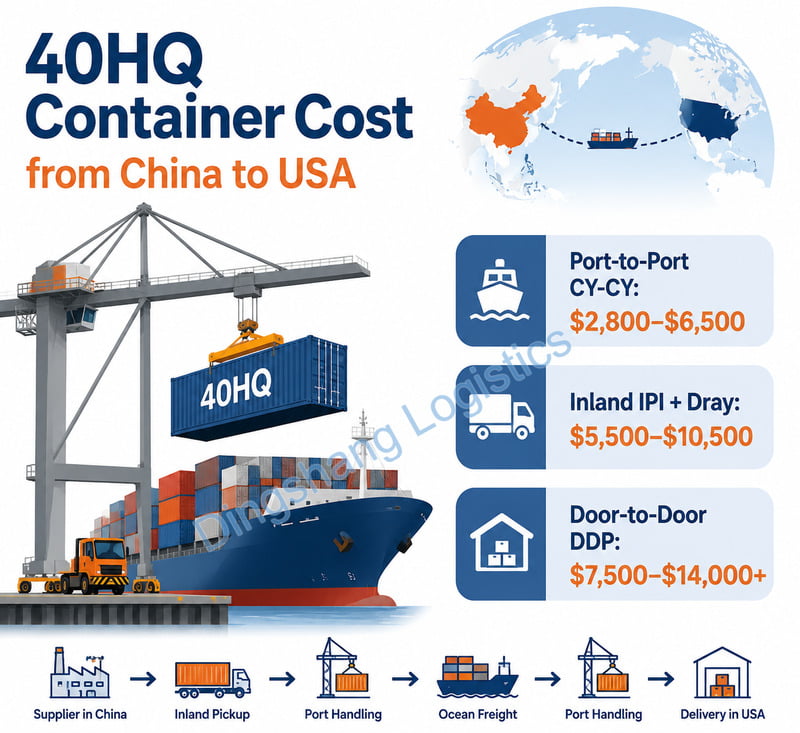
For current pricing, compare quotes only after giving each forwarder the same shipment assumptions: origin, destination, 40HQ equipment, commodity, gross weight, cargo-ready date, Incoterm, customs requirements, and final delivery location.
What Affects the Cost of a 40HQ Container from China to USA?
The main factors affecting a 40HQ container cost from China to the USA are the China origin, U.S. destination, cargo-ready date, carrier market, cargo weight, Incoterm, customs requirements, and service scope. A quote ending at a U.S. container yard can be very different from one that includes an inland rail move and final warehouse delivery.
This distinction matters because ocean freight is not the same as total delivered logistics cost. If you are new to the process, this guide to how container shipping works from China to the USA explains the major transportation stages.
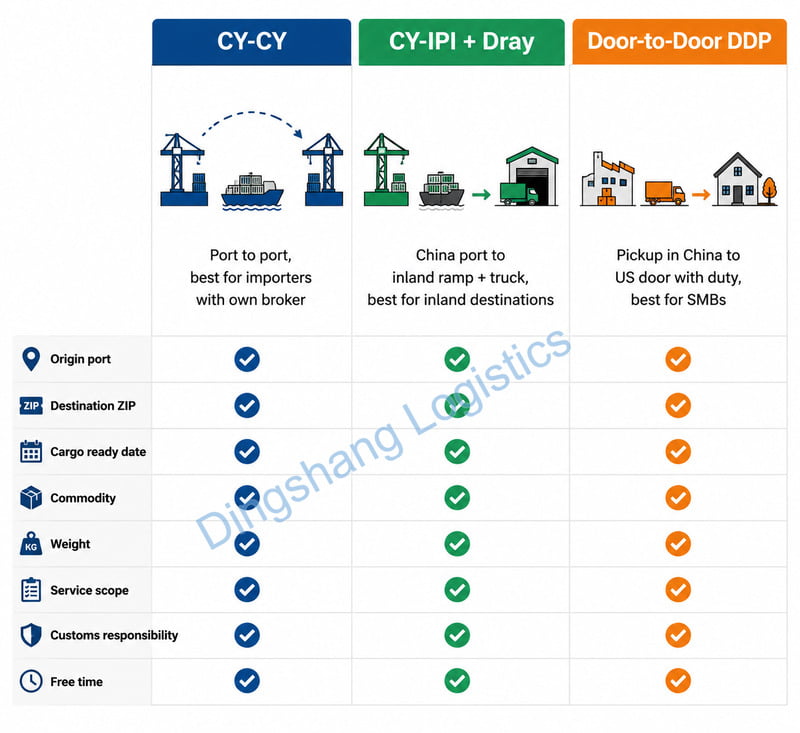
Three Common Service Scopes
| Service scope | What it means for budgeting | Best suited to | Main item to verify |
|---|---|---|---|
| CY-CY | Container yard to container yard; inland delivery and other destination costs may be separate | Importers managing their own U.S. customs and trucking arrangements | Exactly which origin and destination charges are included |
| IPI + drayage | Ocean transportation plus inland intermodal movement and final drayage, depending on the quoted routing | Importers shipping to inland U.S. markets | Inland ramp, free time, chassis, drayage, and empty return |
| Door-to-door | Transportation is coordinated through to the specified delivery address | Importers wanting one coordinated logistics process | Customs scope, duties, delivery conditions, and exclusions |
An inland rail ramp is not the same as door delivery. If a quote ends at an inland ramp, you still need a plan for container pickup, chassis, drayage, unloading, and empty-container return unless those services are expressly included.
Incoterms also matter. Incoterms® 2020 rules clarify how transportation-related tasks, costs, and risks are allocated between buyer and seller. DDP (Delivered Duty Paid), for example, assigns substantially different responsibilities from FOB, FCA, or EXW.1
Assumptions to Lock Before Requesting a Quote
For a normal dry 40HQ shipment, provide:
- Origin: supplier address or China port such as Ningbo, Shanghai, Shenzhen, or Qingdao
- Destination: U.S. port, inland ramp, or final warehouse ZIP code
- Commodity: specific product name, material, and HS/HTS code if available
- Gross cargo weight: needed to evaluate loading and inland transportation
- Cargo-ready date: rates and available routings are time-sensitive
- Incoterm: for example, FOB or EXW
- Customs scope: whether customs-clearance coordination and duty handling are required
- Delivery requirements: live unload, drop-and-pick, appointments, or other receiving restrictions
- Special cargo conditions: hazardous materials, temperature control, oversized cargo, or other non-standard requirements
CBP places responsibility on the importer of record to exercise reasonable care when entering, classifying, and valuing imported merchandise and providing information needed for applicable import requirements.2 A freight forwarder or customs broker can assist with the process, but that does not remove the importer's compliance responsibilities.
If you are building a broader import process rather than pricing only transportation, see how to import products from China to the USA step by step.
Quote-comparison rule: Do not compare the headline freight number until you have compared the service scope, exclusions, validity, free-time terms, and final-delivery responsibility.
How Does the U.S. Destination Affect a 40HQ Shipping Cost?
The U.S. destination can materially change a 40HQ shipping cost because a West Coast gateway shipment, an East Coast all-water shipment, and a shipment continuing to an inland market involve different transportation legs. Compare the total cost to the actual destination, not simply the lowest ocean rate to the first U.S. port.
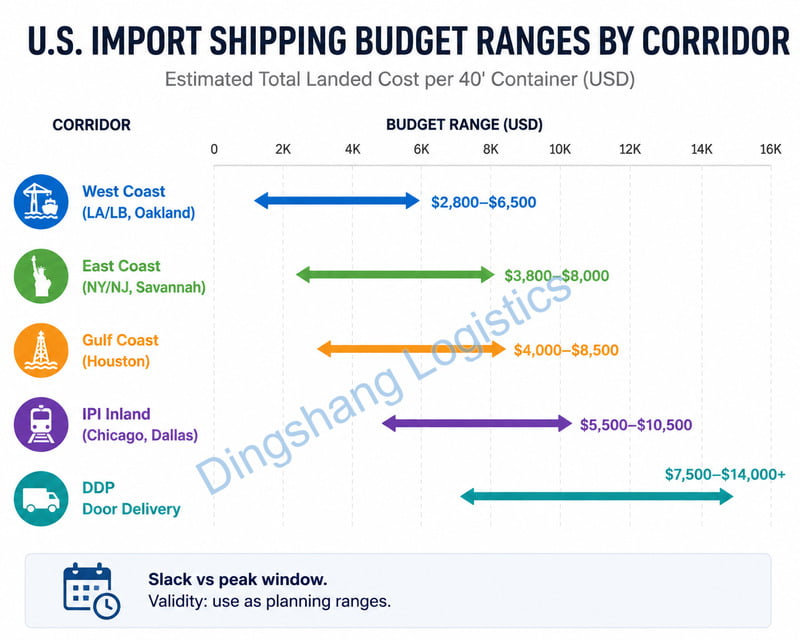
For example, a container destined for Southern California may require a relatively short inland move after arriving at Los Angeles or Long Beach. A container destined for Chicago, Dallas, Memphis, or another inland market may require rail, long-haul trucking, local drayage, or a combination determined by the actual booking and delivery plan.
| Destination type | Cost structure to compare | Important question |
|---|---|---|
| West Coast port market | China origin + ocean + destination charges + local drayage | What is included after vessel arrival? |
| East Coast port market | China origin + ocean/all-water service + destination charges + local drayage | Does the gateway make sense for the final delivery location? |
| Gulf Coast market | China origin + ocean routing + destination handling + inland delivery | Is the gateway efficient for the final ZIP code? |
| Inland U.S. market | Ocean + inland rail/truck + ramp charges + drayage | Does the quote end at the ramp or warehouse? |
| Door delivery | Origin-to-door transportation plus specifically quoted customs and destination services | Which charges remain outside the quoted total? |
A Chicago importer, for example, should compare the complete inland plan rather than assume that the lowest ocean rate to Los Angeles produces the lowest delivered cost. The guide to shipping a container from China to Chicago explains that inland-market distinction in more detail.
Likewise, an importer delivering in Southern California can review the operational considerations for shipping a container from China to Los Angeles.
Why the Lowest Port-to-Port Rate May Not Produce the Lowest Delivered Cost
Suppose two routing options reach different U.S. gateways. One has a lower ocean rate but requires more expensive inland transportation. The other has a higher ocean rate but places the container closer to the consignee.
You cannot identify the better option from ocean freight alone. Compare:
- Ocean freight and applicable carrier charges
- Destination terminal or ramp charges
- Inland rail or trucking
- Chassis and drayage
- Free-time terms
- Delivery appointment requirements
- Empty-container return requirements
- Operational risks for the actual shipment window
For inland destinations in particular, the better route is the one that provides the right balance of total delivered cost, lead time, free-time exposure, and operational reliability for the shipment and receiving plan.
Which Charges Make Up a 40HQ Container Cost from China to USA?
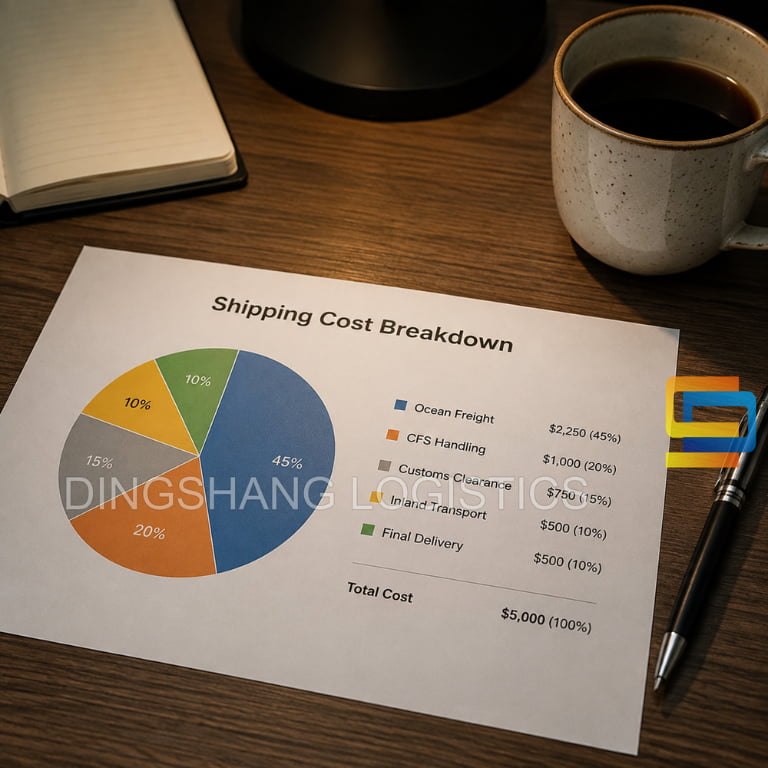
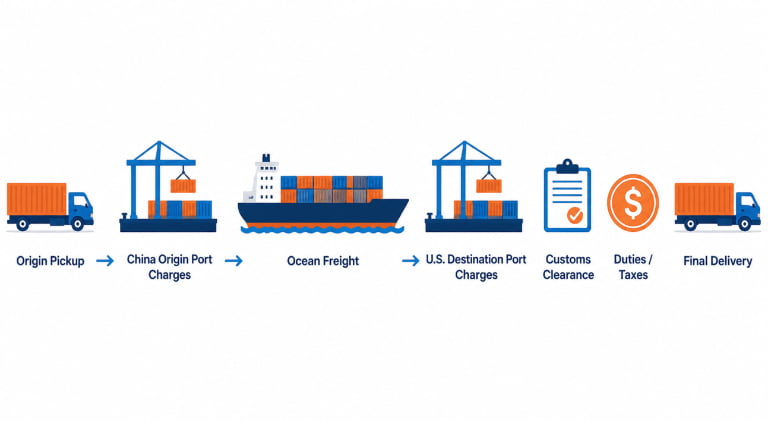
A complete 40HQ container cost from China to USA can include China origin charges, ocean freight, U.S. destination charges, customs-related costs, inland transportation, chassis, drayage, and time-related accessorial charges. Duties and taxes are separate from freight unless the quotation explicitly identifies them as included.
If you are comparing quotations, it helps to understand what you are really paying to ship a container from China.
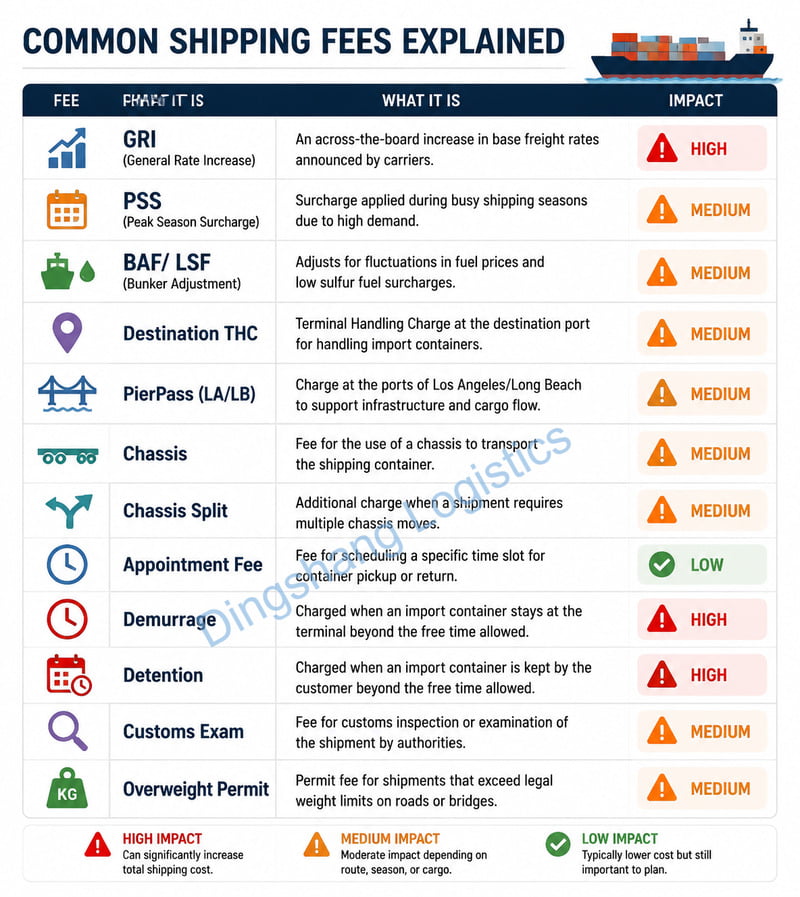
Common Cost Categories
| Cost category | Where it occurs | What to confirm |
|---|---|---|
| China inland pickup | Supplier to port/container loading point | Included under the quoted scope or billed separately? |
| Origin handling | China side | Documentation, terminal, VGM, seal, and other applicable origin charges |
| Ocean freight | China to U.S. gateway | Rate validity, equipment, routing, and included carrier surcharges |
| Destination charges | U.S. port or inland ramp | Which carrier, terminal, or ramp charges are included? |
| Customs services | U.S. import entry | Brokerage/clearance scope and bond requirements |
| Duties and taxes | U.S. import | Based on classification, customs value, origin, and applicable trade measures |
| Chassis | U.S. inland move | Included in drayage or charged separately? |
| Drayage | Port/ramp to consignee | Mileage, fuel, appointments, waiting time, and special requirements |
| Rail/inland transportation | Inland destinations | Included in a through rate or separately quoted? |
| Demurrage/detention | Terminal/equipment use | Applicable free-time and billing terms |
| Customs exam costs | If examination occurs | Handling, transportation, storage, or related third-party costs |
| Special delivery costs | Final destination | Waiting, redelivery, special equipment, or receiving restrictions |
Demurrage and Detention Are Different
In general shipping usage, demurrage concerns excess time associated with cargo or containers at a terminal, while detention concerns carrier equipment kept outside the terminal beyond the applicable free period. Actual terminology, free time, and billing should be checked against the applicable carrier, terminal, tariff, contract, and shipment circumstances.
The Federal Maritime Commission regulates demurrage and detention billing practices in U.S. international ocean transportation. Its current rules include requirements concerning invoice timing, invoice contents, and dispute processes; a 2025 court decision set aside one portion of the 2024 rule concerning who may be billed, while the FMC states that the other provisions remain in effect.3
Free time is therefore a commercial term worth comparing before booking—not a minor detail to investigate after the container arrives.
Ask your forwarder to identify:
- Applicable terminal or carrier free time
- How that free time is calculated
- Container return requirements
- How weekends or holidays are treated under the applicable terms
- Where the empty container must be returned
- How delays outside the normal plan may affect storage or equipment charges
Do not assume that free-time terms are identical across carriers, terminals, service contracts, or bookings.
How Should You Compare 40HQ Quotes from China to USA?
Compare 40HQ quotes on an apples-to-apples service basis. Give every forwarder the same origin, destination, cargo weight, cargo-ready date, Incoterm, customs scope, and delivery requirements, then separate fixed quoted charges from variable or conditional charges.
A practical comparison looks like this:
| Quote item | Forwarder A | Forwarder B | What to check |
|---|---|---|---|
| Origin scope | Included / excluded | Included / excluded | Supplier pickup or port only? |
| Ocean freight | Quoted | Quoted | Same equipment and destination? |
| Rate validity | Date | Date | Covers the cargo-ready window? |
| Destination charges | Included / excluded | Included / excluded | Same terminal/ramp scope? |
| Customs clearance | Included / excluded | Included / excluded | Bond and special entries separate? |
| Duties/taxes | Included / excluded | Included / excluded | Based on verified classification and value? |
| Chassis | Included / excluded | Included / excluded | What charging basis applies? |
| Drayage | Included / excluded | Included / excluded | Same ZIP and delivery conditions? |
| Free time | Confirmed terms | Confirmed terms | Same type and scope of free time? |
| Exams/storage | Conditional | Conditional | How are exceptions billed? |
A lower headline rate is not necessarily a lower total cost. It may simply contain fewer services.
For additional procurement guidance, see how to choose a freight forwarder in China.
Watch the Quotation Validity
Container freight pricing is time-sensitive. A quotation should identify its validity period and be checked against the shipment's actual cargo-ready date.
Do not use an old quote as a current budget without reconfirmation. Carrier pricing, capacity, equipment availability, routing, and surcharges can change between the planning stage and the actual booking.
Is the Cheapest 40HQ Route Always the Best Route?
No. The cheapest 40HQ ocean rate is not necessarily the best route because the container still has to complete the U.S. import process, become available for pickup, reach the consignee, unload, and have the equipment returned according to the applicable terms.
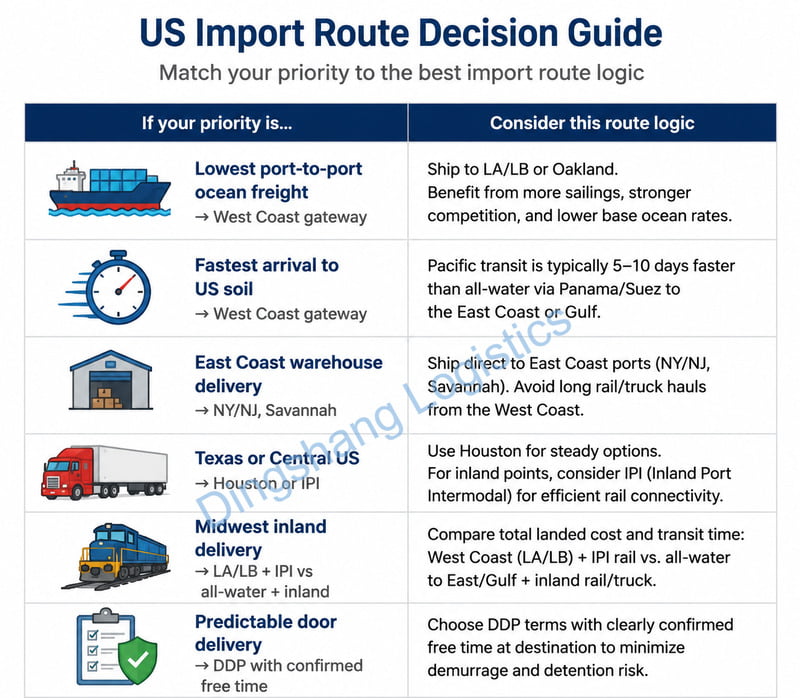
Instead of ranking routes only by ocean freight, evaluate five factors:
- Total transportation cost — including destination and inland charges
- Total lead time — not just vessel transit
- Free-time exposure — especially when warehouse receiving is tight
- Delivery feasibility — appointments, unloading, cargo weight, and equipment requirements
- Exception exposure — customs exams, terminal delays, missed appointments, or other shipment-specific disruptions
A Better Route-Selection Framework
| Importer priority | What to evaluate |
|---|---|
| Lowest delivered cost | Ocean + destination + inland + accessorial exposure |
| Earlier U.S. arrival | Actual sailing and gateway options for the booking |
| Inland delivery | Rail/truck routing plus final drayage |
| Predictable receiving | Free time, warehouse appointments, and delivery plan |
| Heavy cargo | Container payload plus legal inland transportation constraints |
| Regular import program | Cost consistency, routing alternatives, and exception handling |
Ocean transit is not total door-to-door lead time. Origin pickup, vessel cutoff, sailing schedule, transshipment where applicable, terminal availability, customs processing, inland transportation, and warehouse appointments can all affect the final delivery date.
For planning purposes, use actual booking options rather than a generic transit-time promise. The China-to-USA sea freight transit time guide explains the difference between ocean transit and the complete shipment timeline.
How Do Cargo Weight and Volume Affect a 40HQ Quote?
A 40HQ offers substantial cubic capacity, but usable cargo volume is lower than the container's nominal internal volume and should be calculated from the actual packing plan. Around 68 CBM may be a useful planning assumption for many carton-loaded shipments, but it is not a guaranteed loading capacity. Pallets, carton dimensions, packaging, loading pattern, and cargo weight can materially change the usable volume.
Dense cargo may become weight-constrained before the available cubic space is fully used.
U.S. highway movements are also subject to federal and state truck size-and-weight rules. On the Interstate System, federal rules generally limit gross vehicle weight to 80,000 pounds, subject to the Federal Bridge Formula and other applicable rules and exceptions.4 Container payload capacity therefore should not be treated as proof that a loaded container can legally move over the road in every configuration.
Before quoting a heavy 40HQ, provide:
- Total cargo gross weight
- Number and dimensions of packages or pallets
- Weight distribution where relevant
- Supplier loading method
- Final delivery ZIP code
- Unloading requirements
For machinery and other dense commodities, loading and inland weight planning can be more important than maximizing cubic volume.
Can You Get a Fixed DDP Price for a 40HQ from China to USA?
A DDP quotation is only meaningful when the product, value, classification, origin, destination, and import arrangement are understood. Under DDP, the seller assumes extensive delivery and import responsibilities, so duties and import requirements should not be treated as an unknown flat amount.1
A freight quote also should not be confused with the commercial Incoterm between buyer and seller. Incoterms allocate tasks, costs, and risks under the sales transaction; they do not by themselves define every service included in a freight forwarder's quotation.1
For a customs-inclusive quotation, expect to provide at least:
- Product name and detailed description
- Material or composition
- HS/HTS code if available
- Declared commercial value
- Country of origin
- Supplier location
- U.S. delivery ZIP code
- Importer arrangement
- Commercial invoice and packing information
- Any known government-agency requirements
CBP's reasonable-care framework places important classification and valuation responsibilities on the importer of record.2 Product-specific requirements may also involve other government agencies depending on the merchandise.
Frequently Asked Questions
How many CBM fit in a 40HQ container?
For preliminary freight planning, around 68 CBM can be a useful working figure for many 40HQ shipments, but it is not a guaranteed loading capacity. Actual usable volume depends on the specific container, carton or pallet dimensions, packaging, loading pattern, and cargo weight.
A container's nominal internal volume should not be treated as guaranteed cargo-loading volume. Use the packing list and package dimensions for actual loading and quotation planning.
Is a 40HQ cheaper than two 20GP containers?
Often, one 40HQ can be operationally more efficient than two 20GP containers when the cargo fits safely and legally within one 40HQ, but it is not a universal rule. Compare actual freight rates, cargo weight, loading requirements, inland transportation, and delivery conditions before choosing equipment.
What is included in a port-to-port 40HQ rate?
A port-to-port quote covers a defined ocean transportation scope between specified points, but inclusions vary by quotation. Customs, duties, destination charges, chassis, drayage, exams, and inland delivery should not be assumed included unless the quotation expressly identifies them.
Are customs duties included in a 40HQ shipping quote?
Not automatically. U.S. duties depend on factors including merchandise classification, customs value, country of origin, and applicable tariff measures. Confirm whether a quotation includes only customs-clearance services or also identifies estimated duties and other government charges.
How long does a 40HQ container take from China to the USA?
There is no single transit time for every China-to-USA 40HQ shipment. Timing depends on the China origin, U.S. gateway, carrier service, sailing schedule, routing, transshipment where applicable, and whether inland transportation is required.
Total door-to-door lead time also includes origin handling, customs processing, terminal or rail activity, drayage, and final delivery. Ocean transit and door-to-door lead time are not the same measurement.
What is the biggest hidden cost in 40HQ shipping?
There is no single hidden cost that is always the largest. Depending on the shipment, significant unplanned expenses can come from demurrage, detention, storage, customs exams, chassis, waiting time, redelivery, inland transportation, or other accessorial charges.
A detailed inclusion-and-exclusion list is the best way to reduce quotation surprises.
What Information Do You Need for an Accurate 40HQ Quote?
For an accurate China-to-USA 40HQ quotation, provide enough information to price the actual transportation scope rather than a generic container rate.
Send Dingshang Logistics:
- Product name and description
- HS/HTS code, if available
- Material or composition
- Supplier or pickup location in China
- U.S. delivery ZIP code
- 40HQ equipment requirement
- Total gross cargo weight
- Cargo-ready date
- FOB, EXW, or other agreed Incoterm
- Customs-clearance requirements
- Commercial value when duty estimation is required
- Special loading or unloading requirements
- Any known hazardous, regulated, oversized, or other special cargo conditions
With those details, the shipment can be evaluated by route and service scope so you can compare ocean freight, inland transportation, customs-related costs, delivery charges, and exception exposure rather than choosing a quote based only on the headline ocean rate.
References
[International Trade Administration — Know Your Incoterms](https://www.trade.gov/know-your-incoterms) ↩
[U.S. Customs and Border Protection — Importing Into the United States](https://www.cbp.gov/sites/default/files/documents/Importing%20into%20the%20U.S.pdf) ↩
[Federal Maritime Commission — U.S. Court of Appeals Issues Decision in Case on Demurrage and Detention Billing Practices](https://www.fmc.gov/articles/u-s-court-of-appeals-issues-decision-in-case-on-demurrage-and-detention-billing-practices/) ↩
[Federal Highway Administration — Bridge Formula Weights](https://ops.fhwa.dot.gov/freight/publications/brdg_frm_wghts/bridge_formula_all.pdf) ↩
Leave a Comment