
Quick Answer
The 20ft container shipping cost from China to USA varies by route. DingShang Logistics updates its FCL reference rates every Monday. At the time of writing, the latest published rates for five selected port pairs ranged from $4,720 to $6,400 per 20GP container. For example, Ningbo to Los Angeles was listed at $4,800, while Ningbo to Houston was $6,400. These figures are reference prices, not guaranteed current quotations or all-in warehouse-delivery costs. Actual costs depend on the route, service scope, customs-related expenses, inland transportation, and any applicable additional charges.
Key Takeaways
- 20ft means 20GP: The standard 20-foot general-purpose container is a dedicated FCL unit. It does not need to be filled completely.
- Weekly price reference: The latest published rates at the time of writing ranged from $4,720 to $6,400 per 20GP on five selected routes. Check the weekly rate table for updates.
- Ocean rate is not delivered cost: Ask what the quote includes before adding pickup, U.S. handling, customs brokerage, chassis, or trucking charges.
- Cargo weight matters: A 20GP can be practical for dense commercial goods, but container payload and U.S. road-weight limits are different constraints.
- Compare the alternatives: LCL or 40HQ may be more economical depending on actual volume, gross weight, and receiving location.
How Much Does a 20ft Container Cost to Ship from China to USA?
A 20ft container is commonly quoted as a 20GP (20-foot general-purpose) FCL container. Its freight price depends on the specific Chinese loading port and U.S. destination, not simply on the container's size. A West Coast arrival and an East Coast arrival can have different vessel schedules, handling arrangements, and onward trucking requirements.
The following figures come from the most recently published weekly FCL rate table available when this guide was prepared. DingShang Logistics updates the reference table every Monday; the examples below are not automatically refreshed when prices change.
| China loading port | U.S. destination port | Published 20GP reference | Estimated ocean transit |
|---|---|---|---|
| Shenzhen | Los Angeles, CA | $4,720 | 15 days |
| Ningbo | Los Angeles, CA | $4,800 | 13 days |
| Shanghai | New York, NY | $6,000 | 31 days |
| Qingdao | New York, NY | $6,080 | 32 days |
| Ningbo | Houston, TX | $6,400 | 30 days |
Source: DingShang Logistics weekly FCL reference-rate table, as published when this article was prepared. Prices are USD per 20GP container for the stated port pairs. Transit estimates start after vessel departure. These references do not establish the inclusion of origin local charges, U.S. destination charges, duties, or warehouse delivery.
For current port-pair prices, check the FCL reference-rate table, updated every Monday. Request a written, shipment-specific quote before making a purchasing or delivery commitment.
Why Does the Destination Port Change the Price?
The $4,800 Ningbo–Los Angeles reference and $6,400 Ningbo–Houston reference are not interchangeable services. The first ends at a West Coast gateway; the second names a Gulf Coast gateway. The ocean route, transit time, and local delivery geography differ.
A buyer whose warehouse is in Texas should not book Los Angeles solely because the published port-pair reference is lower. Cross-country rail or trucking, additional handoffs, and the final warehouse appointment could change the comparison. Compare both options to the same destination ZIP code and receiving deadline.
What Is Included in a 20ft Container Shipping Quote?
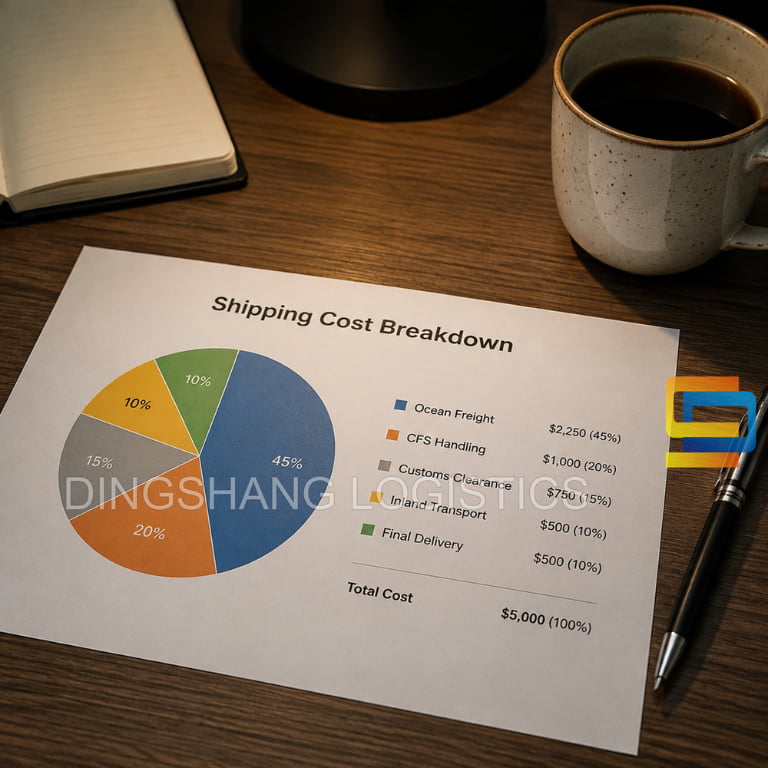
There is no universal definition of an “all-in 20ft shipping price.” One quotation may cover mainly ocean transportation; another may bundle local handling and delivery. The only meaningful comparison is between quotes with the same origin, endpoint, cargo specifications, and clearly stated inclusions.
| Cost category | What to confirm before accepting the quote |
|---|---|
| Origin pickup and handling | Factory collection, stuffing/loading, export documentation, local terminal fees, and which party pays under the agreed trade term |
| Ocean freight | 20GP equipment, named ports, carrier service, applicable surcharges, space, and quote validity |
| U.S. destination charges | Carrier release, terminal handling, and any separately billed destination services |
| Customs services and government charges | Brokerage, customs bond where applicable, duties, tariffs, taxes, and government fees |
| Inland transportation | Rail if required, truck drayage, chassis, fuel, destination ZIP, and delivery appointment |
| Conditional charges | Customs examinations, storage, demurrage, detention, overweight handling, truck waiting, or redelivery if incurred |
Ocean freight, total delivered logistics cost, and landed cost are different measures. Landed cost may also include the value of the goods, duties, and taxes. Do not add a charge twice if it is already included in the forwarder's proposed package.
How FOB and EXW Affect the Quote
Under FOB, the seller generally handles export clearance and delivers the goods on board the vessel at the named port, with responsibilities allocated under the agreed Incoterms rule. Under EXW, the buyer generally assumes more responsibility from the seller's premises. Neither term guarantees a particular freight price or automatically covers U.S. customs and local delivery.
Confirm the named location and the exact services assigned to each party. A supplier saying “FOB Ningbo” and another offering “EXW factory” are not presenting the same logistical starting point.
How to Calculate the Total Cost of Shipping a 20ft Container
Start with a confirmed quotation and separate included charges, additional normal charges, estimated government charges, and conditional costs. This gives you a usable budget without presenting every possible fee as unavoidable.
A practical calculation is:
Estimated delivered logistics cost = quoted transportation charges + separately payable origin/destination services + customs brokerage + inland delivery + any applicable additional logistics services.
Government duties and taxes should be estimated separately from the transport budget. Whether they are paid directly by the importer or arranged through another party depends on the commercial agreement.
Worked Example: Ningbo to a Los Angeles-Area Warehouse
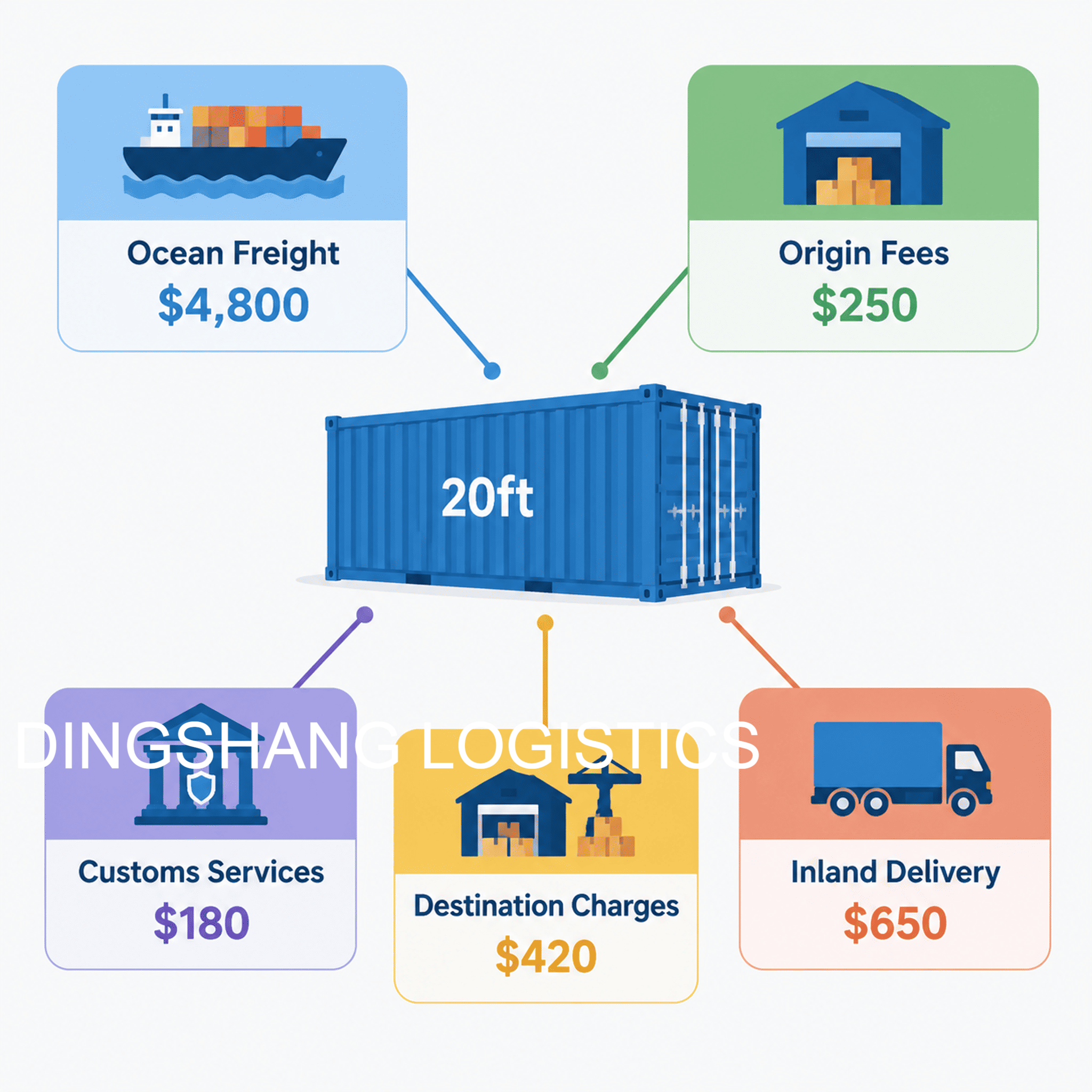
Use the $4,800 Ningbo-to-Los Angeles 20GP reference from the published weekly table as the starting point. Now suppose a particular offer confirms that this amount covers only the quoted port-pair ocean service and separately identifies the charges below.
Illustrative budgeting exercise — not a real shipment, current market rate, or DingShang quotation:
| Example line item | Amount |
|---|---|
| Ningbo–Los Angeles published port-pair reference | $4,800 |
| Hypothetical China origin services not included above | $250 |
| Hypothetical U.S. destination services | $420 |
| Hypothetical customs brokerage | $180 |
| Hypothetical local drayage to the warehouse | $650 |
| Hypothetical chassis or equipment charge | $100 |
| Illustrative logistics subtotal | $6,400 |
The $1,600 in added charges is hypothetical and only demonstrates the calculation. It is not a benchmark for Los Angeles delivery. The subtotal excludes merchandise, applicable duties/taxes, insurance if separately purchased, and conditional charges. A real quote might bundle several of these items, and different warehouse ZIP codes could produce different trucking costs.
This is why two offers described as “20ft shipping from China” can look very different. Ask each provider to specify the exact delivery endpoint and list the services already included.
What Factors Affect 20ft Container Shipping Costs?
The biggest variables are the port pair, sailing market, cargo characteristics, and final delivery requirements. Container size alone cannot determine the price.
- Chinese origin: A supplier near Ningbo may have a different trucking and cutoff arrangement from one near Shenzhen or Qingdao. Multiple suppliers can add consolidation or extra pickup work.
- U.S. gateway and destination ZIP: A port in California, New York, or Houston creates different ocean and inland options. A remote warehouse may cost more to serve than a nearby distribution center.
- Sailing availability and timing: Rates and space can change with carrier capacity, demand, equipment availability, holidays, and seasonal shipping patterns. Advance planning helps, but does not guarantee a cheaper rate.
- Cargo weight and handling: Dense products may require particular loading arrangements or special road transportation. An overweight container can create costs that were not included in an ordinary drayage assumption.
- Contract terms and service scope: FOB, EXW, port-to-port, and door-to-door quotes assign different tasks. Request equal scopes before declaring one offer cheaper.
For unusually heavy goods, send the forwarder a detailed packing list before selecting equipment. A price based on an assumed weight may need to be revised if the final verified mass or legal trucking requirements are different.
20ft vs. 40HQ vs. LCL: Which Is More Cost-Effective?
A 20ft container is often worth evaluating for dense commercial cargo, while a 40HQ may offer better cost per usable cubic meter for bulky goods. LCL remains an option for smaller shipments. There is no universal CBM threshold where one method always wins.
| Comparison | 20GP / 20ft FCL | 40HQ FCL | LCL |
|---|---|---|---|
| Space | Dedicated standard 20ft container | Dedicated 40ft high-cube container | Shared container space |
| Practical volume planning | Around 28 CBM | Around 68 CBM | Based on actual measured cargo |
| Main pricing approach | Per container/service | Per container/service | Commonly chargeable volume or weight, plus handling |
| Often worth comparing for | Dense goods and moderate-volume FCL shipments | Larger, relatively light and bulky cargo | Smaller consignments |
| Additional handling | Container unloading and empty return | Container unloading and empty return | Origin consolidation and destination CFS release |
These are practical volume planning allowances, not guaranteed loading capacities. Actual palletization, packaging, weight distribution, and container condition affect what fits.
The published weekly reference used in this guide lists $4,800 for a 20GP and $6,000 for a 40HQ on the Ningbo–Los Angeles lane. The larger unit's published reference is $1,200 higher on that particular lane, but it provides substantially more planning volume. That does not make 40HQ the right choice for every shipment: cargo weight, handling, and U.S. road limits still matter.
With LCL, several importers' goods share a container, which can reduce the need to pay for unused space. But destination container freight station (CFS) fees, documentation, minimum charges, and final delivery can change the total. Compare the full delivered LCL quote against the full FCL quote—not just LCL's quoted price per CBM.
Explore the relevant FCL shipping service or LCL shipping service when deciding between dedicated and shared container space.
20ft Container Dimensions, Capacity & Weight Limits
A standard 20GP is nominally 20 feet long and about 8 feet wide and 8 feet 6 inches high externally. Internal dimensions and usable cubic capacity vary slightly by container manufacturer and equipment condition. For commercial planning, about 28 CBM is a cautious usable loading allowance, not the physical maximum.
A 20GP can be especially useful when freight is too dense to make effective use of a larger box. However, the container's maximum gross mass does not tell you how much cargo can legally move by truck in the United States. Road rules, axle weights, chassis configuration, bridge limits, and the routing may restrict the shipment before the container reaches its technical capacity.
For stone, machinery, tiles, or other concentrated cargo, confirm the total cargo weight, individual package weights, center of gravity, loading method, and U.S. trucking feasibility. Do not assume that placing all the weight in a smaller container solves road restrictions.
How Long Does 20ft Container Shipping from China to USA Take?
Shipping time is driven primarily by the route and booked service, not by whether the container is 20GP or 40HQ. The selected reference table shows 13–15 days to Los Angeles and 30–32 days to New York or Houston for its listed routes. These are service-specific estimates from vessel departure, not universal transit guarantees.
For a realistic delivery plan, distinguish cargo-ready date, terminal cutoff, actual sailing, vessel arrival, customs/carrier release, and warehouse delivery. Waiting for the next sailing, U.S. terminal availability, trucking, and receiving appointments can all add time.
A container arriving in Los Angeles but destined for a warehouse in Chicago may also require inland rail followed by local drayage. Rail-ramp arrival is not the same as delivery to the final business address. The sea-rail intermodal service offers more detail on this transportation arrangement.
How Does 20ft Container Shipping Work?
A typical China-to-USA FCL move involves six connected stages:
- Prepare the shipment: Confirm cargo details, weight, product classification, pickup location, destination ZIP, and trade term.
- Book the equipment and sailing: Specify 20GP, identify the loading/discharge ports, and confirm vessel cutoff and proposed departure.
- Load and document the container: Arrange stuffing, secure the goods, record the seal, and submit required export and carrier information. Under SOLAS, the packed container needs a Verified Gross Mass (VGM) for loading; see the International Maritime Organization's guidance.
- Complete U.S. advance filing: For applicable ocean shipments, key Importer Security Filing (ISF) data elements are generally due at least 24 hours before the goods are loaded aboard the U.S.-bound vessel; some elements have different deadlines. Refer to CBP's ISF guidance.
- Arrange entry and release: The importer of record remains responsible for compliance even when using a licensed broker. Confirm customs release, carrier release, and terminal availability separately. Discuss U.S. customs clearance coordination ahead of arrival.
- Deliver and return the empty: Arrange the truck or inland rail connection, receiving appointment, unloading, and carrier-equipment return within the applicable deadlines.
If you want one provider to coordinate origin pickup through final U.S. delivery, clarify the inclusions of a door-to-door container shipping service. Door-to-door transportation does not automatically mean DDP or that all import duties are included.
How to Avoid Unexpected 20ft Container Charges
Unexpected costs usually come from a mismatch between the quote and the real shipment, or from an event that changes the normal plan. Before booking, ask your forwarder to identify normal charges, likely government charges, and exception conditions separately.
Confirm the actual cargo weight, whether the receiving site can unload a container, the arrival terminal, chassis availability, and the deadline for empty return. A missed truck appointment can create waiting or redelivery charges. A customs exam or delayed terminal release can also affect the delivery schedule.
Demurrage commonly concerns containers remaining at the terminal beyond applicable free time; detention commonly concerns keeping carrier equipment outside the terminal longer than permitted. Terminal storage may be separate. The applicable terms and invoice requirements matter; consult the Federal Maritime Commission's guidance on demurrage and detention billing. Do not assume one free-time period applies across every carrier and port.
What Information Is Needed for a 20ft Shipping Quote?
For a useful 20GP quote, provide the product name and material, HS code or U.S. HTSUS classification if available, China factory or pickup location, U.S. destination ZIP, cargo-ready date, FOB/EXW trade term, and package count, dimensions, total volume, and gross weight. Specify whether you need customs brokerage, inland delivery, and warehouse unloading.
For dense or unusually heavy cargo, include the supplier's loading plan and individual package weights. Ask the forwarder to quote the same delivery endpoint and state exclusions, equipment restrictions, possible conditional costs, and quote validity.
20ft Container Shipping Cost FAQs
1. How much does it cost to ship a 20ft container from China to USA?
At the time of writing, DingShang's latest published weekly reference listed $4,720–$6,400 per 20GP across five selected port pairs. Rates are updated every Monday and may change. These are not guaranteed quotations or complete warehouse-delivery costs; request a current written quote for your cargo.
2. What is the cheapest U.S. port for a 20ft container from China?
There is no universally cheapest U.S. port. A lower ocean price to Los Angeles may be offset by rail or trucking to an East Coast warehouse. Compare available routes using the same final delivery ZIP code, cargo details, and quotation scope rather than choosing only the lowest published ocean reference.
3. How much does a 20ft container cost to ship to Los Angeles?
In the published weekly reference used for this guide, Shenzhen–Los Angeles was $4,720 per 20GP and Ningbo–Los Angeles was $4,800. Current port-pair rates may differ. U.S. terminal charges, customs services, chassis, and delivery to your specific warehouse may add cost depending on the quotation.
4. Is a 20ft container cheaper than a 40ft container?
A 20GP often has a lower per-container reference price, but not necessarily a lower cost per unit of cargo. A 40HQ can accommodate much more volume, while a 20GP may suit dense goods. Compare actual utilization, gross weight, and complete delivered pricing.
5. When is a 20ft container cheaper than LCL shipping?
FCL may become more attractive when LCL freight, CFS handling, minimum charges, and final delivery collectively approach a full-container quotation. The crossover varies by route, cargo density, and destination. There is no reliable universal CBM threshold.
6. Does a 20ft container shipping quote include customs and delivery?
Not automatically. A port-pair or ocean-freight quote may exclude U.S. brokerage, duties, chassis, drayage, warehouse unloading, and conditional charges. Ask whether the price is port-to-port, port-to-door, or door-to-door and obtain a written list of inclusions and exclusions.
7. How long does it take to ship a 20ft container from China to USA?
Transit depends on the loading port, destination, and booked vessel service. The selected reference table shows 13–15 days to Los Angeles and 30–32 days to the listed East/Gulf Coast ports, counted after vessel departure. Customs, cargo availability, and inland delivery take additional time.
For a shipment-specific comparison, DingShang Logistics can review your 20GP cargo weight, loading requirements, China origin, U.S. delivery ZIP, and requested service scope. Request a 20ft container shipping quotation that shows both the port-pair freight component and what is required to deliver the goods to your warehouse.


Leave a Comment