
How to Ship a Container from China to Port of Kansas?
To ship a container from China to Port of Kansas, I first need to clear up a common misunderstanding: Kansas is an inland destination, not a seaport for ocean vessels.1 If you quote only the ocean leg, your budget can fall apart later. The better solution is to plan the full China-to-Kansas route from the start.
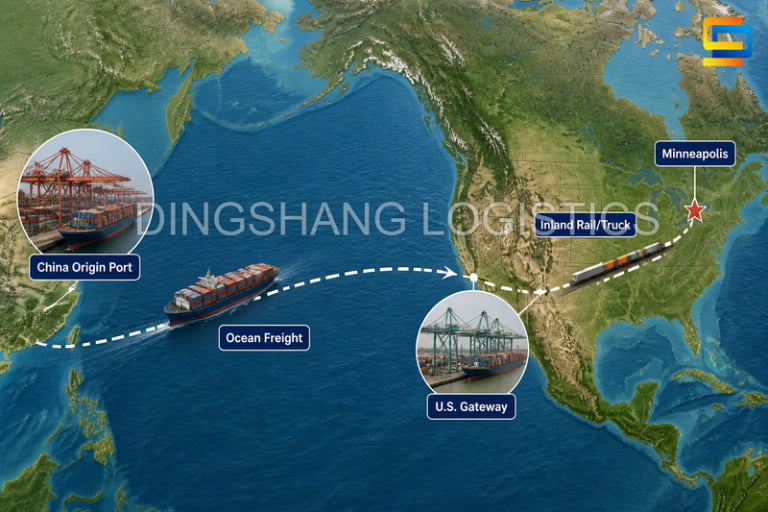
Shipping a container from China to “Port of Kansas” usually means moving cargo from a China port to a U.S. gateway port, then using rail or truck to reach Kansas City or another inland Kansas destination. The real decision is not only the ocean freight rate, but the full door-to-door landed cost.
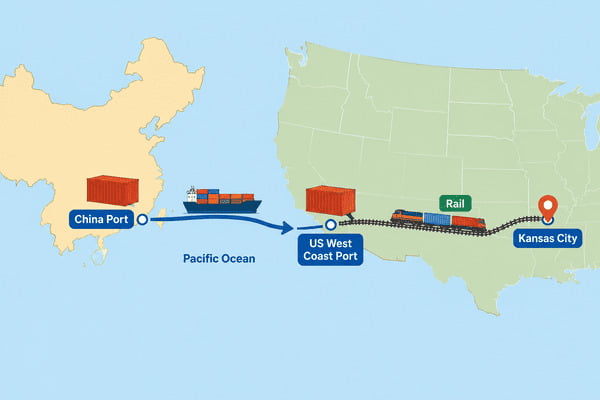
Most problems happen when importers compare quotes that do not include the same services. One quote may stop at Los Angeles. Another may include customs clearance, rail to Kansas City, and final truck delivery. I will break down the route, costs, service options, and quotation details below.
What Does “Port of Kansas” Mean When You Ship a Container from China to Port of Kansas?
Many importers search for Port of Kansas because they want their cargo delivered inland. The problem is that the phrase sounds like a direct ocean route. That misunderstanding can create wrong cost expectations, delayed planning, and incomplete freight quotations.
The practical meaning of “Port of Kansas” is usually Kansas City or another inland delivery point in Kansas or nearby states. Ocean containers move from China to a U.S. coastal port first, then continue by rail, truck, or intermodal service to the final inland destination.
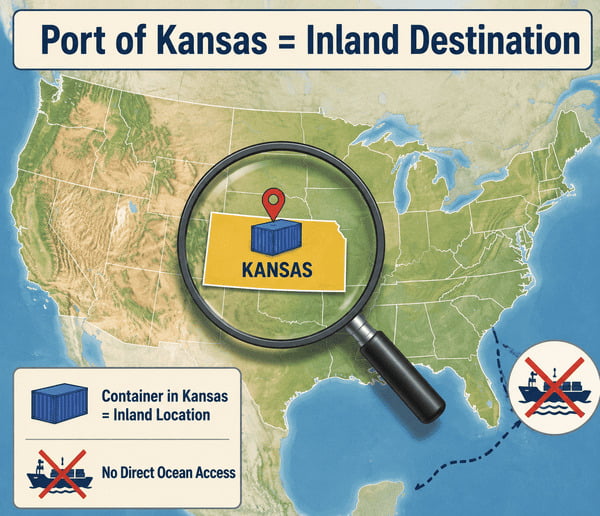
Kansas is not a direct ocean port
Kansas does not receive ocean container vessels in the same way Los Angeles, Long Beach, New York, Savannah, Houston, or Miami do. When I work on inland U.S. shipments, I always explain this point early because it changes the entire cost structure.
A normal container route looks like this:
- Pickup or delivery to origin port in China
- Export customs and terminal handling in China
- Ocean freight to a U.S. gateway port
- U.S. customs clearance and duties
- Rail or truck movement inland
- Final delivery to warehouse, DC, or business address
For Kansas shipments, the U.S. gateway is often a West Coast port, especially Los Angeles/Long Beach, because it can connect efficiently with inland rail networks. However, other U.S. ports may work depending on the origin port, carrier schedule, container availability, rail capacity, and final destination ZIP code.
Why the wording matters
If you ask only, “What is the ocean freight from China to Kansas?” you may receive a misleading answer. Ocean freight technically ends at the U.S. seaport. Kansas delivery requires inland transportation after arrival.
A better question is:
“What is the full cost to move my container from the China factory or China port to my Kansas warehouse?”
This question forces the quote to include the correct responsibility boundary.
Common destination examples
Importers may describe the inland destination in different ways:
| Buyer Says | Practical Meaning |
|---|---|
| Port of Kansas | Usually Kansas City or inland Kansas destination |
| Kansas City rail ramp | Rail terminal destination, not final delivery |
| Door delivery to Kansas | Full inland trucking after U.S. arrival |
| DDP/DDU-style delivery | Must clarify duties, taxes, and responsibility |
| Warehouse delivery | Appointment, unloading, and access rules may apply |
In my experience, the biggest mistake is assuming “arrival in the U.S.” equals “delivered to Kansas.” Those are two different milestones. A container can arrive at Los Angeles and still need several more steps before it reaches the consignee.
What Route Should You Use to Ship a Container from China to Port of Kansas?
A route can look simple on paper, but each leg has different costs and risks. If you choose the wrong gateway port or inland method, your shipment may face extra rail delays, higher drayage costs, or poor delivery appointment control.
To ship a container from China to Port of Kansas, the most common route is China port → U.S. West Coast port → inland rail or truck → Kansas City/final address. The best route depends on origin, container type, sailing schedule, congestion, rail capacity, and destination ZIP code.
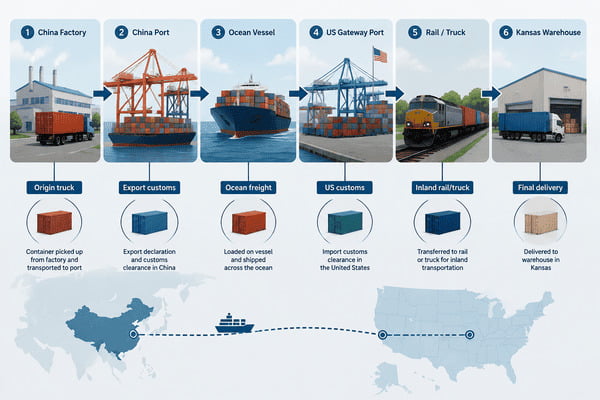
Typical China-to-Kansas routing logic
For many shipments, I review routing in this order:
- Origin city or factory address in China
- Nearest practical loading port
- Available ocean carrier schedules
- U.S. gateway port options
- Rail or truck inland routing
- Final delivery constraints
Dingshang Logistics often coordinates shipments from major China ports such as Ningbo, Shanghai, Shenzhen, and Qingdao. These ports connect well with U.S. gateways. However, the “best” China port is not always the closest one. Sometimes a nearby port has a better sailing schedule, lower origin charges, or more stable space.
Common route examples
| Origin in China | Common Loading Port | U.S. Gateway Option | Inland Move | Kansas Destination |
|---|---|---|---|---|
| Zhejiang / Jiangsu | Ningbo or Shanghai | Los Angeles / Long Beach | Rail + truck | Kansas City or warehouse |
| South China | Shenzhen / Yantian | Los Angeles / Long Beach | Rail + truck | Kansas City area |
| North China | Qingdao | West Coast or Gulf route | Rail/truck | Kansas or Midwest |
| Mixed suppliers | Consolidation warehouse | Best matched port | LCL or FCL inland | Final address |
Rail vs. truck to Kansas
The inland leg is where many quotes become difficult to compare.
Rail intermodal is often suitable for long inland distances. It can be more cost-effective for containers moving from West Coast ports to inland rail ramps. However, rail service depends on equipment, schedule, ramp congestion, and final truck delivery availability.
Truck delivery can be faster and more direct in some cases. It may work better when the cargo needs tight appointment control or when the final destination is not close to a rail ramp. However, trucking can become expensive over long distances.
I usually ask one simple routing question
When I review a shipment to Kansas, I ask:
“Does the buyer need the cheapest reasonable route, the fastest route, or the most predictable delivery plan?”
These are not always the same option.
A low ocean rate may create higher inland cost. A faster port may have more expensive drayage. A cheaper rail route may not match the warehouse appointment date. That is why a professional China-to-Kansas container plan should include both ocean and inland logic.
How Much Does It Cost to Ship a Container from China to Port of Kansas?
Many importers want one fixed number immediately. I understand that because budgets matter. However, a single ocean freight rate does not show the full picture. The final cost changes with market season, container type, route, duties, and delivery requirements.
The cost to ship a container from China to Port of Kansas includes ocean freight, China origin charges, U.S. port charges, customs clearance, duties, inland rail or truck, delivery fees, and possible surcharges. A realistic quote should show the total door-to-door cost, not only the port-to-port rate.
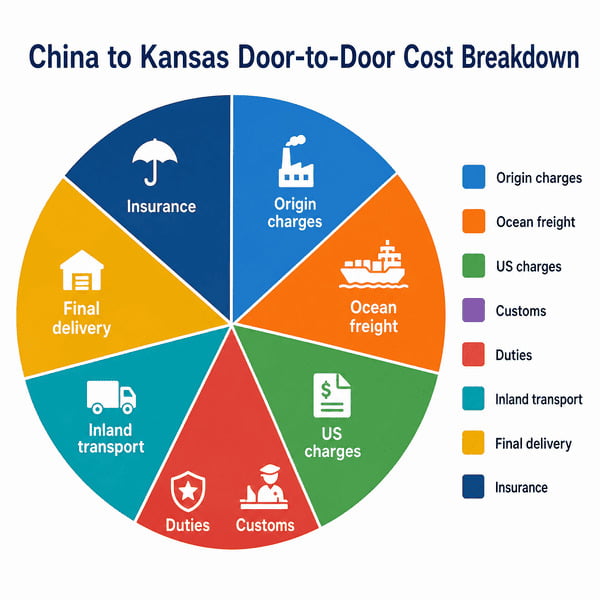
Main cost components
A complete landed-cost estimate usually includes the following items:
| Cost Item | What It Covers | Why It Matters |
|---|---|---|
| Origin charges | China port handling, export docs, trucking if needed | Depends on FOB or EXW terms |
| Ocean freight | Container movement from China to U.S. port | Changes by season and space |
| U.S. destination charges | Terminal, handling, documentation | Often excluded in basic quotes |
| Customs clearance | Broker filing and entry process | Must be handled correctly |
| Duties and taxes | Based on HS Code, value, origin, and regulations | Must be confirmed by broker/compliance expert |
| Inland rail/truck | U.S. port to Kansas destination | Major cost for inland shipments |
| Final delivery | Drayage, appointment, chassis, waiting time | Depends on warehouse rules |
| Insurance | Cargo protection | Important for door-to-door risk control |
Why quote comparison is tricky
I have seen importers compare two offers and think one forwarder is much cheaper. Then we look closer and find that the cheaper quote stops at the U.S. port. It does not include customs clearance, rail to Kansas, final truck delivery, or destination charges.
That is not a true comparison.
You should compare quotes based on the same scope:
- Port-to-port
- Port-to-door
- Door-to-port
- Door-to-door
- FOB shipment
- EXW shipment
- FCL or LCL
- Customs included or not
- Duties included or only estimated
- Final delivery appointment included or not
Duties and HS Code must be verified
The HS Code affects duty rate, additional tariffs, and compliance requirements.2 I can help organize shipping documents and coordinate customs clearance support, but I do not treat HS classification as a guesswork item.
You should confirm HS Code, duty rate, and special import rules with a qualified customs broker or compliance specialist. This is especially important for regulated products, high-value goods, textiles, electronics, food-contact goods, chemicals, and products subject to additional U.S. tariffs.
Hidden cost risks
For Kansas deliveries, several costs can appear if the shipment is not planned well:
- Demurrage3 if the container stays too long at port
- Detention if the container is not returned on time
- Chassis fees for inland container movement
- Pre-pull fees if delivery timing requires storage
- Waiting time if the warehouse is not ready
- Residential or limited-access delivery fees
- Liftgate fees for smaller LCL deliveries
- Re-delivery fees after failed appointments
A transparent quote should explain which charges are included and which are variable. At Dingshang Logistics, I prefer to quote with clear boundaries because surprises damage long-term cooperation.
Should You Choose FCL, LCL, or Door-to-Door Service for Kansas Shipments?
The wrong service type can make a shipment more expensive than expected. A buyer may choose LCL to save money, but destination handling and inland delivery can change the equation. Another buyer may choose FCL without checking warehouse unloading ability.
You should choose FCL when your cargo can fill or nearly fill a container, LCL when your shipment is smaller, and door-to-door when you want one coordinated plan from China to Kansas. The right option depends on volume, cargo value, timing, and delivery control needs.
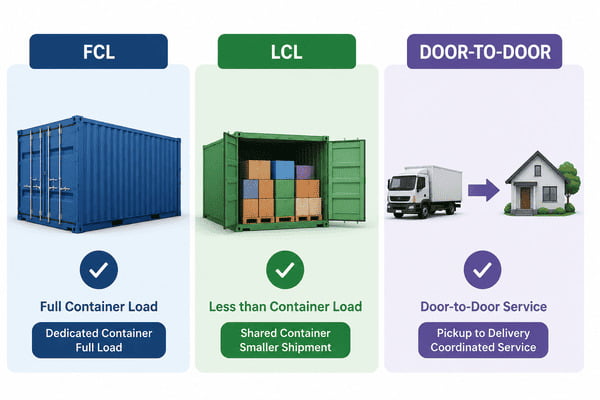
FCL: best for full container control
FCL means Full Container Load. Common container types include:
- 20GP
- 40GP
- 40HQ
A 40HQ is often used for bulky but lighter goods. A 20GP may work better for dense cargo because weight limits matter.4 You should not choose only by cubic meters. You should also check gross weight, packing method, loading equipment, and U.S. road limits.
FCL works well when:
- You have enough cargo volume
- You want less cargo handling
- You need better schedule control
- You want direct container delivery
- You want reduced risk of mixed-cargo damage
LCL: useful for smaller shipments
LCL means Less than Container Load. Your cargo shares container space with other shipments. It can be cost-effective for smaller volumes, but you should pay attention to the full cost structure.
LCL often includes:
- China warehouse receiving
- Consolidation fees
- Ocean freight by CBM or weight
- U.S. deconsolidation
- Destination handling
- Truck delivery to Kansas
LCL may become expensive if the shipment is large enough to justify a 20GP. As a rough operational habit, I start comparing LCL vs. FCL carefully when volume grows beyond a meaningful partial-container level. The exact break-even point depends on rates, port pairs, destination charges, and inland delivery.
Door-to-door: best for total responsibility clarity
Door-to-door service is often the easiest option for U.S. importers who want predictable cost and fewer handoffs. In this model, the forwarder coordinates the international freight process from the China pickup point or loading port to the final U.S. address.
For Kansas shipments, door-to-door may include:
- Supplier coordination in China
- Export handling
- Ocean freight
- U.S. customs clearance support
- Duty handling coordination
- Rail or truck inland transport
- Final delivery appointment
- Container return coordination
Dingshang Logistics can arrange FCL, LCL, sea-rail intermodal transportation, customs clearance support, duty handling coordination, and door-to-door delivery to Kansas City and other U.S. inland destinations. I mention this here because the service scope matters more than a headline rate.
FOB vs. EXW matters
Incoterms can change the cost boundary.
| Incoterm | Buyer Usually Controls From | Key Point |
|---|---|---|
| FOB | China port after export handoff | Supplier handles local export to port |
| EXW | Supplier factory door | Buyer handles pickup, export, and international freight |
| CIF/CFR | Destination port only | Often excludes U.S. clearance and inland delivery |
Many importers think CIF to a U.S. port means the shipment is almost finished. It is not. For Kansas delivery, you still need U.S. destination handling, clearance, duties, inland transport, and final delivery.
What Information Do I Need to Ship a Container from China to Port of Kansas?
A vague shipment request leads to a vague quote. If key details are missing, the forwarder must guess. Those guesses can produce inaccurate pricing, wrong routing, or later surcharges. Good quotation details save time and reduce risk.
To ship a container from China to Port of Kansas, you should provide the factory address, loading port, destination ZIP code, cargo name, HS Code, container type, cargo volume and weight, Incoterms, declared value, shipping date, insurance needs, and warehouse delivery requirements.
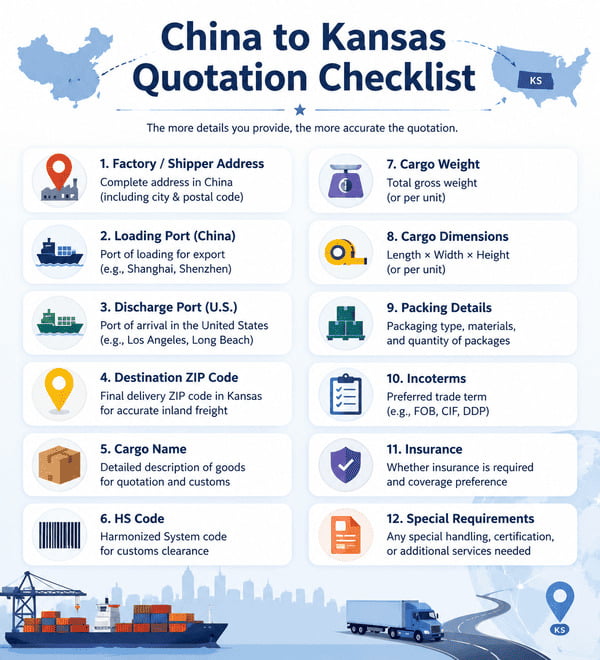
China-to-Kansas quotation checklist
When I prepare a door-to-door estimate, I normally ask for the following details:
| Information Needed | Example | Why It Matters |
|---|---|---|
| Supplier/factory address | Yiwu, Shenzhen, Ningbo, Qingdao | Determines pickup and port choice |
| Loading port | Shanghai, Ningbo, Shenzhen, Qingdao | Affects sailing schedule and cost |
| Destination address | Kansas City, KS ZIP code | Determines rail/truck cost |
| Cargo name | Furniture, machinery, tools | Needed for handling and compliance |
| HS Code | 10-digit U.S. HTS if available | Used for duty estimate and entry |
| Declared value | Commercial invoice value | Used for customs and insurance |
| Container type | 20GP or 40HQ | Affects ocean and inland cost |
| Cargo weight | Gross weight in kg/lbs | Important for road and rail limits |
| Cargo volume | CBM and package count | Important for LCL/FCL comparison |
| Incoterms | FOB Ningbo or EXW factory | Defines cost responsibility |
| Ready date | Cargo ready on March 15 | Affects sailing plan |
| Insurance need | Door-to-door cargo insurance | Protects against cargo risk |
| Delivery rules | Appointment, dock, forklift | Affects final trucking cost |
Why final address matters so much
Kansas is not one delivery point. A warehouse in Kansas City may price differently from a location in Wichita, Topeka, Overland Park, or a rural delivery area. Even within the same metro area, trucking costs can change based on distance from rail ramp, appointment windows, unloading time, and access restrictions.
A complete destination address helps the forwarder check:
- Distance from ramp or terminal
- Truck route feasibility
- Delivery appointment requirements
- Commercial vs. residential access
- Need for liftgate or special equipment
- Warehouse receiving hours
- Container live unload vs. drop option
Documents usually needed
For U.S. import clearance, the broker usually needs core documents such as:
- Commercial invoice
- Packing list
- Bill of lading
- Arrival notice
- Importer information
- Customs bond details
- HS Code / HTS classification
- Product-specific certificates if required
The exact document requirements depend on the cargo. A customs broker should verify regulated-product requirements and classification issues.
A short anecdote from my work
I once reviewed a shipment where the buyer asked only for “China to Kansas ocean freight.” The quote they received looked cheap. However, it did not include rail, customs, duties, chassis, delivery appointment, or container return. Once those costs were added, the final number was much higher.
Since then, I always ask importers for the final ZIP code and Incoterms before discussing price. It is a small step, but it prevents a large misunderstanding.
Frequently Asked Questions
Is Port of Kansas a real ocean port?
No. Kansas is an inland destination, not a conventional ocean port for container vessels. When importers say “Port of Kansas,” they usually mean Kansas City, an inland rail ramp, or a final warehouse in Kansas. The route still requires a U.S. coastal gateway port.
What is the fastest way to ship from China to Kansas?
The fastest option depends on the China origin, U.S. gateway port, rail capacity, truck availability, and final address. A West Coast port plus inland rail or truck is common. However, you should confirm timing based on the actual sailing schedule and delivery ZIP code.
Should I use FOB or EXW when shipping from China to Kansas?
FOB is often simpler because the supplier handles China local delivery to the export port. EXW gives the buyer more control but adds pickup and export responsibility in China.5 The better choice depends on supplier capability, cost transparency, and your preferred control level.
Can duties be included in a door-to-door quote?
Duties can be estimated or coordinated, but they should be verified by a qualified customs broker or compliance expert. Duty cost depends on HS Code, declared value, product origin, and current U.S. regulations. You should not rely on guesswork for customs classification.
Is LCL cheaper than FCL for Kansas delivery?
LCL can be cheaper for small shipments, but it is not always cheaper when destination handling and inland delivery are included. If your cargo volume is large or heavy, you should compare LCL against a 20GP or 40HQ full container option.
Conclusion
To ship a container from China to Port of Kansas, you need to plan more than the ocean freight. Kansas is an inland destination, so the real route includes a China loading port, U.S. gateway port, customs clearance, duties, inland rail or truck, and final delivery. The smartest approach is to compare full door-to-door costs with the same service scope. If you are importing from China to Kansas City or another inland U.S. destination, send us your shipment details, and I can help calculate a realistic total cost.
"Kansas", https://www.noaa.gov/sites/default/files/2021-11/NIYSKS.pdf. A geographic reference identifying Kansas as a landlocked U.S. state supports the statement that it is not a direct ocean-port destination for container vessels; this evidence establishes geography rather than specific freight routing practice. Evidence role: definition; source type: encyclopedia. Supports: A neutral geographic source should confirm that Kansas is a landlocked U.S. state without an ocean coastline.. Scope note: Contextual support: it proves Kansas lacks ocean access, not that every China-to-Kansas shipment must follow a particular route. ↩
"USITC HTS Search - Harmonized Tariff Schedule", https://hts.usitc.gov/search. CBP and USITC tariff-classification materials explain that imported goods are classified under the Harmonized Tariff Schedule to determine applicable duty rates and related import requirements, supporting the article’s warning that HS/HTS classification should be verified. Evidence role: mechanism; source type: government. Supports: A CBP or USITC source should show that tariff classification under the HTS determines applicable rates of duty and can affect import requirements.. ↩
"Detention and Demurrage", https://www.fmc.gov/detention-and-demurrage/. Federal Maritime Commission materials define demurrage as a charge associated with containers remaining at a marine terminal beyond free time, supporting the article’s identification of demurrage as a potential destination-cost risk. Evidence role: definition; source type: government. Supports: A Federal Maritime Commission source should define demurrage and explain its role in container shipping charges.. ↩
"Container Size and Type Code Explained | BIC", https://www.bic-code.org/size-type-code/. Container standards and technical specifications show that 20-foot general-purpose and 40-foot high-cube containers differ in internal volume and payload constraints, supporting the article’s point that cargo density and weight limits affect container choice. Evidence role: mechanism; source type: institution. Supports: A standards or container-information source should provide dimensions and payload differences for 20-foot general-purpose and 40-foot high-cube containers.. Scope note: Contextual support: specifications explain why the advice is plausible, but actual suitability depends on carrier limits, road regulations, packing, and cargo details. ↩
"Know Your Incoterms", https://www.trade.gov/know-your-incoterms. International Chamber of Commerce Incoterms materials distinguish EXW and FOB by the point at which costs and risks transfer and by export-side obligations, supporting the article’s explanation that EXW generally places more pickup and export-process responsibility on the buyer than FOB. Evidence role: definition; source type: institution. Supports: An International Chamber of Commerce Incoterms source should describe the responsibility allocation under EXW and FOB.. Scope note: Contextual support: Incoterms set standard responsibility rules, but contracts may modify operational details. ↩
Leave a Comment