
Shipping CNC Machines from China to USA by Container: What Should Importers Check First?
Shipping CNC machines from China to USA by container looks simple until the machine is too tall, too heavy, poorly packed, or impossible to unload at the final site. That is when a “cheap freight quote” becomes expensive. I prefer to solve this early with proper size checks, risk planning, and door-to-door coordination.
Shipping CNC machines from China to USA by container requires more than checking ocean freight rates. Importers must confirm machine dimensions, gross weight, center of gravity, packaging, container fit, loading method, customs documents, inland trucking, delivery appointment, and unloading equipment before booking. A safe plan controls damage risk, delays, and unexpected destination costs.
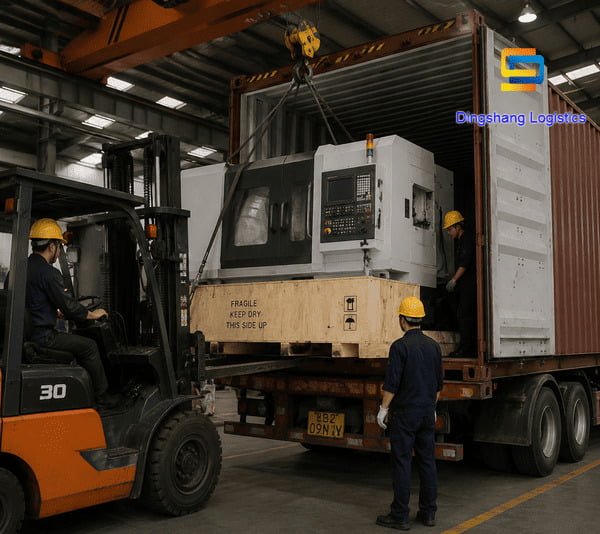
In my daily work at Dingshang Logistics, I often see buyers start with one question: “How much is the container freight?” That question matters, but it is not enough. For CNC machinery, I first want to know whether the machine can be transported safely from the Chinese factory floor to the U.S. destination floor.
Can Shipping CNC Machines from China to USA Fit in a Standard Container?
A CNC machine may look container-ready on a supplier’s invoice, but problems often appear when the actual dimensions, wooden case size, weight, or center of gravity are checked. If the cargo plan is wrong, the shipment may face repacking, container change, extra lifting charges, or even loading failure.
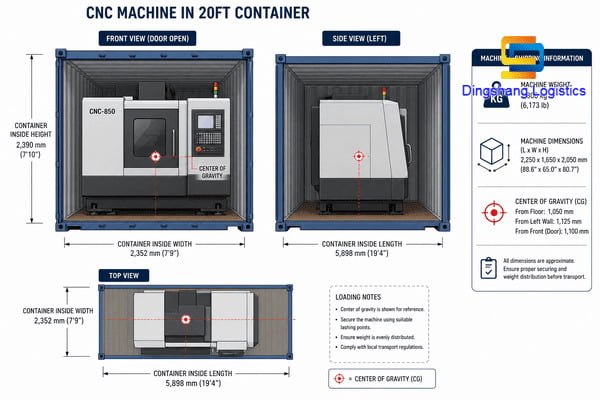
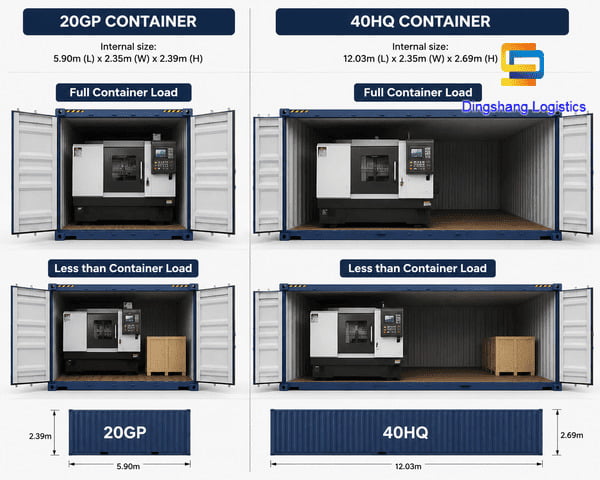
A CNC machine can fit in a standard container only if its packed dimensions, gross weight, loading method, and center of gravity are suitable for the container type. Importers should confirm whether the machine fits a 20GP, 40HQ, flat rack, or LCL shipment before requesting a final quote or booking.
Why “CBM + Weight” Is Not Enough
Many importers send me only two numbers: CBM and gross weight1. Those numbers help, but they do not tell the full story. A CNC machine is not like cartons of consumer goods. It can be tall, top-heavy, dense, delicate, and difficult to move. A 12 CBM machine may be easy to ship if it is compact and properly crated. Another 12 CBM machine may be difficult if it is too tall, too wide, or has a narrow base with a high center of gravity.
For container planning, I usually ask for:
- Machine bare dimensions
- Packed dimensions
- Gross weight
- Net weight
- Photos of the machine and package
- Lifting points or forklift pockets
- Whether the machine can be dismantled
- Whether the wooden case is stackable or non-stackable
- China pickup address
- U.S. delivery address
- Unloading equipment at destination
Common Container Options for CNC Machinery
Different CNC machines need different container solutions. I do not recommend choosing a container only by price.
| Option | Typical Use | Main Concern |
|---|---|---|
| 20GP container | Compact but heavy CNC machines | Payload, weight distribution, loading access |
| 40HQ container | Larger or taller packed machines | Height and securing space |
| LCL shipping | Small machines or accessories | Handling risk and consolidation limits |
| Flat rack container | Oversized machinery | Higher cost, special securing, exposure risk |
| Open top container | Over-height cargo | Crane loading, cover protection, extra charges |
A 20GP is often useful for heavy compact machines because it has a strong payload capacity.2 A 40HQ gives more space and height, but it does not automatically solve weight distribution.3 Some buyers assume a bigger container means safer shipping. That is not always true.
The Three Fit Checks I Care About Most
When I check shipping CNC machines from China to USA, I usually focus on three practical questions:
-
Can the packed machine physically enter the container door?
The internal height may look sufficient, but the door opening can be the limiting factor.4 -
Can the container legally and safely carry the weight?
Cargo weight, container tare weight, road limits, and truck rules all matter.5 -
Can workers load and secure the machine safely?
The factory may need forklifts, cranes, ramps, skates, chains, blocks, or professional riggers.
My rule is simple: if the machine is expensive, heavy, or hard to replace, the shipping plan should be checked before the supplier finishes packing.
I have seen cases where the buyer received a good machine price, but the package became too tall after the supplier added a heavy wooden crate. That small change affected the container option and the total cost. So, I always prefer to confirm the packing drawing or final crate dimensions before issuing a serious door-to-door quote.
What Information Do I Need Before Quoting Shipping CNC Machines from China to USA?
A rough ocean freight estimate may be possible with basic cargo data, but a reliable door-to-door quote needs more detail. Without pickup, packing, customs, delivery, and unloading information, the importer may receive a low number that later changes during execution.
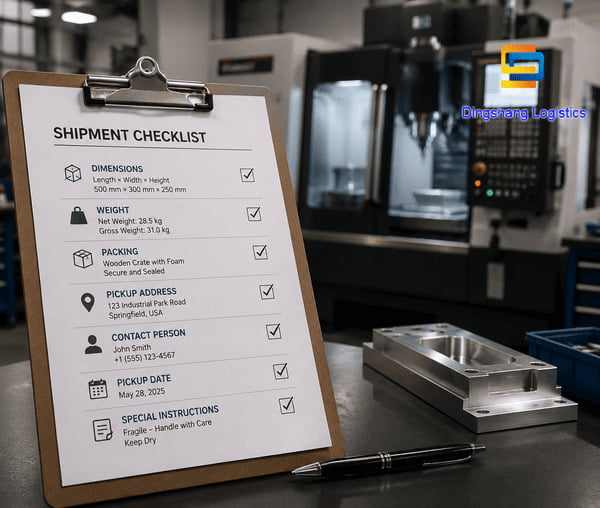
To quote shipping CNC machines from China to USA accurately, I need machine dimensions, packed dimensions, gross weight, packing method, pickup address in China, loading conditions, U.S. delivery address, unloading equipment, customs documents, HS code guidance from the broker, importer details, and whether service is port-to-port or door-to-door.
The Quotation Checklist I Use
When a U.S. importer asks me for a CNC machine freight quote, I try to avoid a fast but weak answer. A fast quote may look helpful, but it can hide many assumptions. CNC machinery has too many risk points for guesswork.
Here is the information I normally request:
| Information Needed | Why It Matters |
|---|---|
| Supplier name and pickup address | Determines China inland trucking cost and loading support |
| Cargo ready date | Affects sailing schedule and space planning |
| Machine dimensions | Helps assess dismantling and package design |
| Packed dimensions | Confirms container fit and LCL feasibility |
| Gross weight | Affects container selection, trucking, lifting, and permits |
| Packing method | Impacts damage risk and insurance review |
| Photos/videos | Helps identify lifting points and weak packaging |
| U.S. delivery address | Determines inland trucking cost and delivery restrictions |
| Business or residential site | Changes delivery feasibility and equipment needs |
| Forklift/crane available or not | Determines whether special unloading is needed |
| Importer of record details | Needed for customs coordination |
| HS code and product description | Should be confirmed with broker or relevant authority |
| Customs broker status | Clarifies who handles entry, duties, and compliance |
Why Door-to-Door Quotes Need More Care
Port-to-port shipping is simpler because the forwarder handles the ocean leg and the buyer handles the rest. Door-to-door shipping is different. The logistics provider must consider the full route:
- Factory pickup in China
- Loading at supplier warehouse
- Export declaration
- Terminal handling
- Ocean sailing
- ISF coordination before U.S. arrival
- Customs clearance support
- Destination port or rail ramp handling
- Final inland trucking
- Delivery appointment
- On-site unloading readiness
If any link fails, the total cost changes. For example, if the U.S. destination does not have a forklift suitable for the machine weight, a normal truck delivery may fail. Then the importer may need a crane truck, flatbed, rigging crew, or re-delivery. These costs are usually much higher than planning correctly from the beginning.
Customs and Duty Preparation
I am a freight forwarder, not a customs attorney. So, I do not promise a fixed duty rate or customs outcome. Still, I help buyers prepare the shipping side properly.
For CNC machinery, the importer should prepare or confirm:
- Commercial invoice
- Packing list
- Bill of lading
- Importer of record information
- HS code, confirmed with the customs broker or relevant authority6
- Machine description and model
- Declared value
- Country of origin
- Any applicable compliance documents, if required by the broker or authority
For U.S. imports, ISF filing is also important for ocean shipments.7 The importer or broker normally needs key shipment details before cargo arrival. Late or incorrect information can create penalties or delays, so I always encourage importers to involve their broker early.
A good quotation is not just a price. It is a plan based on facts. When I receive complete cargo and destination details, I can give a much more realistic all-in logistics estimate and reduce the chance of surprise costs.
What Are the Biggest Risks When Shipping CNC Machines from China to USA by Container?
The biggest risks are rarely caused by the ocean freight rate itself. They usually come from poor packaging, weak securing, moisture exposure, overweight planning, unclear insurance responsibility, customs delays, or a failed unloading arrangement at the destination.
The major risks when shipping CNC machines from China to USA by container include cargo damage from movement, rust from moisture, improper lifting, overweight containers, unsuitable container selection, unclear customs preparation, insufficient insurance, and delivery failure when the U.S. site lacks forklifts, cranes, dock access, or space for safe unloading.
Risk 1: Weak Packaging
CNC machines are heavy and valuable. The machine may include sensitive components, control panels, electrical parts, motors, tool changers, and precision assemblies. I do not judge machine performance, but I do pay attention to transport protection.
A strong package usually includes:
- Export-grade wooden case or strong base
- Moisture barrier or waterproof wrapping
- Shock-resistant padding for vulnerable parts
- Clear lifting marks
- Forklift pockets or reinforced base
- Internal blocking to prevent movement
- Photos before closing the crate
A wooden case should be built for the cargo weight. I have seen crates that looked clean outside but had weak bottom support. That is dangerous because heavy machinery puts stress on the base during forklift handling, container loading, vessel movement, and final delivery.
Risk 2: Poor Securing Inside the Container
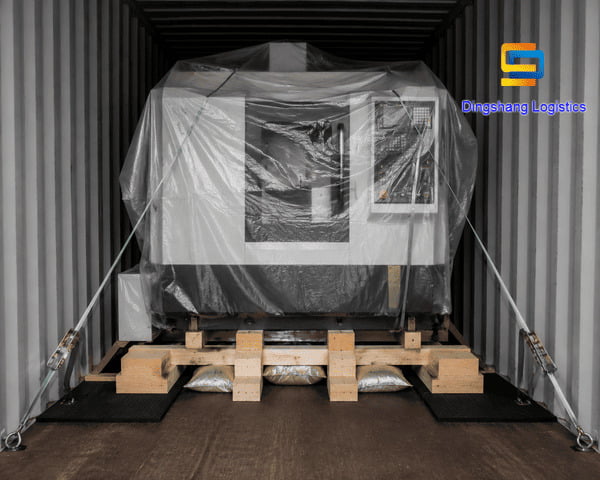
Even if the machine is packed well, the container still needs proper securing. Ocean transport creates movement. Trucks brake. Cranes lift. Rail ramps vibrate. A top-heavy machine can shift if it is not blocked and lashed correctly.
Common securing methods include:
- Wooden blocking and bracing
- Steel wire or heavy-duty straps
- Chains for very heavy cargo
- Anti-slip mats
- Nailing or bolting the base when suitable
- Weight distribution planning
- Center-of-gravity attention
The goal is simple: the machine should not slide, tilt, or hit the container wall. If the machine is placed near one side without balance, it may also create handling and road safety concerns.
Risk 3: Moisture and Rust
Ocean shipping exposes cargo to changing temperatures and humidity. Condensation can form inside containers, especially during long voyages or seasonal changes. For machinery, moisture protection matters.
Useful measures may include:
| Protection Method | Purpose |
|---|---|
| Vacuum packing or sealed wrapping | Reduces moisture exposure |
| Desiccant bags | Absorbs humidity inside the package |
| Anti-rust oil or coating | Protects exposed metal surfaces |
| Container desiccants | Reduces container sweat risk |
| Waterproof outer cover | Helps during handling and loading |
The supplier should decide suitable machine protection, but the buyer should ask for evidence. I often suggest that importers request packing photos before the machine leaves the factory.
Risk 4: Unclear Insurance Responsibility
Damage claims become harder when insurance responsibility is unclear. For door-to-door shipments, Dingshang Logistics can provide free cargo insurance, but importers should still confirm the insured value, cargo description, coverage terms, exclusions, and claim documents before shipment.
Insurance does not replace good packaging. Insurance is a financial protection tool. It cannot prevent delays, lost production time, or customer disappointment. That is why I treat packaging, securing, and insurance as one combined risk-control plan.
Risk 5: Failed Destination Unloading
This is one of the most overlooked risks. Many buyers focus on China loading but forget the U.S. delivery site.
Before delivery, I want to know:
- Is the destination a warehouse, factory, farm, workshop, or residential-style address?
- Is there a loading dock?
- Is there a forklift with enough capacity?
- Is the driveway suitable for a truck?
- Is there room for a container chassis or flatbed?
- Does the site need a delivery appointment?
- Does the machine require a crane or rigging company?
A standard truck driver usually does not unload a heavy CNC machine by hand. If the site is not ready, the truck may leave, and the importer may pay waiting time, storage, re-delivery, or special equipment charges. This is why I always ask about unloading before confirming door delivery.
How Does the Full Shipping Route Work from China Pickup to U.S. Delivery?
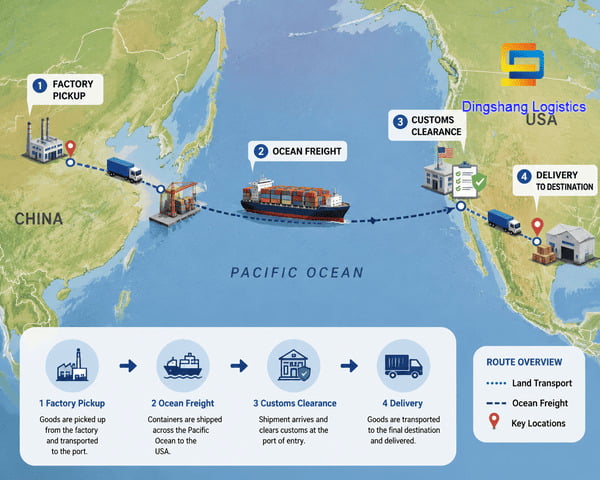
Many buyers think the shipment starts at the Chinese port and ends at the U.S. port. In reality, shipping CNC machines from China to USA by container is a full route that includes inland pickup, port work, ocean freight, customs coordination, destination handling, trucking, and delivery appointment.
The full route includes China factory pickup, cargo loading, export declaration, container drayage, port handling, ocean sailing, U.S. customs and ISF coordination, destination port or rail ramp handling, inland trucking, delivery appointment, and unloading at the final site. Each step affects cost, timing, and cargo safety.
Step 1: China Pickup and Loading
The process starts at the supplier’s factory or warehouse. For CNC machines, the pickup is not always a simple truck collection. The supplier may need cranes, workers, and enough space to load the machine into a container or onto a truck.
China loading ports often used for machinery shipments include:
- Ningbo
- Shanghai
- Shenzhen
- Qingdao
At Dingshang Logistics, we arrange shipments from these major ports frequently. Still, the best port depends on the supplier location, cargo ready date, container availability, and sailing schedule.
For factory loading, I usually check:
- Can the container enter the factory?
- Can the machine be loaded safely on site?
- Are photos available before and after loading?
Step 2: Export and Ocean Freight
After loading, the container moves to the port. Export declaration and terminal handling follow. Then the container is loaded onto the vessel.
Transit time varies by port pair, route, congestion, weather, vessel changes, and inland routing. I do not like promising fixed transit times because real shipping has variables. Instead, I prefer to give the current sailing schedule and explain the expected window.
Common U.S. destination ports include:
| U.S. Port | Common Use |
|---|---|
| Los Angeles / Long Beach | West Coast delivery and inland rail |
| New York / New Jersey | Northeast and Midwest distribution |
| Houston | Texas and central U.S. delivery |
| Savannah | Southeast distribution |
| Miami | Florida and nearby markets |
Step 3: U.S. Customs and ISF Coordination
For ocean shipments to USA, customs preparation should begin before the vessel arrives. The importer, broker, and forwarder should coordinate on shipment documents.
I normally help from the logistics side, while the customs broker handles entry details. The importer should confirm HS code, duty rate, and compliance matters with the broker or relevant authority.
Important customs-related points include:
- ISF filing timing
- Correct consignee information
- Accurate invoice and packing list
- Clear machine description
- Correct value declaration
Step 4: Destination Handling and Inland Delivery
After customs release and port or rail availability, the container moves inland. Inland delivery may use truck, rail, or a combination. Dingshang Logistics regularly supports delivery to inland destinations such as:
- Chicago
- Dallas
- Atlanta
- Memphis
- Detroit
- Kansas City
- Charlotte
- Nashville
- Minneapolis
For heavy CNC machines, inland delivery planning must include unloading. A door-to-door quote should not assume the driver can unload. If a forklift, crane, or rigging crew is required, the importer should plan it before the truck arrives.
Step 5: Final Delivery Appointment and Site Readiness
Final delivery is where many avoidable problems happen. A machine may travel across the ocean successfully, clear customs, and reach the city on time. Then delivery fails because the driveway is narrow, the forklift is too small, or nobody is ready to receive the truck.
Before final delivery, I recommend confirming:
- Site contact name and phone number
- Business hours
- Appointment requirements
- Truck access
- Loading dock availability
- Forklift capacity
- Crane or rigging company schedule
- Ground condition and turning space
- Whether the container must be live-unloaded or dropped
For container delivery, free time and detention risk also matter. If the importer keeps the container too long, extra charges may apply. That is why unloading readiness is not only a safety issue. It is also a cost-control issue.
Should You Choose FCL, LCL, or Door-to-Door for CNC Machine Shipping?
Choosing the cheapest freight mode can create higher risk later. CNC machinery needs a shipping method based on cargo size, cargo value, handling sensitivity, delivery site, customs plan, and unloading ability. The right mode balances cost, control, and damage prevention.
For CNC machine shipping, FCL is often better for heavy or valuable machines because the container is dedicated to one shipment. LCL may work for smaller machines or accessories, but it adds handling risk. Door-to-door service is useful when the importer wants one coordinated plan from China pickup to U.S. delivery.
Comparing FCL, LCL, and Door-to-Door
Each shipping option has a place. I usually explain the trade-offs before recommending one.
| Shipping Method | Best For | Main Advantage | Main Risk |
|---|---|---|---|
| FCL 20GP | Heavy compact machines | Dedicated container, strong control | Weight and loading limits |
| FCL 40HQ | Larger packed machinery | More space and height | Not always ideal for very heavy cargo |
| LCL | Small machines or parts | Lower cost for small volume | More handling and consolidation risk |
| Door-to-door | Importers needing full coordination | One route plan and clearer cost control | Requires accurate site details |
| Sea-rail intermodal | Inland U.S. destinations | Efficient for inland cities | Rail schedule and ramp handling variables |
Why FCL Is Often Preferred
For valuable CNC machinery, FCL shipping often gives better control. The machine stays in one container, and there is less handling compared with LCL. That can reduce the risk of forklift damage, cargo shifting during consolidation, and confusion at warehouses.
FCL also makes securing easier because the container can be planned around the machine. Workers can block, brace, and lash the cargo specifically for that shipment.
However, FCL still needs proper planning. A 20GP may be better for dense machinery. A 40HQ may be better for size. A flat rack may be needed if the machine is oversized. The right decision depends on the actual cargo, not on a simple price table.
When LCL May Work
LCL can work when the machine is small, well-packed, and not extremely heavy. It may also make sense for spare parts, accessories, control cabinets, or small equipment.
But LCL has more touchpoints:
- Supplier warehouse handling
- Origin consolidation warehouse handling
- Container loading with other cargo
- Destination deconsolidation
- Final pickup or delivery
Each touchpoint adds risk. For heavy machinery, the LCL warehouse must also be able to handle the cargo safely. If the machine is non-stackable or very dense, LCL costs may rise. Sometimes LCL looks cheap at first, but the final handling and delivery costs reduce the savings.
Why Door-to-Door Can Reduce Surprises
Many U.S. importers prefer door-to-door service because they want one logistics partner to coordinate the route. This is especially useful when the buyer does not have a separate customs broker, trucking company, and destination warehouse team already organized.
At Dingshang Logistics, our door-to-door service can include:
- China pickup
- Export handling
- Ocean freight
- U.S. customs support
- Duty handling support
- Destination port handling
- Inland trucking
- Delivery appointment
- Cargo insurance for DDP shipments
I still ask many questions before quoting door-to-door. That is because a good all-in quotation should be transparent. It should not hide unloading limits, customs assumptions, storage risks, or extra handling conditions.
Frequently Asked Questions
How much does it cost to ship a CNC machine from China to the USA?
The cost depends on packed dimensions, gross weight, container type, China pickup address, U.S. destination, customs handling, inland trucking, and unloading needs. A reliable quote needs more than CBM and weight. I recommend preparing photos, packing details, and both addresses before requesting pricing.
Can a CNC machine be shipped by LCL from China to the USA?
Yes, some smaller CNC machines or accessories can ship by LCL. However, LCL adds more handling at consolidation and deconsolidation warehouses. For heavy, valuable, or sensitive machinery, I usually review the packing, weight, and handling conditions carefully before recommending LCL.
Do I need a customs broker for importing a CNC machine into the USA?
Most importers use a customs broker to handle entry, duty calculation, and compliance requirements. The HS code, duty rate, and any special requirements should be confirmed with the importer, broker, or relevant authority. A freight forwarder can coordinate documents but should not replace legal customs advice.
Who is responsible for unloading the CNC machine at the U.S. destination?
Usually, the receiver is responsible for unloading unless unloading service is specifically arranged in advance. The site may need a forklift, crane, loading dock, flatbed delivery, or rigging team. I always recommend confirming unloading capacity before the truck is dispatched.
Is cargo insurance necessary for CNC machine shipping?
Yes, cargo insurance is strongly recommended because CNC machines are high-value and difficult to replace quickly. Insurance terms, insured value, exclusions, and claim documents should be confirmed before shipment. For door-to-door shipments, Dingshang Logistics can provide free cargo insurance, subject to confirmation.
Conclusion
Shipping CNC machines from China to USA by container is a transportability and risk-control decision, not just a freight rate question. Importers should confirm dimensions, weight, center of gravity, packaging, securing, customs documents, inland delivery, and unloading readiness before booking. A careful plan helps avoid damage, delays, and surprise charges. If you are buying CNC machinery from China, contact Dingshang Logistics for a transparent door-to-door quotation based on your actual machine details and U.S. delivery conditions.
"IMO/ILO/UNECE Code of Practice for Packing of Cargo Transport ...", https://www.imo.org/en/ourwork/safety/pages/ctu-code.aspx. The IMO/ILO/UNECE Code of Practice for Packing of Cargo Transport Units treats cargo dimensions, mass distribution, centre of gravity, blocking, bracing, and securing as core factors in safe container packing, supporting the view that CBM and gross weight alone are incomplete planning data. Evidence role: general_support; source type: institution. Supports: A cargo transport unit packing standard should support that safe container planning requires attention to cargo dimensions, weight distribution, center of gravity, securing, and handling, not only volume and gross weight.. Scope note: The CTU Code is a general cargo-transport standard and does not address CNC machines specifically. ↩
"20' Standard - Hapag-Lloyd", https://www.hapag-lloyd.com/en/services-information/cargo-fleet/container/20-standard.html. Standard intermodal-container specifications list 20-foot dry containers with high maximum gross-weight ratings relative to their cubic volume, providing contextual support for their use with compact dense cargo. Evidence role: definition; source type: encyclopedia. Supports: A container specification source should support that standard 20-foot containers commonly have substantial payload capacity relative to their volume, making them common for dense cargo.. Scope note: Payload varies by container rating, carrier acceptance, road limits, and axle-weight constraints. ↩
"IMO/ILO/UNECE Code of Practice for Packing of Cargo Transport ...", https://unece.org/transport/intermodal-transport/imoilounece-code-practice-packing-cargo-transport-units-ctu-code. The IMO/ILO/UNECE CTU Code states that cargo mass should be distributed appropriately within a cargo transport unit and secured against movement, supporting the distinction between having more space and achieving safe weight distribution. Evidence role: mechanism; source type: institution. Supports: A cargo-packing standard should support that container packing requires appropriate weight distribution regardless of container size or cubic capacity.. Scope note: The source gives general packing principles rather than a rule specific to 40HQ containers. ↩
"High Cube - OOCL", https://www.oocl.com/eng/ourservices/containers/containerspecifications/pages/highcube.aspx. Reference tables for intermodal containers distinguish internal dimensions from door-opening dimensions, showing that cargo can meet interior clearance while still being constrained by the doorway. Evidence role: definition; source type: encyclopedia. Supports: A container reference should show that standard containers have separate internal dimensions and door-opening dimensions, and that the door aperture can be smaller than the internal clearance.. Scope note: Exact dimensions vary by container manufacturer, age, and specification. ↩
"Compilation of Existing State Truck Size and Weight Limit Laws", https://ops.fhwa.dot.gov/freight/policy/rpt_congress/truck_sw_laws/app_a.htm. U.S. federal truck size-and-weight rules, including gross vehicle weight and axle-weight controls under the Federal Bridge Formula, support considering cargo weight, container tare, and road limits when planning inland container movement. Evidence role: general_support; source type: government. Supports: A U.S. government source should support that commercial truck movements are subject to federal and state size and weight limits, making gross vehicle weight and axle distribution relevant to container delivery.. Scope note: Federal rules provide the baseline; state permits and local routing restrictions may impose additional requirements. ↩
"Binding Ruling Program - help.CBP.gov", https://www.help.cbp.gov/s/article/Article-1106. U.S. customs and tariff guidance explains that imported merchandise is classified under the Harmonized Tariff Schedule, which affects duty treatment and compliance, supporting the need to confirm the HS code with a qualified broker or authority. Evidence role: definition; source type: government. Supports: A U.S. customs or tariff source should support that imported goods must be classified under the Harmonized Tariff Schedule and that classification determines duty treatment.. Scope note: The source supports the classification requirement but does not determine the correct code for any specific CNC machine model. ↩
"Importer Security Filing '10+2' - U.S. Customs and Border Protection", https://www.cbp.gov/border-security/ports-entry/cargo-security/importer-security-filing-102. U.S. Customs and Border Protection describes the Importer Security Filing requirement for U.S.-bound ocean cargo, supporting the article’s statement that ISF coordination is an important part of ocean import preparation. Evidence role: general_support; source type: government. Supports: A CBP source should support that Importer Security Filing applies to U.S.-bound ocean cargo and requires specific data before arrival.. ↩
Leave a Comment