
Shipping from China to Savannah is generally arranged by ocean freight to the Port of Savannah, followed by truck or rail delivery to the final destination. At the time this article was prepared, DingShang's FCL reference table showed sea freight rates of $5,360-$5,520 for a 20GP and $6,700-$6,900 for a 40HQ, depending on the Chinese departure port. Published transit estimates ranged from 30 to 40 days after departure.
These are FCL sea freight reference rates, not complete door-to-door prices. Your final logistics cost depends on the origin location, sailing, cargo details, U.S. destination ZIP code, customs arrangements, and inland delivery requirements.
Key Takeaways
- The reference table covers six Chinese departure ports: Ningbo, Shanghai, Qingdao, Tianjin, Xiamen, and Shenzhen.
- Published transit estimates to Savannah range from 30 to 40 days after departure.
- Garden City Terminal is the Port of Savannah's main container terminal, with on-terminal rail connections to CSX and Norfolk Southern.
- Savannah can serve the Southeast and selected inland markets, including Atlanta, Charlotte, Memphis, and other destinations reached by rail or truck.
- Compare the complete route and charges. Vessel arrival, container availability, customs release, and warehouse delivery are separate milestones.
How Much Does Shipping from China to Savannah Cost?
The cost of shipping a container from China to Savannah depends on the departure port, container size, sailing, and services included in the quote. DingShang's published FCL table provides a route-specific reference for 20GP and 40HQ containers.
China-to-Savannah FCL reference rates
The figures below are taken from DingShang's weekly FCL reference rates page.Freight rates are updated every Monday; please contact us directly for current pricing.
| China departure port | 20GP | 40HQ | Published transit estimate |
|---|---|---|---|
| Ningbo | $5,440 | $6,800 | 30 days |
| Shanghai | $5,440 | $6,800 | 31 days |
| Qingdao | $5,520 | $6,900 | 32 days |
| Tianjin | $5,520 | $6,900 | 40 days |
| Xiamen | $5,440 | $6,800 | 31 days |
| Shenzhen | $5,360 | $6,700 | 32 days |
USD per container. These are published FCL sea freight reference rates for the listed port pairs, not complete door-to-door prices. Transit time is counted after departure. Final rates are confirmed after shipment details are reviewed. Figures in this article do not update automatically.
A lower ocean rate does not always mean a lower total cost. If the factory is far from the departure port, additional pickup or inland transport may offset the difference. Sailing availability and the cargo-ready date also matter.
What else may be included in the total shipping cost?
An ocean freight rate is only one part of the cost of moving cargo from a Chinese supplier to a U.S. warehouse.
| Cost item | What to confirm in the quote |
|---|---|
| China pickup and origin charges | Factory collection, export-side handling, documentation, and terminal-related charges; clarify EXW or FOB responsibilities |
| Ocean freight | Departure and destination ports, container type, sailing, rate validity, and exclusions |
| U.S. destination charges | Terminal handling, release, and applicable carrier or port charges |
| Customs and government charges | Brokerage, applicable filing fees, duties, and other government charges; separate estimates from confirmed fees |
| Inland delivery | Drayage, chassis, rail, final-mile trucking, delivery ZIP, appointment, and unloading assumptions |
| Conditional charges | Examination, storage, demurrage, detention, waiting, or redelivery if specific conditions trigger them |
Compare quotes for the same origin, equipment, final ZIP code, shipment date, and delivery scope. A port-to-port rate should not be compared with a door-to-door quote as if they cover the same service. For updated figures, use the current FCL reference rates.
How Long Does Shipping from China to Savannah Take?
DingShang's published FCL transit estimates to Savannah range from 30 to 40 days after departure, depending on the Chinese port of loading. They do not represent the full time from factory readiness to delivery at a U.S. warehouse.
| China departure port | Published transit estimate |
|---|---|
| Ningbo | 30 days |
| Shanghai | 31 days |
| Qingdao | 32 days |
| Tianjin | 40 days |
| Xiamen | 31 days |
| Shenzhen | 32 days |
These are planning references, not guaranteed arrival dates. Actual transit depends on the booked service, vessel rotation, transshipment if any, schedule changes, and port conditions. The published estimates are counted after departure, so they do not include factory preparation, pickup, or pre-departure terminal time.
After the vessel arrives, the container must be discharged and made available by the terminal and carrier. Customs entry and release must be completed before delivery can proceed. If the cargo is moving inland by rail, allow for the rail schedule, ramp availability, and final trucking appointment as well.
For planning, distinguish the vessel ETA from container availability, customs release, inland-ramp arrival, and warehouse delivery. If your receiver has a fixed appointment, build a buffer into the schedule rather than treating the ocean transit estimate as the delivery date.
Which Chinese Port Should You Ship From?
The best departure port depends on where the cargo is ready, the available sailing, and the complete origin-to-Savannah cost. The lowest published ocean rate does not necessarily make a distant port the best choice.
| Departure port | When it may be practical | Published transit estimate to Savannah |
|---|---|---|
| Ningbo | Cargo ready in Zhejiang or nearby East China areas | 30 days |
| Shanghai | Cargo ready in Shanghai or the Yangtze River Delta | 31 days |
| Qingdao | Cargo from Shandong or nearby North China areas | 32 days |
| Tianjin | Cargo from Tianjin or nearby North China areas | 40 days |
| Xiamen | Cargo from Fujian or nearby areas | 31 days |
| Shenzhen | Cargo from the Pearl River Delta or South China | 32 days |
Use the port that gives you a workable combination of factory access, vessel schedule, and total logistics cost. Moving cargo a long distance overland just to save a small amount on ocean freight may not be worthwhile. For an accurate comparison, provide the supplier's city or pickup address, cargo-ready date, container size, gross weight, and Savannah delivery ZIP code.
Why Use the Port of Savannah for U.S. Imports?

The Port of Savannah is an important container gateway for the U.S. Southeast. Its main container operation, Garden City Terminal, connects ocean services with interstate trucking and on-terminal rail operated by two Class I railroads.
According to the Georgia Ports Authority's FY2026 report, the Port of Savannah handled 5.67 million TEUs in fiscal year 2026. Mason Mega Rail moved 541,405 containers by rail, representing 17% of Savannah's total container trade for that fiscal year.
Garden City Terminal and highway access
Garden City Terminal is the port's primary container terminal. It has direct access to I-16 and I-95, connecting the port with cities and distribution markets across Georgia and the wider Southeast. For a Savannah-area warehouse, drayage is usually the relevant inland move to quote. The cost depends on the delivery address, container availability, chassis arrangements, appointments, and unloading conditions.
Rail connections through Mason Mega Rail
Savannah's Mason Mega Rail facility connects Garden City Terminal with CSX Transportation and Norfolk Southern. The Georgia Ports Authority reports that the facility works 42 trains per week and supports inland markets such as Atlanta, Charlotte, Chicago, Dallas, and Memphis.
The port authority also reports a vessel-to-rail transfer time of around 20 hours at the facility. This is a port performance figure, not a promise that a container will reach its final warehouse in 20 hours. Inland rail schedules, ramp availability, customs release, and final trucking must still be confirmed for each shipment.
See the Georgia Ports Authority pages for Garden City Terminal and Mason Mega Rail for facility details.
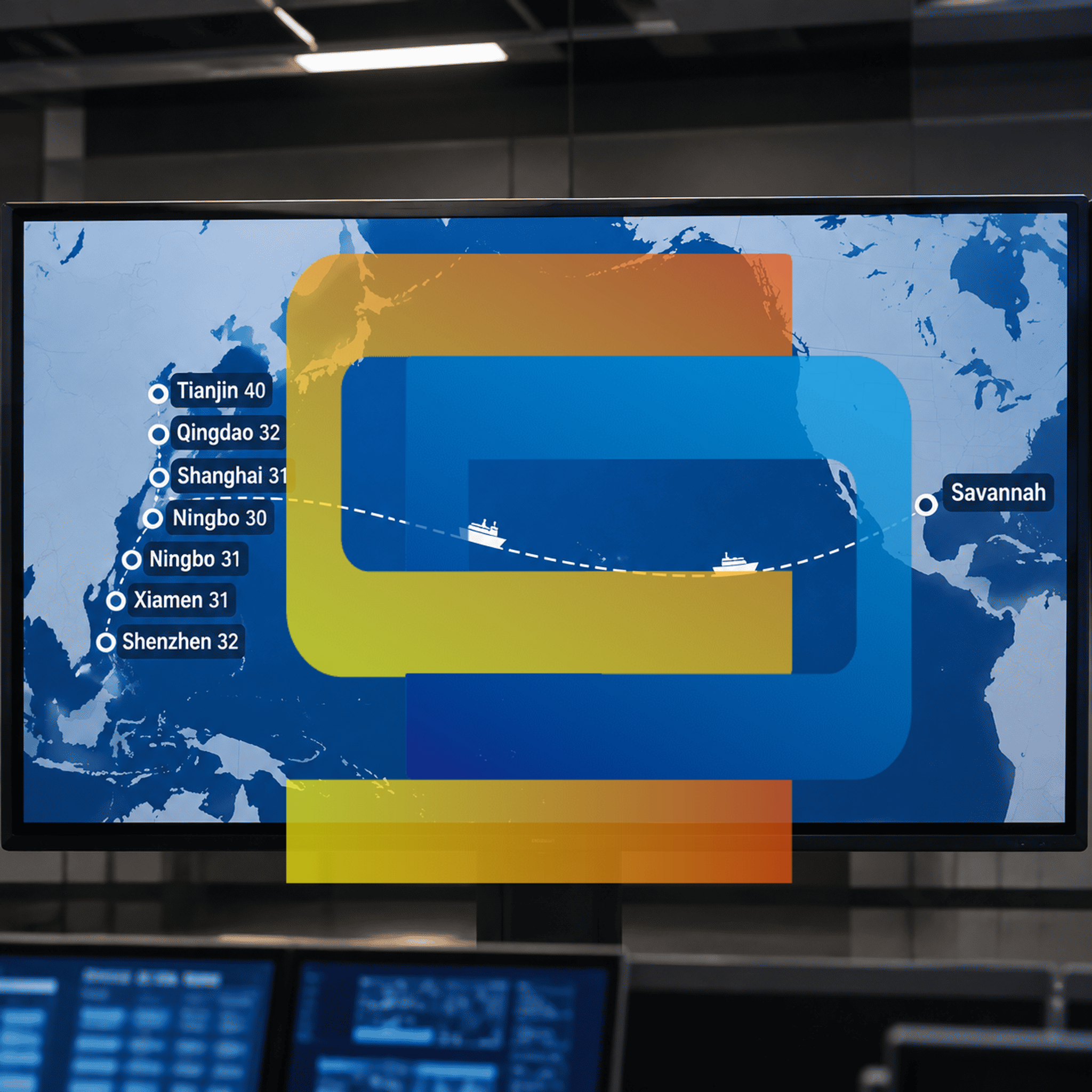
All-Water Shipping to Savannah vs. West Coast Plus Rail
For cargo destined for Savannah or nearby Southeast locations, an ocean service to Savannah is a natural route to compare first. If the final receiver is farther inland, such as Atlanta, Charlotte, or Memphis, compare the Savannah gateway with other port-and-rail combinations using the same final delivery ZIP.
| Route option | Typical movement | When to compare it | Main cost and timing factors |
|---|---|---|---|
| All-water to Savannah | China port → ocean vessel → Savannah → local truck or inland rail | Savannah-area receivers and Southeast destinations served from Savannah | Ocean rate, vessel itinerary, Savannah terminal charges, rail or drayage, and final delivery |
| West Coast plus IPI | China port → Los Angeles/Long Beach or another West Coast gateway → inland rail → final truck | Inland destinations where a suitable West Coast rail service is available | West Coast ocean rate, destination handling, rail rate, inland ramp, and final-mile trucking |
IPI (Inland Point Intermodal) refers to moving containerized cargo inland from a U.S. gateway by rail, followed by truck delivery where needed. It is an inland continuation of the shipment, not a separate ocean route.
Do not assume every China-to-Savannah sailing passes through the Panama Canal. Vessel routes vary by carrier service and operating conditions; published service maps may show different routings. Check the confirmed vessel itinerary, including any transshipment and canal routing.
A West Coast-plus-IPI option is not automatically a better alternative for a shipment whose receiver is in Savannah itself. For Atlanta or another inland destination, however, it may be worth comparing if the ocean service, rail connection, and total charges are competitive. The right comparison is always from the same China origin to the same final U.S. ZIP code.
DingShang also provides sea-rail intermodal services for selected U.S. inland destinations. Confirm the actual routing and service availability before choosing a rail option.
FCL vs. LCL Shipping to Savannah
FCL and LCL are both used for commercial cargo moving from China to Savannah. FCL provides a dedicated container, while LCL combines your cargo with other shipments and charges according to the applicable volume or weight calculation.
FCL: 20GP and 40HQ
A 20GP or 40HQ may suit a shipment that justifies a full container, needs control over loading, or benefits from fewer handling points. As practical planning references, importers may use around 28 CBM for a 20GP and 68 CBM for a 40HQ. These are not guaranteed usable capacities; cargo dimensions, weight, loading method, and U.S. road limits also matter. See DingShang's FCL ocean freight service.
LCL: shared container space
LCL can suit commercial shipments that do not require a full container. Charges commonly use a weight-or-measurement basis, but the rating method, minimum charge, and conversion rules depend on the consolidation service and quotation.
Compare the complete LCL cost, including origin CFS, destination CFS, documentation, handling, customs coordination, and final delivery. There is no universal CBM threshold at which LCL always becomes more expensive than FCL. Cargo density, dimensions, handling needs, route, and destination charges all affect the comparison. See LCL ocean freight services.
What Should a China-to-Savannah Shipping Quote Include?
A useful quote should identify the route, equipment, service scope, included charges, exclusions, and conditions. Prepare the following before asking for a price:
- Cargo: Product name, material, HS code if available, package count, dimensions, gross weight, and total CBM.
- Origin: Supplier city or pickup address in China, and whether the shipment is EXW or FOB.
- Equipment: 20GP or 40HQ for FCL; package, weight, and volume details for LCL.
- Destination: Savannah port only, a local warehouse, or a specific U.S. delivery ZIP code.
- Timing and service: Cargo-ready date, required delivery window, and whether you need customs coordination, rail, trucking, or door-to-door delivery.
Ask whether destination terminal charges, customs brokerage, government fees, duties, chassis, appointments, unloading, and empty-container return are included or excluded. Examination, storage, demurrage, detention, waiting, and redelivery are conditional charges; they apply only when specific events or delays trigger them.
A door-to-door quote should identify the final delivery address and the assumptions used for trucking and unloading. Review the door-to-door shipping service if you need delivery beyond the port. Door-to-door describes the transportation scope; it does not automatically mean DDP under Incoterms.
U.S. Customs Clearance and Import Requirements
The importer of record remains responsible for accurate U.S. import declarations and applicable product compliance, even when a freight forwarder coordinates transportation and a customs broker files the entry. Customs clearance should be planned before the vessel departs, not left until the container arrives in Savannah.
Common documents and information include a commercial invoice, packing list, bill of lading details, country of origin, U.S. HTSUS classification, importer of record information, and any permits or agency documents required for the product.
ISF filing
For applicable U.S.-bound ocean cargo, eight key Importer Security Filing (ISF) data elements are generally due no later than 24 hours before the cargo is laden aboard the vessel destined for the United States. The two additional elements - container stuffing location and consolidator - must be submitted as early as possible and no later than 24 hours before the vessel arrives at a U.S. port. Confirm filing details and timing with your customs broker. See CBP's ISF filing guidance.
Duties and product requirements
Import duties depend on the product's HTSUS classification, customs value, country of origin, and tariff measures in effect at entry. Duties can often be estimated before shipment, but the final amount is subject to CBP assessment. Check the U.S. Harmonized Tariff Schedule with your broker; do not apply one tariff percentage to every product from China.
Customs clearance does not replace product-specific compliance. Depending on the goods, other U.S. agencies may have requirements. DingShang can coordinate U.S. customs-clearance services, while the importer remains responsible for providing accurate information and meeting its obligations.
Frequently Asked Questions
1. How much does it cost to ship a 20ft container from China to Savannah?
DingShang's FCL reference table last updated November 2, 2026, showed 20GP sea freight rates of $5,360 to $5,520, depending on the Chinese departure port. The figures are per container and do not represent a complete door-to-door price. Check the live FCL rate table for updates.
2. How long does shipping from China to Savannah take?
The published FCL transit estimates range from 30 to 40 days after departure: Ningbo 30 days, Shanghai 31, Qingdao 32, Tianjin 40, Xiamen 31, and Shenzhen 32. These are planning references, not guaranteed warehouse delivery dates.
3. Which Chinese port is best for shipping to Savannah?
The best port depends on your factory location, pickup cost, cargo-ready date, available sailing, and total quote. Compare Ningbo, Shanghai, Qingdao, Tianjin, Xiamen, and Shenzhen using the same container size and delivery scope.
4. Does every shipment from China to Savannah pass through the Panama Canal?
No. The route depends on the carrier and the booked service. Ask for the vessel itinerary and confirm whether the shipment includes a transshipment or a particular canal routing.
5. Can containers from Savannah move inland to Atlanta by rail?
Yes. The Georgia Ports Authority lists Atlanta among the inland markets served by rail from the Port of Savannah's Mason Mega Rail facility. The actual service, rail ramp, schedule, and final truck delivery must be confirmed for the shipment.
6. Is Savannah or Los Angeles better for shipping cargo to Atlanta?
Neither gateway is automatically better. Compare an all-water service to Savannah followed by rail or truck with a West Coast service followed by inland rail and final trucking. Use the same China origin, Atlanta delivery ZIP, cargo-ready date, and quote scope.
7. Does the ocean freight rate include U.S. customs clearance and final delivery?
Not necessarily. A sea freight reference rate should not be assumed to include customs brokerage, duties, destination handling, rail, or trucking. Ask for an itemized quote that identifies the final delivery address and every included service.
Get a Shipping Quote from China to Savannah
DingShang Logistics coordinates China-to-USA FCL and LCL ocean freight, customs-clearance coordination, and U.S. inland delivery options. To compare a shipment to Savannah, send the details below so the route and quote can be matched to your cargo.
For FCL, provide the product, material, HS code if available, China pickup city, 20GP or 40HQ, gross weight, cargo-ready date, and final U.S. ZIP code. For LCL, include the product, material, pickup location, package count, dimensions, gross weight, CBM, cargo-ready date, and packing list if available.
Specify whether you need port-to-port service or delivery to a warehouse. Request a China-to-Savannah shipping quote for a shipment-specific rate and routing comparison.


Leave a Comment