
Quick Answer
FOB (Free On Board) and CIF (Cost, Insurance and Freight) differ mainly in who books and pays for ocean shipping. Under FOB, that is the buyer; under CIF, it is the seller, who also obtains the required cargo insurance.
Under both terms, however, the risk of loss or damage transfers to the buyer when the goods are loaded on board the vessel at the origin port—not when the ship reaches the United States. Neither term automatically includes U.S. import clearance, duties, or delivery to your warehouse.
Key Takeaways
- FOB offers buyers more control over carrier selection, freight quotations, and shipping arrangements.
- CIF simplifies the main ocean booking, but the seller's insurance may provide only minimum coverage and the buyer still bears transit risk after loading.
- Compare delivered costs, not just the supplier's FOB or CIF price.
- For containerized cargo, FCA or CIP may fit the actual handover at a terminal better than the traditional FOB/CIF rules.
FOB vs CIF: What Is the Difference?
FOB and CIF are Incoterms® rules published by the International Chamber of Commerce (ICC). Both apply to sea or inland waterway transport, but allocate freight payment differently.
| Comparison | FOB (Free On Board) | CIF (Cost, Insurance and Freight) |
|---|---|---|
| Named place | Port of shipment, such as FOB Ningbo | Port of destination, such as CIF Los Angeles |
| Who arranges main ocean freight? | Buyer | Seller |
| Who pays main ocean freight? | Buyer | Seller, through the sale contract |
| Who arranges required cargo insurance? | No mandatory insurance under FOB; buyer should consider coverage | Seller must obtain the insurance required by CIF |
| When does cargo risk transfer? | Once goods are on board at origin | Once goods are on board at origin |
| China export clearance | Seller, where applicable | Seller, where applicable |
| U.S. import clearance and duties | Buyer | Buyer |
| U.S. warehouse delivery | Not automatically included | Not automatically included |
| Typical buyer advantage | Control over freight and logistics partners | Fewer ocean-booking tasks |
Cost is not risk: paying freight to a destination port does not mean bearing cargo risk until arrival.
The ICC's Incoterms® rules are the primary reference for these definitions. A purchase contract should identify the precise port and the agreed version, such as FOB Ningbo Port, China — Incoterms® 2020.
What Does FOB Mean in Shipping?
FOB means the seller delivers the goods on board the buyer-nominated vessel at the named port of shipment. The seller handles export clearance where required and bears costs and risk through that on-board delivery. From that point, the buyer bears the transit risk and ordinarily arranges and pays for the ocean freight.
Suppose a U.S. distributor buys a 40HQ container of commercial fixtures from a supplier under FOB Shanghai, Incoterms® 2020. The supplier must arrange the agreed export-side steps and load the cargo on board at Shanghai. The importer or its freight forwarder selects the vessel service, manages the ocean booking, and arranges the U.S. side.
The importer controls the carrier and sailing choice, freight quote, insurance, and U.S. delivery arrangements.
FOB does not mean dropping goods at a port gate: delivery occurs on board. The buyer also remains responsible for U.S. import arrangements.
What Does CIF Mean in Shipping?
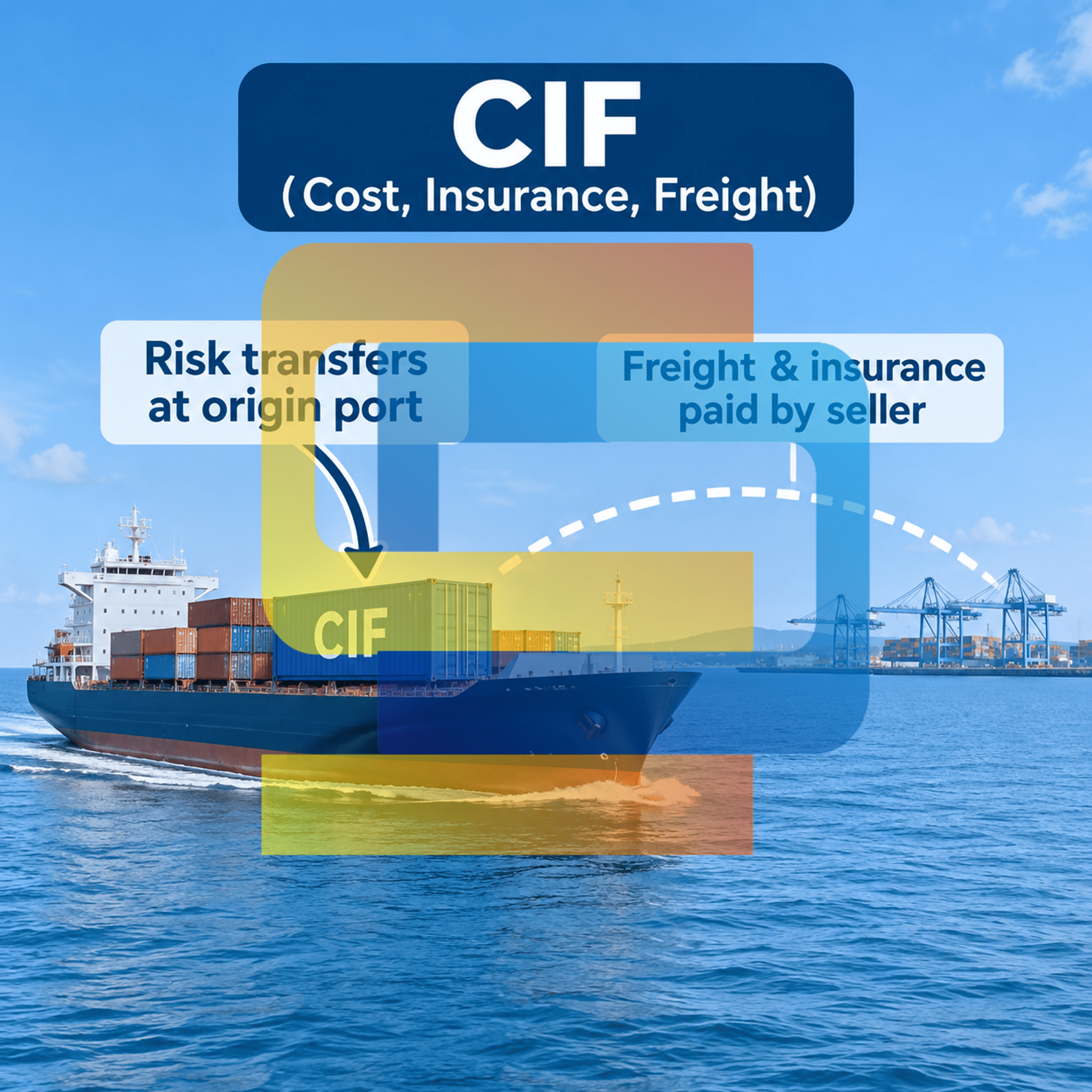
CIF means the seller contracts and pays for transportation to the named destination port and obtains the cargo insurance required by the rule. The seller also completes the export-side delivery obligation by putting the goods on board at the origin port.
For example, CIF Los Angeles, Incoterms® 2020 includes the seller's ocean freight and required insurance. U.S. import formalities remain the buyer's responsibility.
What insurance does CIF actually include?
Under Incoterms® 2020, CIF normally requires minimum cover comparable to Institute Cargo Clauses (C), unless the parties agree otherwise. The insured amount must generally be at least 110% of the contract price. That amount is the insured value, not a promise that every kind of loss will be paid.
Minimum cover may exclude damage an importer expects to be insured. Request the certificate, covered risks, exclusions, and claims process; arrange broader coverage when needed.
CIF insurance does not change the risk-transfer point. See the ICC's Incoterms® 2020 guidance.
When Does Risk Transfer Under FOB and CIF?
Risk transfers at the same point under both rules: when the goods are on board the vessel at the named origin port. Freight payment and insurance arrangements are separate matters.
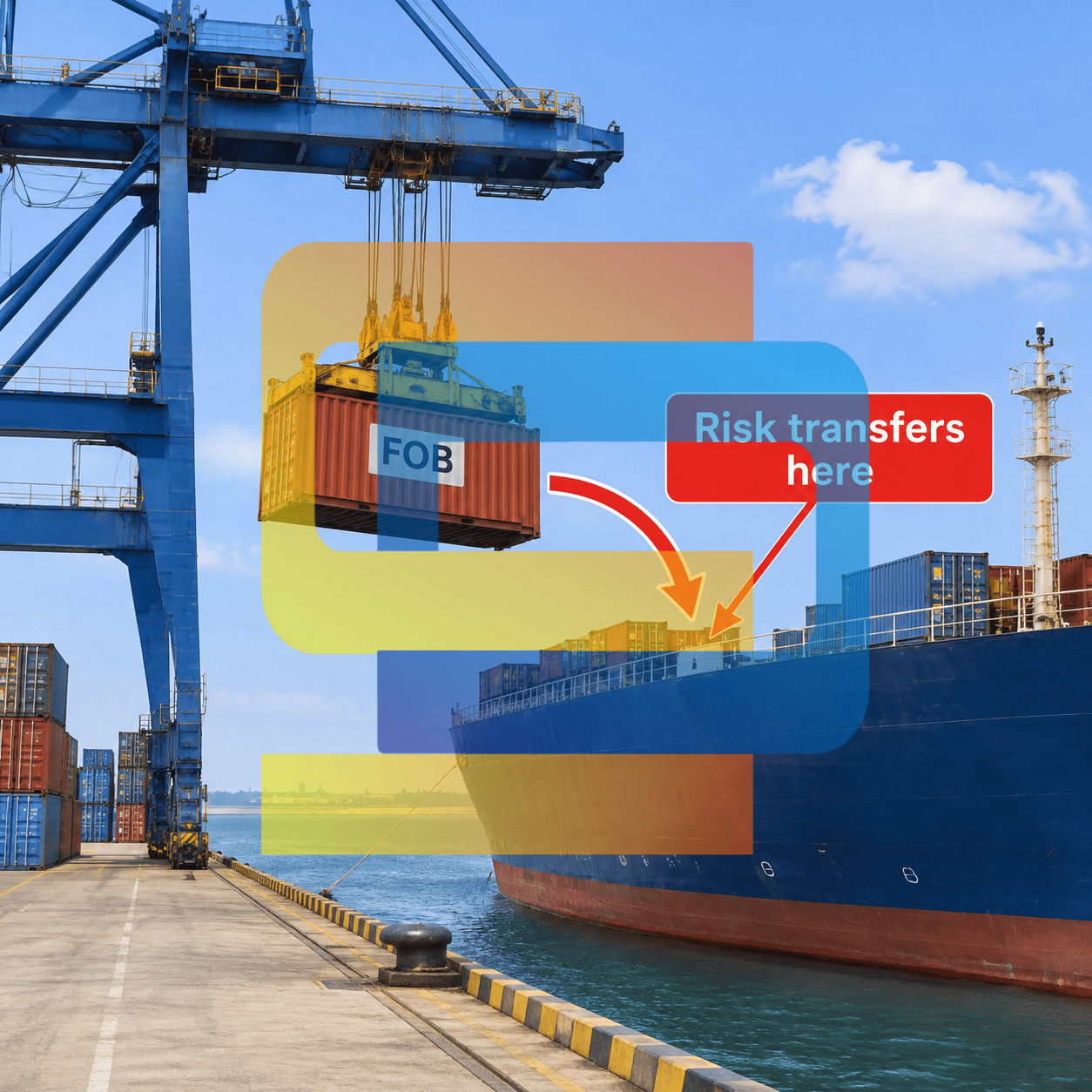
Consider a container loaded in Ningbo and shipped to Los Angeles:
- Before on-board delivery: The Chinese seller bears the risk under the agreed FOB or CIF rule.
- Once the goods are on board: The risk passes to the U.S. buyer under both rules.
- During the ocean voyage: Under FOB, the buyer typically purchases its own cargo insurance. Under CIF, the seller-arranged policy covers the buyer's insurable interest as required by the contract and policy terms.
- At Los Angeles: Customs entry, terminal availability, and final delivery still need to be arranged. The named destination in CIF does not shift the original risk-transfer point.
If cargo is damaged at sea, a CIF buyer should review the insurance policy, contract, carrier liability, and timing—not assume the seller bears that transit risk.
Risk transfer is not the same as transfer of ownership. Title and payment terms depend on the separate sale agreement and applicable law.
FOB vs CIF Shipping Costs: A Practical Example
FOB is not automatically cheaper than CIF. The right comparison is what the importer pays to move the same goods to the same U.S. destination under equivalent insurance and service conditions—not the two supplier prices in isolation.
Hypothetical example: One 40HQ container from China to Los Angeles
Assume a U.S. importer is buying the same commercial goods and comparing two proposals. The figures below are illustrative assumptions only. They are not DingShang shipment records, carrier rates, or current market quotations.
| Cost component | FOB offer: buyer-arranged freight | CIF offer: seller-arranged freight |
|---|---|---|
| Supplier's goods price or CIF contract price | $20,000 FOB | $25,250 CIF, including freight and required insurance |
| Main ocean freight paid separately by buyer | $4,800 | Included in CIF price |
| Marine insurance paid separately by buyer | $120 | Included in CIF price |
| U.S. destination handling, assumed excluded from both offers | $650 | $650 |
| U.S. customs brokerage, assumed same scope | $175 | $175 |
| Truck delivery to the same Los Angeles warehouse | $900 | $900 |
| Illustrative subtotal | $26,645 | $26,975 |
FOB is $330 cheaper in this example. CIF could win if the seller negotiates better freight terms.
Both subtotals exclude import duties, government fees, and conditional charges. They assume the listed destination costs are not already included. Match insurance coverage and exclusions before comparing real offers.
What to request before comparing quotes
Request each supplier offer's named port, freight and insurance scope, cargo details, and destination inclusions. Ask your forwarder for ocean freight, U.S. destination charges, customs coordination, and delivery on identical terms.
For actual ocean-market context, DingShang publishes China-to-USA FCL reference rates and updates that page every Monday. Those figures are reference freight rates, not a substitute for a complete FOB-to-door or CIF-to-door cost comparison.
FOB vs CIF for Importing from China to the USA
For U.S. importers, neither FOB nor CIF automatically includes customs clearance, import duties, or delivery to the warehouse. These responsibilities need separate planning regardless of who books the vessel.
Customs value is not necessarily the CIF invoice total
U.S. customs valuation is an area where a simple FOB-versus-CIF price comparison can lead to an expensive mistake. For many goods assessed under transaction value, eligible international freight and insurance costs are not included in the customs value. That does not mean an importer can automatically subtract a guessed freight amount from a CIF invoice.
The importer and customs broker need the relevant commercial documentation and support for the actual eligible costs being excluded. Other valuation additions may apply, including certain assists, royalties, or selling commissions. CBP explains the general treatment in its guidance on CIF charges and duty.
For CIF purchases, request a supported breakdown of merchandise, international freight, and insurance when needed for customs valuation.
Importer of record, ISF, and product requirements
The importer of record (IOR) remains responsible for accurate entry information and applicable compliance. A freight forwarder or customs broker does not automatically become the IOR simply because it coordinates shipping or clearance.
For applicable U.S.-bound ocean freight, key Importer Security Filing (ISF) data elements generally must be submitted at least 24 hours before the cargo is loaded aboard the vessel destined for the United States; some elements follow different timing rules. Neither FOB nor CIF removes that obligation.
Confirm the U.S. HTS classification, origin, and product requirements. Applicable duties depend on the product and tariff measures—not a universal rate for Chinese goods.
DingShang can coordinate U.S. customs clearance alongside ocean freight. A clear quote should state whether brokerage, government charges, and duty-payment support are included or billed separately.
Destination charges and delivery do not vanish under CIF
CIF names a destination port, not the buyer's warehouse. Depending on the agreed freight contract, certain unloading-related charges may be included in the seller's carriage price, while terminal release, storage, local handling, and onward trucking may remain payable by the buyer. These need to be checked, not assumed.
Under either term, coordination between the ocean carrier, customs broker, and U.S. delivery provider matters. Confirm who handles each handoff.
Which Is Better for US Importers: FOB or CIF?
FOB is often attractive when an importer wants to choose its forwarder and manage the complete China-to-USA logistics quote. CIF can be convenient when the supplier has a suitable carrier arrangement and the buyer prefers not to organize the ocean booking. Neither is inherently the best or cheapest choice for every shipment.
| Your situation | Option worth considering | Why |
|---|---|---|
| You have a trusted China-to-USA forwarder | FOB, or FCA for a terminal handover | More direct control over carrier choice, freight scope, and U.S. delivery |
| You prefer the supplier to arrange the main carriage | CIF, or CIP where appropriate | Fewer ocean-booking tasks for the buyer |
| You are importing high-value or damage-sensitive goods | Compare insurance terms first | CIF minimum cover may be inadequate even when an insurance certificate is provided |
| Your warehouse is inland, such as Chicago or Dallas | Compare through to the final ZIP | A port-only CIF quote does not settle rail, trucking, or warehouse delivery |
| You are receiving an LCL shipment | Review destination CFS and release charges closely | A low supplier freight price may not reflect the total collect charges at destination |
CIF can simplify booking for new importers but make costs and destination arrangements less visible. A clear FOB-to-door quote may be easier to budget—or a transparent CIF offer may prove better.
Confirm the named port, insurance, exclusions, documents, and final delivery point. Compare either arrangement with a door-to-door shipping quote.
Should Container Shipments Use FOB/CIF or FCA/CIP?
FOB and CIF are still widely used in commercial quotations, but they are not always the best technical fit for containerized cargo. The ICC advises considering FCA (Free Carrier) when goods are handed to a carrier at a container terminal before the container is loaded on the ship.
A container may reach the terminal days before loading. Yet FOB risk transfers on board. FCA can align delivery and risk transfer with the earlier terminal handover.
If the seller is expected to arrange transportation and insurance for a container or multimodal movement, CIP (Carriage and Insurance Paid To) may be more suitable than CIF. Under CIP, risk ordinarily passes when the goods are delivered to the relevant carrier at the agreed point, while the seller contracts and pays for carriage to the named destination. Incoterms® 2020 also calls for broader default insurance under CIP than under CIF.
The U.S. International Trade Administration identifies which Incoterms apply to which transport modes. Choose terms that reflect the actual handover.
Frequently Asked Questions
1. What is the main difference between FOB and CIF?
Under FOB, the buyer arranges and pays for main ocean carriage after the seller delivers goods on board at the origin port. Under CIF, the seller arranges and pays for carriage and the required insurance to the named destination port. Risk still transfers on board at origin under both rules.
2. Is FOB or CIF cheaper when importing from China?
Neither is automatically cheaper. FOB may offer more freight-pricing control, while a supplier may obtain favorable freight terms under CIF. Compare the merchandise price, ocean freight, insurance quality, destination charges, customs-related expenses, and final delivery for the same shipment. A low FOB product price is not the same as a low delivered cost.
3. Who pays for ocean freight under FOB and CIF?
The buyer normally contracts and pays for the main ocean freight under FOB. Under CIF, the seller contracts and pays for freight to the named destination port and provides the required cargo insurance. In either case, verify exactly which origin and destination services the quotation includes.
4. When does the risk of loss transfer under CIF?
Under CIF Incoterms® 2020, the risk transfers to the buyer when the goods are on board the vessel at the shipment port, not when the vessel reaches the destination. The seller must still pay for agreed carriage and insurance. The insurance is intended to protect the buyer's interest during the covered voyage.
5. Does CIF include U.S. customs clearance and import duties?
No. CIF does not require the seller to clear goods for U.S. import or pay import duties. The buyer generally handles those tasks, unless a separate contractual arrangement provides assistance. CIF also does not automatically include delivery from the U.S. port to the importer's warehouse.
6. Is FOB or CIF better for a first-time U.S. importer?
CIF simplifies ocean booking, but customs and destination charges remain. FOB can be manageable with a forwarder. Compare itemized FOB-to-door and CIF-to-door offers.
7. Should I use FOB or CIF for a 20GP or 40HQ container?
Both are common, but ICC advises considering FCA for containers handed over at terminals before loading, or CIP for seller-arranged multimodal carriage and insurance. Confirm the handover point.
Compare Your FOB and CIF Shipping Options
Importing commercial cargo from China to the United States? DingShang Logistics can help you compare FOB-based freight arrangements, destination costs, and FCL shipping or LCL options for commercial shipments of at least 2 CBM.
For a useful comparison, send your supplier's FOB/CIF offer and named port, product description and material, HS code if available, cargo-ready date, China origin, and U.S. destination ZIP. Include 20GP/40HQ and gross weight for FCL, or carton count, CBM, dimensions, and gross weight for LCL. Tell us whether you need customs coordination, insurance, and final delivery.
Request a China-to-USA freight quote with clear service scope and itemized costs.


Leave a Comment