
How Do You Really Find the Best Shipping From China to the US?
Struggling with unpredictable shipping costs from China? Hidden fees and delays are eroding your profits1. The key is to shift your focus from price to total value and reliability.
The "best" shipping isn't about the lowest price. It’s about finding a reliable partner who offers transparent, all-in pricing and stable transit times. This approach protects your profit margins by avoiding unexpected delays and hidden costs for your FCL shipments.
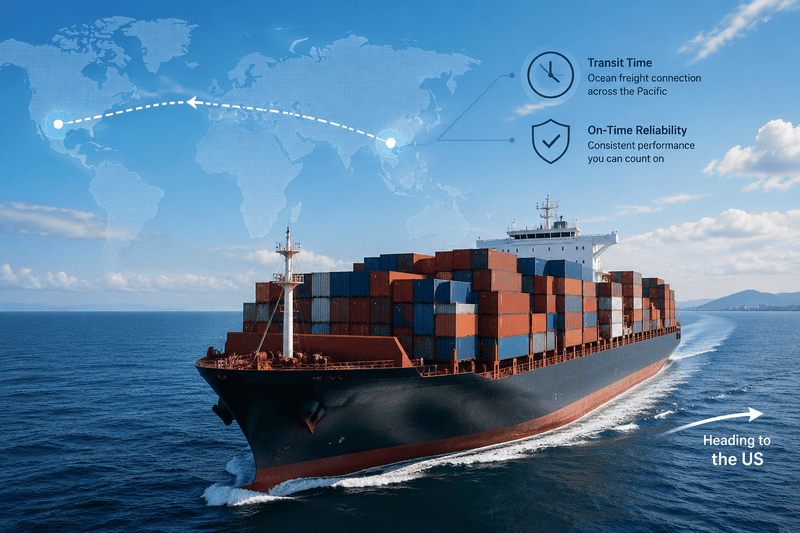
In my 15 years in logistics, I've seen countless importers get burned by chasing the lowest quote2. They end up paying more in the long run. The truth is, a shipping quote is more than a number—it's a reflection of the service and reliability you'll receive. Let's break down what really matters when you're moving full containers from China to your warehouse in the US.
Is the Cheapest Freight Quote Hiding Your True Shipping Costs?
Got an unbelievably low shipping quote? Be careful. These "teaser rates" often lead to a final bill full of surprise charges that destroy your budget and peace of mind.
Often, yes. Many forwarders use low initial quotes to attract clients, then add significant charges3 for customs, port fees, and drayage later. A trustworthy partner provides a transparent, one-time bill that locks in your total landed cost upfront, ensuring no hidden surprises.
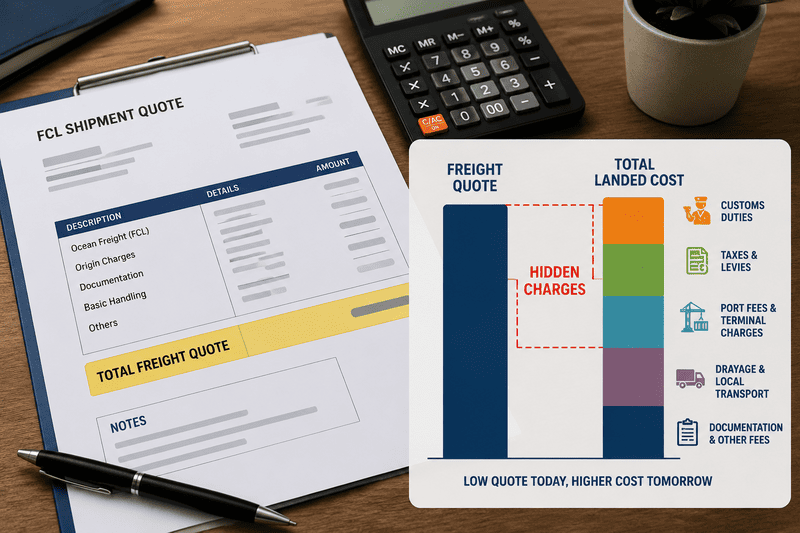
A common mistake I see new buyers make is fixating on the initial ocean freight cost. The real number you should care about is the Total Landed Cost4. This includes every expense to get your container from the factory in China to your final destination in the US. Forwarders offering teaser rates know that once your cargo is on the water, you have little choice but to pay whatever fees they add5. A question I always encourage my clients to ask any potential forwarder is: "Does this quote include everything?" A reliable partner will provide an all-in, one-time bill. This isn't just about price; it's about financial predictability.
Key Costs Beyond Ocean Freight
| Fee Type | Description | Why It's Often Hidden |
|---|---|---|
| Origin Charges | Trucking, terminal handling (THC), documentation. | Bundled vaguely or omitted from initial quotes. |
| Destination Charges | US customs clearance, duties, port fees, drayage. | Forwarder claims it's "not their responsibility." |
| Inland Transport | Rail and truck fees for non-port destinations. | Complex and often underestimated by cheap quotes. |
Does Your Choice of Shipping Line Actually Affect Your Delivery Date?
Frustrated by shipments that never arrive on time? A two-week delay can mean missed sales and unhappy customers. The carrier your forwarder chooses is often the culprit.
Absolutely. Carrier reliability varies significantly6. Some lines have better on-time performance and schedule integrity. Paying a slight premium for a top-tier carrier, like those in the Ocean Alliance, is often cheaper than the cost of a delay to your supply chain7.
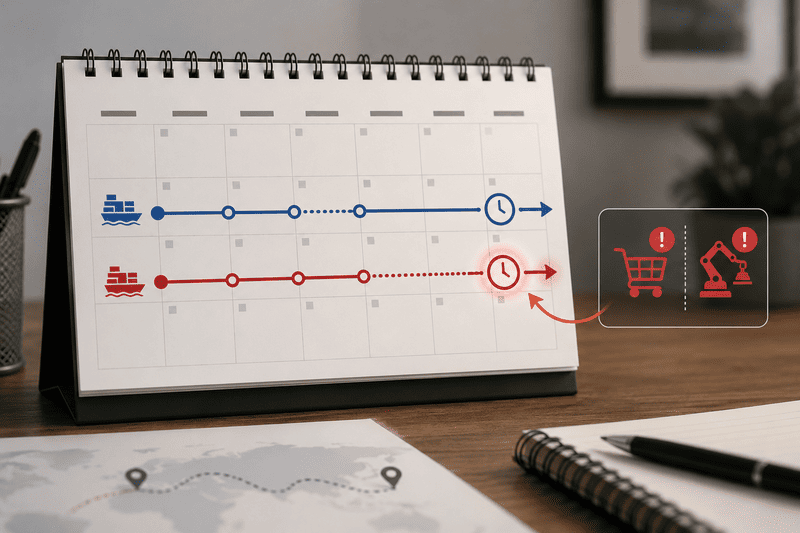
After 15 years, I can tell you that not all shipping lines are created equal. Some are notorious for rolling cargo to the next vessel8, while others consistently maintain their schedules. A delay isn't just an inconvenience; it costs you money in lost sales, potential penalties from your customers, and disrupted production schedules. I always advise my clients to ask their forwarder, "Which shipping lines do you primarily use?" At Dingshang Logistics, we prefer stable, fast carriers like those in the Ocean Alliance because their schedule integrity protects our clients' timelines. It’s a simple risk management decision. A slightly higher freight cost for a reliable vessel is an investment in predictability. It’s far less expensive than having your container sit at a port for two extra weeks. Think of it as insurance for your supply chain's health.
Why Is a Single Partner for Door-to-Door Shipping a Smarter Move?
Juggling multiple contacts for trucking, customs, and shipping? This complexity creates errors, delays, and endless headaches. There is a much simpler, more secure way to manage your logistics.
Using a single partner for true door-to-door service is a powerful risk reduction strategy9. It eliminates coordination errors between different vendors and gives you one point of contact and accountability for the entire journey, from the factory in China to your US warehouse.
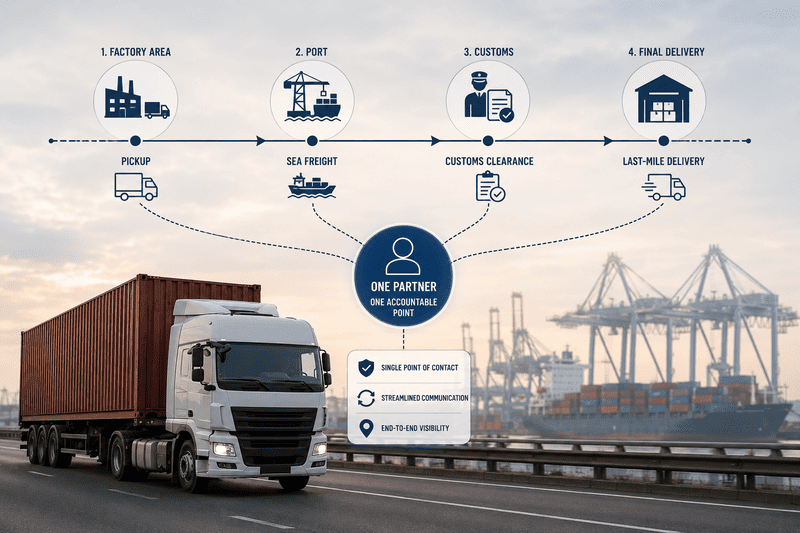
I've seen importers try to stitch together their own logistics chain, hiring one company for ocean freight, another for customs, and a third for final-mile trucking. This rarely ends well. When a delay happens, everyone points fingers, and you're left in the middle10 trying to solve the problem. True door-to-door service from a single, competent partner is about simplifying complexity and minimizing risk. When one company like Dingshang Logistics manages the entire process—including pickup, sea freight, customs clearance, duties, and final delivery—there's no one else to blame. We handle the coordination, so you don't have to. This single point of accountability is crucial, especially when things go wrong. It ensures your shipment moves seamlessly and you have a trusted advisor to call who owns the entire process from end to end.
Isn't Shipping to Los Angeles the Same as Shipping to Chicago?
Think all US destinations are created equal in shipping? A simple port-to-port quote can be misleading if your final destination is inland. This assumption can lead to major delays.
Not at all. Shipping to a coastal port like Los Angeles is straightforward. Shipping to an inland hub like Chicago involves complex sea-rail intermodal logistics11. The "best" option depends entirely on your specific scenario and final destination, requiring a tailored plan.
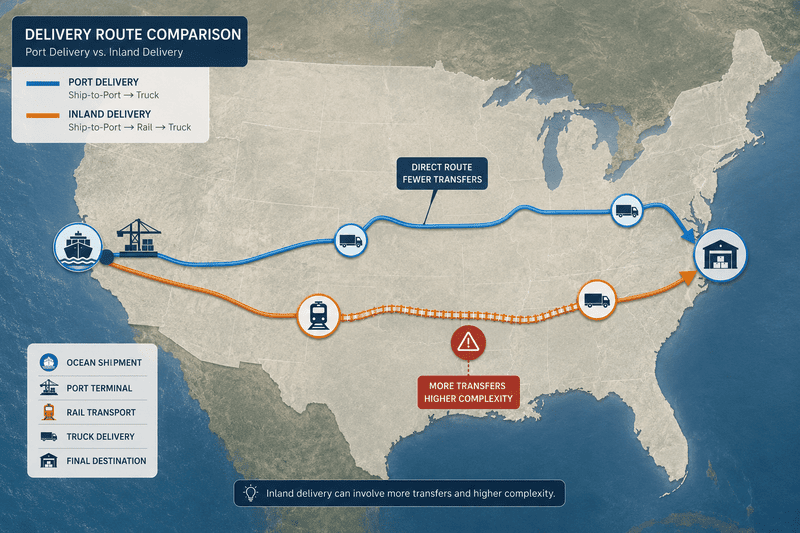
A classic mistake I see is a buyer in, say, Dallas, getting a cheap port-to-port quote for Houston and assuming they've found a great deal. They forget about the complex and often expensive journey from the port to their warehouse. Shipping a container to an inland destination like Chicago, Dallas, or Memphis is a completely different ballgame than a simple port delivery to Los Angeles or New York. It requires a sophisticated sea-rail intermodal plan. A good forwarder understands these nuances. They will design a route that balances cost, speed, and reliability for your specific endpoint, rather than just quoting the cheapest ocean leg.
Key Differences: Port vs. Inland
| Factor | Port Delivery (e.g., Los Angeles) | Inland Delivery (e.g., Chicago) |
|---|---|---|
| Logistics Chain | Ship -> Port -> Truck | Ship -> Port -> Rail -> Truck |
| Complexity | Low. One mode of transport post-ocean. | High. Requires seamless port-to-rail transfer. |
| Risk Points | Port congestion, truck availability. | Rail congestion, chassis shortages12, transfers. |
Conclusion
Ultimately, smart shipping isn't about finding the lowest price. It’s about partnering with an expert who helps you manage risk, control total costs, and build a reliable supply chain.
"From Ports to Prices: The Inflationary Effects of Global Supply Chain ...", https://www.elibrary.imf.org/view/journals/001/2026/026/article-A001-en.xml. Industry reports and academic studies on supply chain management quantify the costs associated with shipping delays and unforeseen charges, which can include lost sales, increased inventory carrying costs, and production downtime, thereby eroding profit margins. Evidence role: statistic; source type: research. Supports: The claim that unexpected costs and delays have a measurable negative impact on the profitability of importing goods.. ↩
"Beyond Rates: Evolving the Value of Freight Forwarders - Zencargo", https://www.zencargo.com/resources/beyond-rates-why-its-time-for-the-value-of-freight-forwarders-to-evolve/. Business and supply chain management principles, such as the Total Cost of Ownership (TCO) model, support the idea that the lowest-priced option may not be the most economical once all associated costs—including those from delays, fees, and service failures—are factored in. Evidence role: general_support; source type: education. Supports: The claim that focusing on the lowest quote can lead to higher overall costs.. ↩
"Complaints and Assistance - Federal Maritime Commission", https://www.fmc.gov/complaints-and-assistance/. Reports and advisories from maritime regulatory bodies, such as the U.S. Federal Maritime Commission, have addressed billing practices in the ocean shipping industry, including instances of shippers receiving final invoices with significant charges not included in the initial quote. Evidence role: general_support; source type: government. Supports: The claim that some freight forwarders use artificially low initial quotes as a business practice.. ↩
"What is Landed Cost? Meaning, Formula & Calculation | DHL US", https://www.dhl.com/discover/en-us/global-logistics-advice/essential-guides/landed-cost-meaning-formula-calculation. Business encyclopedias and international trade resources define Total Landed Cost as the total expense of a product on its journey from the factory to a buyer's doorstep, including purchase price, freight, insurance, customs duties, and other fees. Evidence role: definition; source type: encyclopedia. Supports: The definition and importance of Total Landed Cost in international commerce.. ↩
"[PDF] Right of Maritime Carrier to Exercise a Lien on Cargo to Secure the ...", https://docs.rwu.edu/cgi/viewcontent.cgi?article=1003&context=law_ma_jmlc. Under maritime law and standard carrier agreements, freight forwarders and carriers can exercise a lien on cargo for unpaid charges, giving them legal possession of the goods until all fees, including those disputed by the shipper, are paid. Evidence role: mechanism; source type: other. Supports: The claim that shippers have little leverage to withhold payment for new fees once cargo is in transit.. Scope note: This describes the legal leverage a carrier has, which supports the claim but does not prove that all forwarders will exploit it. ↩
"Global schedule reliability drops to 62.8% in December 2025", https://sea-intelligence.com/press-room/368-global-schedule-reliability-drops-to-62-8-in-december-2025. Maritime analytics firms like Sea-Intelligence publish regular reports on global liner performance, which provide statistics showing significant variance in schedule reliability across different ocean carriers and alliances. Evidence role: statistic; source type: research. Supports: The claim that on-time performance differs greatly among ocean carriers.. ↩
"The Business Costs of Supply Chain Disruption - Economist Impact", https://impact.economist.com/projects/next-gen-supply-chains/reports/the-business-costs-of-supply-chain-disruption/. Academic research and industry studies on supply chain risk management demonstrate that delays can lead to significant downstream costs, including lost sales from stockouts, reputational damage, and expenses for expedited shipping, which can far outweigh savings on initial freight rates. Evidence role: statistic; source type: paper. Supports: The claim that supply chain delays can incur costs that exceed initial freight savings.. ↩
"What is Rolled Cargo or Container & How to Manage by Exception", https://www.vizionapi.com/blog/what-is-rolled-cargo-or-container-how-to-manage-by-exception. Logistics industry resources define 'rolled cargo' as the practice of a carrier not loading a container onto its scheduled vessel, often due to overbooking, vessel capacity issues, or customs delays, forcing it to wait for a subsequent sailing. Evidence role: definition; source type: other. Supports: The definition and common causes of 'rolled cargo' in the shipping industry.. ↩
"Fragmentation of production amplifies systemic risks from extreme ...", https://pmc.ncbi.nlm.nih.gov/articles/PMC7769560/. Supply chain management literature supports the concept that integrated logistics, or using a single provider for end-to-end service, can reduce risks by simplifying communication, centralizing accountability, and minimizing coordination errors between different vendors. Evidence role: general_support; source type: education. Supports: The claim that a single, integrated logistics partner reduces risk compared to a fragmented, multi-vendor approach.. ↩
"Diffusion of Responsibility - Ethics Unwrapped", https://ethicsunwrapped.utexas.edu/glossary/diffusion-of-responsibility. Studies in organizational behavior and supply chain management describe how using multiple, disconnected vendors can lead to a diffusion of responsibility, where it becomes difficult to assign accountability for failures, resulting in delays in problem resolution. Evidence role: mechanism; source type: paper. Supports: The claim that fragmented, multi-vendor systems lead to accountability problems.. ↩
"Intermodal freight transport", https://en.wikipedia.org/wiki/Intermodal_freight_transport. Resources from transportation authorities, such as the U.S. Department of Transportation, define intermodal freight transport as the movement of cargo in a container using multiple modes of transportation (e.g., ship and rail) without handling the freight itself when changing modes. This process involves complex coordination at transfer points like seaports. Evidence role: definition; source type: government. Supports: The definition of intermodal logistics and the complexities involved in sea-to-rail transfers.. ↩
"[PDF] Intermodal Chassis Availability for Containerized Agricultural ...", https://www.ams.usda.gov/sites/default/files/media/ChassisSummary.pdf. Industry publications and reports from transportation research groups frequently document ongoing issues within the U.S. intermodal network, citing rail congestion at key hubs and persistent chassis shortages at ports and inland ramps as major sources of import delays. Evidence role: case_reference; source type: research. Supports: The claim that rail congestion and chassis shortages are current problems in the US logistics network.. ↩
Leave a Comment